This video features an interview with Carl Jacobs, a vocalist, arranger, composer, and businessman, who shares his journey from his early training in music at CIC College to becoming a prominent figure in the music scene. Jacobs discusses his musical career, starting with his initial band, Beams, and later forming other bands including Shandelier, which became a major success. He explains the challenges and transformations in Trinidad’s music culture, including the emphasis on loud volumes due to carnival traditions and the lack of structured musical education. Jacobs also talks about his international career, overcoming throat cancer, and his efforts to promote live music through his platform, Kafé Blue. Additionally, he reflects on his 54-year marriage with Carol, stressing the importance of mutual support and respect. He concludes by advocating for more institutional support for local musicians and a mandatory quota of local music on radio stations to preserve Trinidad’s cultural heritage.
Month: November 2024
Move Away From Being Leaders in Diabetes Death Rate

Is the PAN an independent instrument
In this program, Mikhail discusses his introduction to playing the steel pan through school and music festivals, and the progression of his career from solo performances to playing a diverse range of music on ships.
He emphasizes the versatility of the steel pan, advocating for its recognition as an instrument beyond Caribbean genres like soca and calypso. Mikhail highlights the importance of exploring opportunities abroad for pan players and detaching the instrument from geographical and cultural confines to allow its true potential to shine globally.
He also touches on adapting to audience requests and the value of reading music for quick learning. The conversation concludes with Mikhail’s vision for the future of the steel pan, advocating for it to be appreciated as an instrument on par with the piano or guitar.
Conversation with Gregory Aboud on the Key to Reviving Port of Spain Amid Crime and Chaos
Holy Name Convent – A space to grow and dream …
I sat in this hall years ago, wondering what my future would bring. For five years, Holy Name Convent was my safe space, a refuge from the challenges I faced at home. Growing up on Quarry Street in East Dry River, Holy Name provided me with the environment I needed to grow and dream.
In this presentation at the Prize Distribution ceremony, I encouraged the young women to reflect on their futures and recognize their potential to make meaningful contributions to Trinidad and Tobago, despite societal challenges and stereotypes. I emphasized the critical role of women in minimizing criminality and corruption, urging them to reclaim their voices and leadership roles. By doing so, women can drive positive change and help rebuild the nation.
I also highlighted the importance of personal well-being, including physical fitness, balanced living, and intentional decision-making, as foundational to this transformation. Drawing from my overcoming adversity and achieving academic and professional success, I hope to inspire young women to take charge of their futures with truth and purpose. They were challenged to commit to their communities, embrace change, and lead by example, fostering a vision of empowered women driving progress and unity in Trinidad and Tobago. Ending on a hopeful note, I underscored the importance of balance, transformation, and truth in shaping a better future.
Watch Your Words, Mr Prime Minister
John Acton’s (1834-1902) famous quote, “Power tends to corrupt, and absolute power corrupts absolutely,” serves as a stark reminder of the risks of unchecked authority.
In Trinidad and Tobago, Prime Minister Dr. Keith Rowley has drawn growing criticism for his increasingly harsh and at times, derogatory language—a significant shift from the more respectful tone he maintained as Leader of the Opposition from 2010 to 2015. His rhetoric as Prime Minister raises important questions about the role of language in leadership.
During his tenure as Leader of the Opposition, Dr. Rowley’s public comments were mostly respectful, allowing for civil discourse. However, since becoming Prime Minister, his language has at times taken a more troubling turn. In one notable exchange with businessman Inshan Ishmael, Dr. Rowley responded to criticism by saying, “kiss my ar**” and, “You GO TO HELL!!!” Many citizens, who expect dignity from their leaders, expressed disappointment, noting the lack of courtesy expected from a national figure.
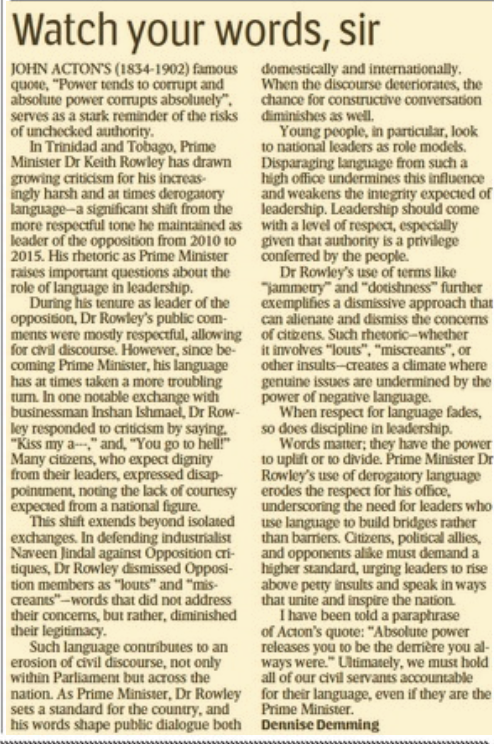
This shift extends beyond isolated exchanges. In defending industrialist Navin Jindal against opposition critiques, Dr. Rowley dismissed opposition members as “louts” and “miscreants”—words that did not address their concerns but rather diminished their legitimacy. Such language contributes to an erosion of civil discourse, not only within Parliament but across the nation. As Prime Minister, Dr. Rowley sets a standard for the country, and his words shape public dialogue both domestically and internationally. When the discourse deteriorates, the chance for constructive conversation diminishes as well.
Young people, in particular, look to national leaders as role models. Disparaging language from such a high office undermines this influence and weakens the integrity expected of leadership. Leadership should come with a level of respect, especially given that authority is a privilege conferred by the people.
Dr. Rowley’s use of terms like “jammetry” and “dotishness” further exemplifies a dismissive approach that can alienate and dismiss the concerns of citizens. Such rhetoric—whether it involves “louts,” “miscreants,” or other insults—creates a climate where genuine issues are undermined by the power of negative language.
When respect for language fades, so does discipline in leadership. Words matter; they have the power to uplift or to divide. Prime Minister Dr. Rowley’s use of derogatory language erodes the respect for his office, underscoring the need for leaders who use language to build bridges rather than barriers. Citizens, political allies, and opponents alike must demand a higher standard, urging leaders to rise above petty insults and speak in ways that unite and inspire the nation.
I have been told a paraphrase of Acton’s quote: “Absolute power releases you to be the derrière you always were.” Ultimately, we must hold all of our civil servants accountable for their language, even if they are the Prime Minister.
Conversation with Brian Lewis, Past President of Trinidad and Tobago Olympic Committee
In this interview, Brian Lewis, the past president of the Trinidad and Tobago Olympic Committee (TTOC), shares his commitment to sports volunteerism, background, and passion for fostering gender equality and empowering women in sports. He explains how he has never been financially compensated for his decades-long involvement in sports, emphasizing his commitment to improving the sector.
Lewis discusses the importance of bridging the gap between governance and management in sports and acknowledges the challenges that volunteer leaders face, such as burnout and the difficulty of effecting change within a culture that sees sports as recreational rather than essential. He highlights the need for cultural change, advocating for sports to be viewed as an investment in youth, rather than just a hobby. His ideal transformation would integrate physical education within the educational system, supported by trained PE teachers, as seen in Jamaica, to build a healthier, socially adjusted population.
A significant part of his legacy is the “Future is Female” initiative, inspired by his mother and dedicated to promoting gender equality. This program aims to increase female representation in sports leadership and support for female athletes.
Addressing Trinidad and Tobago’s Olympic prospects, Lewis stresses the long-term effort required to produce elite athletes and the impact of challenges like crime, the COVID-19 pandemic, and societal attitudes toward sports on youth participation. He believes in the need for better community-based talent development systems and innovative support to retain young people in sports. For sustained progress, he emphasizes the importance of setting ambitious goals, such as TTOC’s “10 Goals.
Engineering Clarity and Resilience: Dr. Brian Copeland on Sound, Education, and Trinidad & Tobago’s Future
Dr. Brian Copeland shared his work in sound engineering on Power Conversations focusing on enhancing sound systems in Roman Catholic churches in Trinidad and Tobago. His recent projects include installations in churches at Tortuga, Belmont, and St. Joseph. He emphasizes “intelligibility” in sound, noting that clarity, rather than loudness, enhances listeners’ experiences and reduces mental fatigue from reverberation.
As chairman of COSTAATT and Cipriani College of Labour and Cooperative Studies, Dr. Copeland advocates for an education system that builds national resilience, preparing citizens for economic challenges and natural disasters.
Inspired by Germany’s model and Costa Rica’s success, he envisions an economy strengthened by small and medium-sized enterprises, with COSTAATT playing a central role. His vision includes democratizing education to enable more people to contribute to Trinidad and Tobago’s economy and adapt to technological changes, such as AI.
Dr. Copeland also highlights the importance of societal engagement on issues like social justice and recidivism. Through accessible education and inclusive dialogue, he believes Trinidad and Tobago can create a more resilient, equitable society, helping individuals reintegrate and contribute meaningfully to national growth.
 Dennise Demming