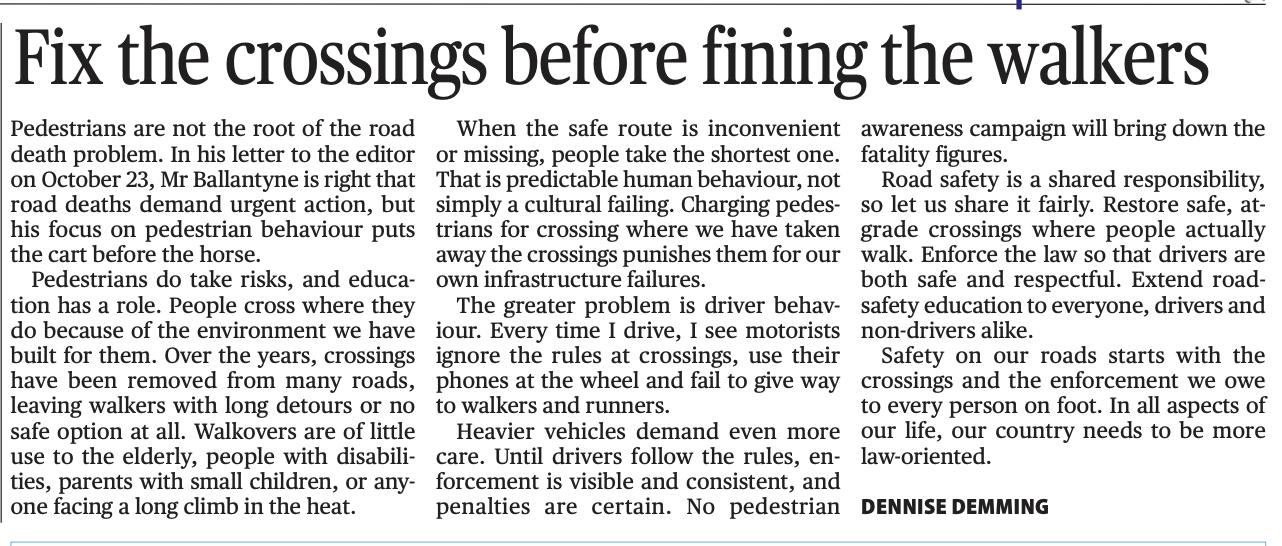
In his letter to the editor, Mr Ballantyne is right that road deaths demand urgent action, but his focus on pedestrian behaviour puts the cart before the horse.
Pedestrians do take risks, and education has a role. People cross where they do because of the environment we have built for them. Over the years, crossings have been removed from many roads, leaving walkers with long detours or no safe option at all. Walkovers are of little use to the elderly, people with disabilities, parents with small children, or anyone facing a long climb in the heat. When the safe route is inconvenient or missing, people take the shortest one. That is predictable human behaviour, not simply a cultural failing. Charging pedestrians for crossing where we have taken away the crossings punishes them for our own infrastructure failures.
The greater problem is driver behaviour. Every time I drive, I see motorists ignore the rules at crossings, use their phones at the wheel and fail to give way to walkers and runners. Heavier vehicles demand even more care. Until drivers follow the rules, enforcement is visible and consistent, and penalties are certain. No pedestrian awareness campaign will bring down the fatality figures.
Road safety is a shared responsibility, so let us share it fairly. Restore safe, at-grade crossings where people actually walk. Enforce the law so that drivers are both safe and respectful. Extend road-safety education to everyone, drivers and non-drivers alike.
Safety on our roads starts with the crossings and the enforcement we owe to every person on foot. In all aspects of our life, our country needs to be more law-oriented.
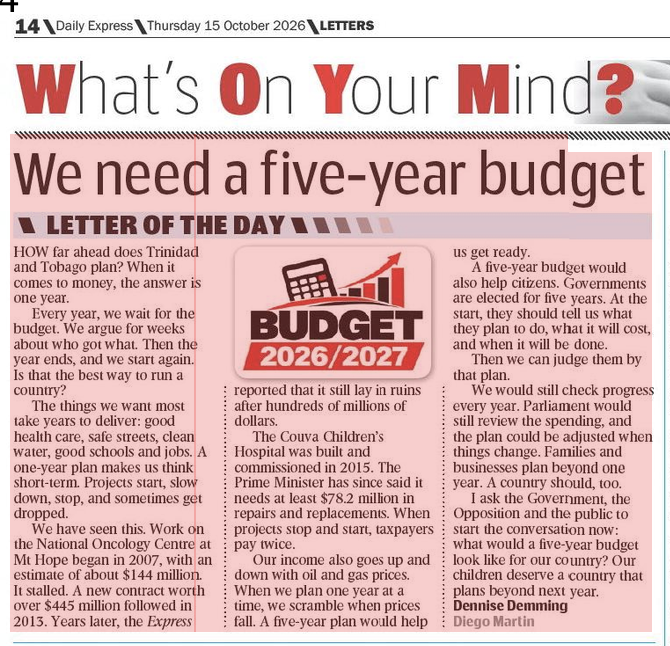
How far ahead does Trinidad and Tobago plan? When it comes to money, the answer is one year.
Every year, we wait for the budget. We argue for weeks about who got what. Then the year ends, and we start again. Is that the best way to run a country?
The things we want most take years to deliver: good health care, safe streets, clean water, good schools and jobs. A one-year plan makes us think short-term. Projects start, slow down, stop, and sometimes get dropped.
We have seen this. Work on the National Oncology Centre at Mt Hope began in 2007, with an estimate of about $144 million. It stalled. A new contract worth over $445 million followed in 2013. Years later, the Express reported that it still lay in ruins after hundreds of millions of dollars.
The Couva Children’s Hospital was built and commissioned in 2015. The Prime Minister has since said it needs at least $78.2 million in repairs and replacements. When projects stop and start, taxpayers pay twice.
Our income also goes up and down with oil and gas prices. When we plan one year at a time, we scramble when prices fall. A five-year plan would help us get ready.
A five-year budget would also help citizens. Governments are elected for five years. At the start, they should tell us what they plan to do, what it will cost, and when it will be done.
Then we can judge them by that plan.
We would still check progress every year. Parliament would still review the spending, and the plan could be adjusted when things change. Families and businesses plan beyond one year. A country should, too.
I ask the Government, the Opposition and the public to start the conversation now: what would a five-year budget look like for our country? Our children deserve a country that plans beyond next year.
Piles of road paving material now sit in the Queen’s Park Savannah opposite the President’s House. Given the material, what is being staged here is not temporary flooring. It is the material for a permanent road.
What makes this more troubling is what’s missing. Any legitimate construction site of this scale would ordinarily carry a notice board — the contractor, the commissioning agency, the scope and duration of works. I have not seen this here. No signage identifying who is doing this work, on whose authority, or why. Citizens are left to guess who is paving a piece of the Savannah and on what basis.
We have been here before, and the precedent should worry us. In 1999, then-Minister of Works Carlos John admitted to paving a part of the Savannah so that soldiers marching in the Independence Day parade would not have to walk through mud. The job was never put out for tender, and the cost was never disclosed to the public. The late environmentalist and former minister Eden Shand staged a one-man protest against it — and was nearly buried in gravel for his trouble. That paving still scars the Savannah today. A quarter-century later, we are watching the same justification, the same silence, and the same disregard for process play out again on the same ground.
I ask directly: who authorized this paving, under what statutory approval, and why is there no notice on site identifying the responsible party? If this work is lawful, there should be nothing to hide. If it isn’t, citizens deserve to know that too.
Our governments have allowed the gradual encroachment on the lungs of the Queen’s Park Savannah and Port of Spain. Barbados has its Garrison Savannah. London has Hyde Park. New York has Central Park. If we cannot say the same of our own Savannah a generation from now, it will not be because no one warned us. I am calling on the relevant authorities — Town and Country Planning, the National Trust, and whichever body commissioned this work — to halt further paving, post proper notice, and issue a public accounting within the week, before the last patch of grass on that stretch disappears for good.
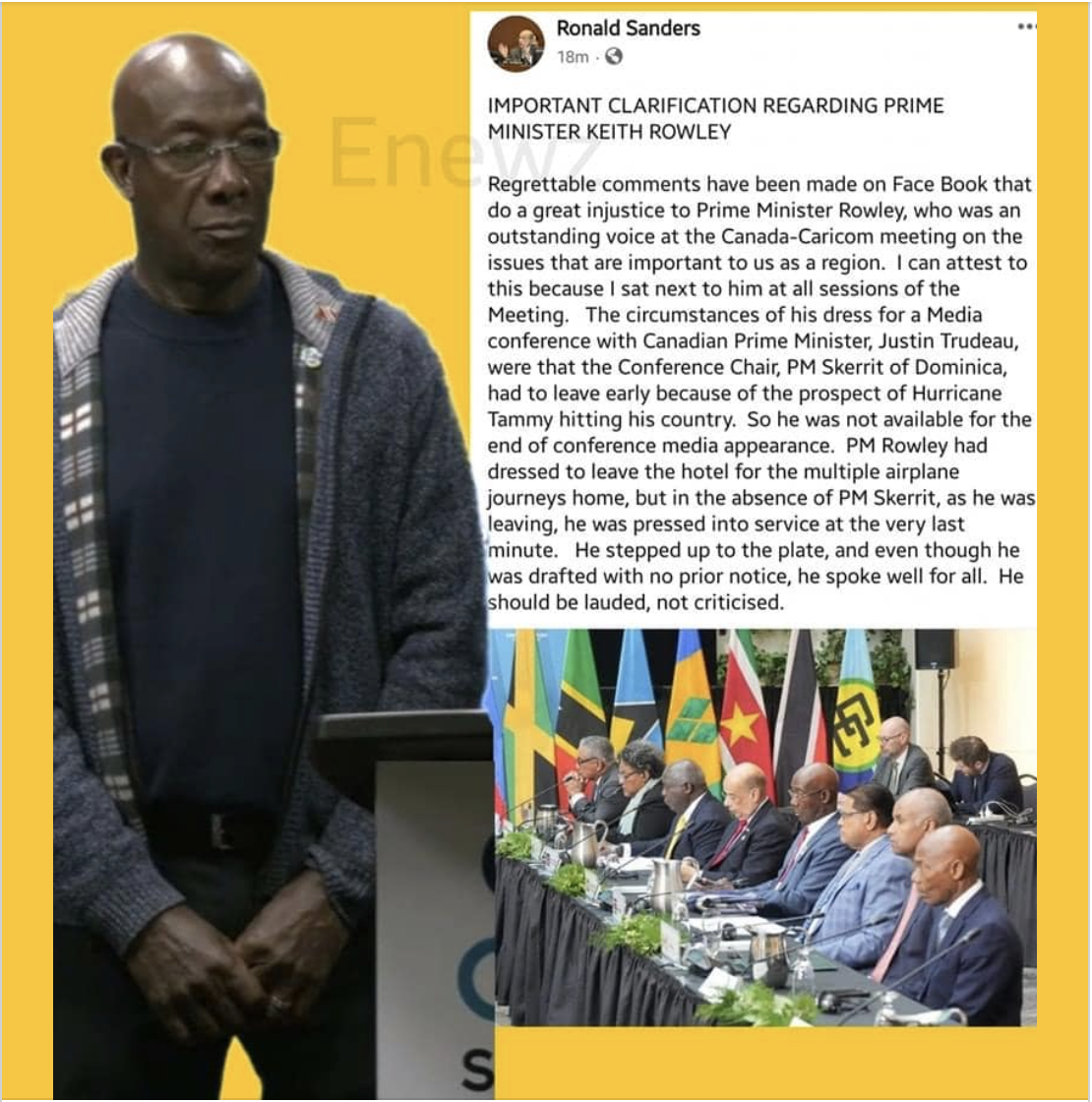
What is happening to my Prime Minister? What was his inspiration to be casually dressed at the closing ceremony of the inaugural Canada-CARICOM Summit. A photograph from the closing ceremony showed Canada’s Prime Minister, Justin Trudeau, and Guyana’s President and Dr. Irfaan impeccably dressed while my Prime Minister wore a casual jersey paired with a hooded sweater.
This visual contrast raised the question: Is my Prime Minister truly engaged on behalf of my country? How does he think the world will assess the quality of our nation’s global representation? Some may interpret his choice as an attempt to connect with everyday citizens and I respect that perspective. But I felt ashamed.
There might be a valid explanation for this nonconformity, such as the unfortunate scenario of his luggage being misplaced or failing to arrive with him. Although the chances of the Prime Minister’s luggage not arriving in a foreign country are slim, such an event would warrant investigating potential lapses in responsibility, and somebody should be fired.
Even in the event of his luggage not arriving, his accompanying team should have the capacity to swiftly visit a shopping mall to acquire suitable clothing.
An alternative rationale for his choice of attire could be a scheduling mishap. Perhaps, while on the golf course, an unforeseen urgency arose, requiring an immediate meeting with the Canadian Prime Minister. In his haste to return to his lodgings, he may have been unable to locate his formal attire, leading him to represent our nation in casual wear. Nonetheless, this possible explanation is my imagination overworking because conference agendas are typically well-prepared in advance.
A third possible reason for his relaxed appearance could be a deliberate attempt to convey a message that the world should transition away from formality in favor of more informal and friendly interactions. I hope that his departure from traditional attire will not be misconstrued as a breach of protocol and diplomatic norms.
Regardless of the reasons behind my Prime Minister’s seemingly unconventional attire in representing our nation, I extend my empathy and understanding. This incident offers us another opportunity for introspection as a nation. As the next election approaches, we should make decisions to ensure our country’s global representation meets the highest standards.
Congratulations on your recent appointment as a commercial officer for the Ministry of Trade. Your appointment is an indication that you passed the background check with flying colours and landed this very important job to represent our country.
Then Sport Minister Darryl Smith prepares to return a service on the table tennis board. (via MSYA)
It is truly heart-warming to see you triumph against the odds, especially since you were fired by the Prime Minister in 2018 for ‘interfering improperly in the public service’. What better way to inspire the next generation than by demonstrating that a person could be fired, survived allegations of sexual harassment, and still achieve such a high-status job?
I wonder what would have happened if a woman was accused of sexual harassment?! She might still be languishing in her bedroom begging for forgiveness.
But in the men’s club, you are being celebrated. Whoopie!
In this high-class “wuk”, your main responsibility will be: “to develop overseas markets and boost exports to key strategic trading partners”. I am sure that your resume is littered with examples of how you are ideally suited for this fantastic position.
During the background check, I suspect that your current boss, Trade Minister Paula Gopee-Scoon asked your former boss, Prime Minister Dr. Keith Rowley if he would recommend you for the position.
Former Minister of Sport Darryl Smith and PM Dr Keith Rowley at Brian Lara Stadium opening in 2017. (via trinidadexpress.com)
And your former boss, who had also appointed you chairman of the Diego Martin Regional Corporation, answered politely to endorse your capabilities.
Maybe, your former boss reflected on the chances of him losing his own “wuk” in 2025 and said: boy, now dat ah in charge, ah go give meh friend everything.
Whatever the considerations, congratulations and may you continue to be a shining beacon of hope for all those who lack ethics or basic qualifications.
Goodbye, Auntie Tantie. May our country continue to benefit from your wisdom and fervour. As you depart, I wonder what has changed during your service as the first female President of the Republic of Trinidad and Tobago.
Early in your tenure, I was inspired by your visit to Sea Lots on that Friday evening. Then you embraced Auntie Tantie as a “badge of honour” and had the Tantie courage to pelt bouf at our parliamentarians whenever you had the opportunity.
Throughout your term in office, you have shown empathy for our people, and I recall being stunned by your statement, “People are hurting, and they feel parliamentarians are not listening.”
‘If you are seen to treat each other with respect, courtesy, and good humour, there can be a trickle-down effect and eventual cascade. But when acrimony, contempt, and divisiveness is the example you set, you cannot be surprised when those attitudes and behaviours are replicated on the nation’s roads, in our schools and homes, and on social media.
You continued in that address and said to the Parliamentarians:
Unfortunately, it seems that your messages have fallen on the ears of 41 tone-deaf Parliamentarians who are focused on how they can benefit personally yet have zero empathy for the daily pain citizens are experiencing.
You are leaving office and the country continues to be in deep crisis as captured by your statement: “I fear we have become a savage people. Lines drawn between ethnicities, political affiliations, the haves, and the have-nots, worker, and employer, citizens and migrants have solidified into intolerance, impatience, unkindness, vitriol, and in many cases, downright nastiness…”
In that single statement, you have captured the key issues which our politicians should be addressing.
As the population awaits the selection of your successor, I am hopeful that the new President will be able to use his/her office and weekly meetings to encourage the Prime Minister to focus on the need to redesign our antiquated and mal-functioning systems and processes.
Although your departure provides another opportunity for a new beginning, I would prefer that your successor takes your lead, and carries forward the message that politicians should allow the plight of people to be the impetus for policy change.
Auntie Tantie … Thanks for your service and may your universe unfold exactly as you wish.
Our history records Trinidad and Tobago’s fisherfolk dodging bullets from or being arrested by Venezuela’s Guardia Nacional for supposedly being in Venezuelan waters. Today we continue to metaphorically dodge different kinds of bullets from our Venezuelan neighbours.
For years, the back-and-forth confrontational posturing was a trickle—the fisherfolk dispute, or the occasional Venezuelan found illegally in T&T. Then came the sustained deluge of illegal Venezuelans seeking a better life.
Photo: Venezuelans continue to stream out of their country in search of better lives.
The most recent ‘bullets’ include the jitters caused some weeks ago by the potential environmental hazard posed by the tilting oil tanker, the Nabarima.
This week, it is the mistreatment of Venezuelan children, both on land and sea. Unless specific action is taken to manage our open borders, it is only a matter of time before Trinidad and Tobago is featured globally in some emblematic photograph of a cross-border disaster involving our Venezuelan neighbours.
Remember the pictures of Kim Phuc the naked 9-year old fleeing the Napalm attack in Vietnam on 8 June 1972? Or the little Syrian boy, Alan Kurdi, drowned on a beach in Turkey on 2 September of 2015 while trying to reach shore?
These are not alarmist notions but warnings of possibilities, even as the Minister of National Security claims that the law says they are ‘undesirables’.
There is no question about our inability to absorb unchecked Venezuelan migration but it will continue to happen until our borders are policed and managed, and infrastructure and regulations for humane treatment of refugees and migrants are implemented.
Photo: Trinidad and Tobago Prime Minister Dr Keith Rowley (right) and Venezuela President Nicolas Maduro shake hands during a joint press conference in Port of Spain on 23 May 2016. (Copyright Alva Viarruel/AFP 2016/Wired868)
We did well to regularise 15,000 Venezuelan neighbours and it is almost time for their revalidation. But we are not doing well with the treatment of the estimated 16 Venezuelan children whom we have shunted from prison cells to pirogue onto the ocean and then back again.
Even in times of war, there is a commitment to protect the children unless you have ‘Trumpian’ tendencies and feel no empathy for caged children. In the midst of this, the minister of national security was allegedly unaware of the decision to escort a pirogue filled with children (one of whom was just 4 months old)—in the absence of their parents or guardians—into the open sea.
In a completely different aspect of law and order, the population is yet to receive a reasonable explanation of what happened with the DSS (Drug Sou Sou) money which was shunted from the home of the owner to the police station and back again. The common pattern in these two very different incidents is that either there is no rule book or the rules are not being followed.
Either way, it is time for action to be taken. But first we must admit that we are presiding over deep systemic failure of our institutions. It is from this recognition that things are falling apart that we may find the window of opportunity to redesign our systems and re-imagine a different future.
Photo: National Security Minister Stuart Young (left) gets Police Commissioner Gary Griffith (centre) and half the force to help him find his section in Tribe. (Copyright TTPS)
The anecdotal evidence is that we are generally welcoming the Venezuelans and trying to accommodate them as fellow human beings. Many are being absorbed because their work ethic is superior to ours, although others have become collateral damage and players in our fast expanding underworld.
The country is at crisis level with the influx of Venezuelans, drugs and guns through our porous borders.
If a solution is not implemented soon it will be a matter of time before a humanitarian disaster catapults us onto the world stage in unfortunate ways.