Citizens left guessing on Savannah paving …

Piles of road paving material now sit in the Queen’s Park Savannah opposite the President’s House.  Given the material, what is being staged here is not temporary flooring. It is the material for a permanent road.

What makes this more troubling is what’s missing. Any legitimate construction site of this scale would ordinarily carry a notice board — the contractor, the commissioning agency, the scope and duration of works. I have not seen this here. No signage identifying who is doing this work, on whose authority, or why. Citizens are left to guess who is paving a piece of the Savannah and on what basis.

We have been here before, and the precedent should worry us. In 1999, then-Minister of Works Carlos John admitted to paving a part of the Savannah so that soldiers marching in the Independence Day parade would not have to walk through mud. The job was never put out for tender, and the cost was never disclosed to the public. The late environmentalist and former minister Eden Shand staged a one-man protest against it — and was nearly buried in gravel for his trouble. That paving still scars the Savannah today. A quarter-century later, we are watching the same justification, the same silence, and the same disregard for process play out again on the same ground.

I ask directly: who authorized this paving, under what statutory approval, and why is there no notice on site identifying the responsible party? If this work is lawful, there should be nothing to hide. If it isn’t, citizens deserve to know that too.

Our governments have allowed the gradual encroachment on the lungs of the Queen’s Park Savannah and Port of Spain. Barbados has its Garrison Savannah. London has Hyde Park. New York has Central Park. If we cannot say the same of our own Savannah a generation from now, it will not be because no one warned us. I am calling on the relevant authorities — Town and Country Planning, the National Trust, and whichever body commissioned this work — to halt further paving, post proper notice, and issue a public accounting within the week, before the last patch of grass on that stretch disappears for good.
From Managing Traffic to Transforming Transportation in Chaguaramas

February 12 – Letter to the Editor

We cannot continue to rely almost exclusively on private vehicles in areas that were never designed to accommodate them on a large scale. The time has come to move from managing traffic to transforming transportation.

The congestion following the Stink + Dutty fete in Chaguaramas has understandably generated concern. Assistant Commissioner Garvin Henry is correct in highlighting the structural realities of the western peninsula: a single access route, limited parking, and geography that naturally constrains traffic flow. Under such conditions, delays were predictable, regardless of how robust the operational plan may have been.

Rather than debating whether large events should be hosted in Chaguaramas, we should treat this as an opportunity to address a deeper systemic issue. The peninsula is an ideal location to pilot a modernised transportation framework.

For major events, access passes could be limited to residents and essential services, while patrons utilise organised park-and-ride facilities supported by scheduled shuttle services. Reducing private vehicle volume would significantly ease congestion and demonstrate the value of coordinated public transport planning.

Importantly, this approach should not be limited to event days. Daily traffic in and out of Chaguaramas is already challenging. Residents face routine delays, schoolchildren encounter transportation difficulties, and workers—including members of the Defence Force and Coast Guard—are affected by the persistent bottleneck.

A structured system with reliable bus scheduling, designated pick-up points, managed peak-hour access, and consistent enforcement could improve daily mobility and safety. The western peninsula could serve as a demonstration zone for how disciplined systems, structures, and processes can produce measurable change.

Too often, we respond to congestion tactically—with police deployments and temporary controls. These are necessary but reactive measures. Sustainable improvement requires systemic reform and coordinated implementation.

Chaguaramas offers a practical opportunity to model that change. If we can implement a functioning transport framework there, it could serve as a blueprint for Carnival, major festivals, and other high-density activities across the country.

The disruption was inconvenient, but it has highlighted a larger truth: we must rethink how we move. The question is whether we will continue managing traffic—or commit to transforming transportation.

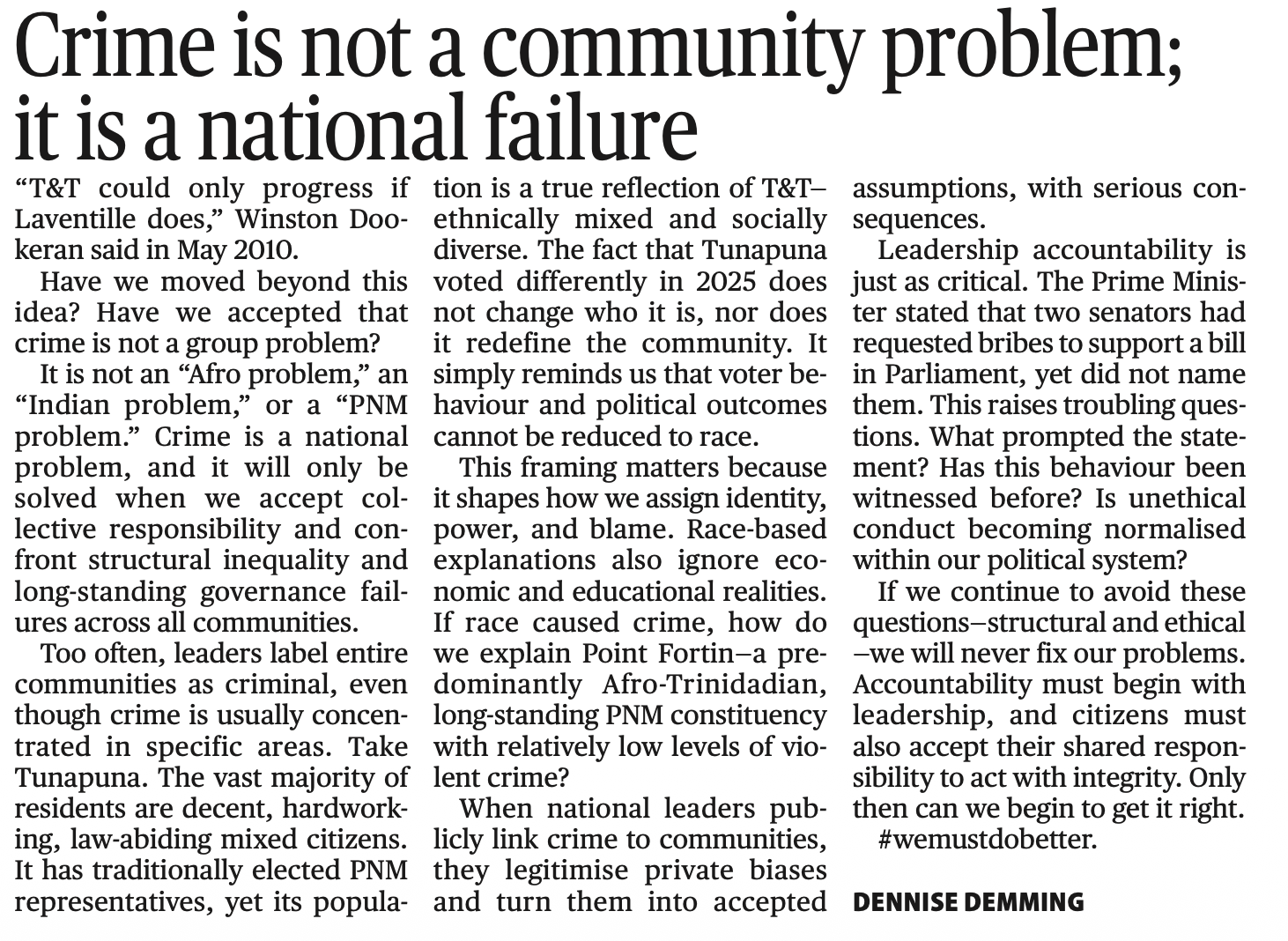
Crime is not a community problem; it’s a national failure …

Trinidad and Tobago could only progress if Laventille does,” Winston Dookeran said in May 2010. Have we moved beyond this idea? Have we accepted that crime is not a group problem? It is not an “Afro problem,” an “Indian problem,” or a “PNM problem.” Crime is a national problem, and it will only be solved when we accept collective responsibility and confront structural inequality and long-standing governance failures across all communities.

Too often, leaders label entire communities as criminal, even though crime is usually concentrated in specific areas. Take Tunapuna. The vast majority of residents are decent, hardworking, law-abiding mixed citizens. It has traditionally elected PNM representatives, yet its population is a true reflection of Trinidad and Tobago — ethnically mixed and socially diverse. The fact that Tunapuna voted differently in 2025 does not change who it is, nor does it redefine the community. It simply reminds us that voter behaviour and political outcomes cannot be reduced to race.

This framing matters because it shapes how we assign identity, power, and blame.

Race-based explanations also ignore economic and educational realities. If race caused crime, how do we explain Point Fortin — a predominantly Afro-Trinidadian, long-standing PNM constituency with relatively low levels of violent crime? When national leaders publicly link crime to communities, they legitimise private biases and turn them into accepted assumptions, with serious consequences.

Leadership accountability is just as critical. The Prime Minister stated that two senators had requested bribes to support a Bill in Parliament, yet did not name them. This raises troubling questions. What prompted the statement? Has this behaviour been witnessed before? Is unethical conduct becoming normalised within our political system?

If we continue to avoid these questions — structural and ethical — we will never fix our problems. Accountability must begin with leadership, and citizens must also accept their shared responsibility to act with integrity. Only then can we begin to get it right.

 #wemustdobetter.

Security Needs Answers, Not Drama

National security is being reduced to political drama.  Many of us followed the recent parliamentary debate on the proposed United States–linked radar installation in Tobago, simply hoping for a clearer explanation. What exactly is being built? Why Tobago? And how will this affect us? Unfortunately, those basic questions were never properly answered, leaving many citizens more uncertain than informed.

It has been widely stated that Trinidad and Tobago has, for many years, participated in Caribbean and hemispheric security cooperation under different governments. It is also worth asking whether our country already operates coastal surveillance radar systems in both Trinidad and Tobago as part of wider regional information-sharing arrangements aimed at tracking illegal drugs, weapons, and human trafficking. Similar systems reportedly exist across the Caribbean and are supported through long-standing regional agreements and partnerships with international allies.

This broader context was missing from the parliamentary debate. Instead of helping citizens understand how this installation fits into existing arrangements, the discussion focused narrowly on secrecy.

What many citizens really want answered are practical questions. Who will control the data collected in Tobago? Will local agencies have full access? Which authority will provide oversight and ensure compliance with our laws? And do we actually have the boats, trained personnel, and resources to act when threats are detected?

These questions go to the heart of sovereignty and public trust. Citizens of Trinidad and Tobago deserve calm explanation, honest engagement, and clear accountability. National security is too important to be reduced to political drama.

Unveiling Giselle Singh: Innovator, Scientist, and Musician


Giselle Singh introduces herself as an inventive creator and empath, drawing inspiration from the divine. She discusses her multifaceted identity as a scientist, innovator, and musician, emphasizing her contributions to soul music. She shares her focus on genuine storytelling and cultivating meaningful relationships.

Giselle advocates for a living wage for artists in Trinidad and encourages aspiring creatives to follow their dreams. She reflects on the importance of creative freedom, effective listening, and the transformative power of imagination from a young age.

Protecting Our Waters: An Interview with Judith Gobin

Gobin calls for addressing environmental issues at their source, particularly in reducing plastic waste. She also discusses the importance of balancing career and family, emphasizing the need for support networks for working women.

Richard Ragoobarsingh. Navigating Law and the Arts

In this episode, Trinidadian actor, director, and lawyer Richard Ragoobarsingh takes us through his remarkable journey of balancing two distinct yet equally demanding careers.

With over 40 years in theater, he reflects on his deep love for literature and the performing arts, the challenges faced by creatives in Trinidad and Tobago, and the resilience required to sustain a life in both law and the arts. Richard highlights the power of passion, the need for greater support for the arts, and his hopes for a future where creativity is valued as much as any profession.

His story is a testament to the idea that with dedication and vision, it is possible to thrive in multiple worlds.