Another While Running conversation. #whilerunning @ruthosman
Month: March 2025
Urgent attention is needed for digitalization in our country …
Richard Ragoobarsingh. Navigating Law and the Arts
In this episode, Trinidadian actor, director, and lawyer Richard Ragoobarsingh takes us through his remarkable journey of balancing two distinct yet equally demanding careers.
With over 40 years in theater, he reflects on his deep love for literature and the performing arts, the challenges faced by creatives in Trinidad and Tobago, and the resilience required to sustain a life in both law and the arts. Richard highlights the power of passion, the need for greater support for the arts, and his hopes for a future where creativity is valued as much as any profession.
His story is a testament to the idea that with dedication and vision, it is possible to thrive in multiple worlds.
Let the people decide on PM, not the party!
Trinidad and Tobago operates under a first-past-the-post electoral system, where the political party winning the majority of parliamentary seats forms the government. How can a new government be formed without holding a General Election? Is this a breach of our constitution? Why have we not seen any challenges by our constitutional lawyers?
Historically every government has been formed after eletions when the leader of the victorious party is appointed Prime Minister he then selets the Attorney General. After 62 years of independence a PNM leader has moved away from that system and is changing the government without an election.
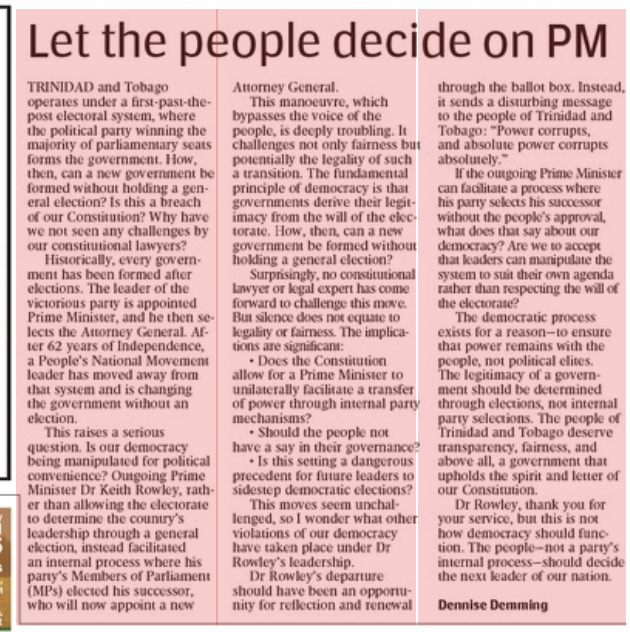
This raises the serious question of whether our democracy is being manipulated for political convenience. Prime Minister Dr. Keith Rowley, rather than allowing the electorate to determine the country’s leadership through a General Election, instead facilitated an internal process where his party’s Members of Parliament (MPs) elected his successor who will now appoint a new Attorney General.
This maneuver, which bypasses the voice of the people, is deeply troubling. It challenges not only fairness but potentially the legality of such a transition. The fundamental principle of democracy is that governments derive their legitimacy from the will of the electorate. How can a new government be formed without holding a General Election?
Surprisingly, no constitutional lawyer or legal expert has come forward to challenge this move. But silence does not equate to legality or fairness. The implications are significant:
- Does the Constitution allow for a Prime Minister to unilaterally facilitate a transfer of power through internal party mechanisms?
- Should the people not have a say in their governance?
- Is this setting a dangerous precedent for future leaders to sidestep democratic elections?
If this move stands unchallenged, what other violations of our democracy have taken place under Dr. Rowley’s leadership?
Dr. Rowley’s departure should have been an opportunity for reflection and renewal through the ballot box. Instead, it sends a disturbing message to the people of Trinidad and Tobago:
“Power corrupts, and absolute power corrupts absolutely.”
If the outgoing Prime Minister can facilitate a process where his party selects his successor without the people’s approval, what does that say about our democracy? Are we to accept that leaders can manipulate the system to suit their own agenda rather than respecting the will of the electorate?
The democratic process exists for a reason—to ensure that power remains with the people, not political elites. The legitimacy of a government should be determined through elections, not internal party selections. The people of Trinidad and Tobago deserve transparency, fairness, and above all, a government that upholds the spirit and letter of our Constitution.
Dr. Rowley, thank you for your service, but this is not how democracy should function. The people—not a party’s internal process—should decide the next leader of our nation.

David Boothman chats with Dennise Demming
David Boothman: The Artistic Journey and Societal Reflections
Join us as we dive into the mind of David Boothman, a reflective and philosophical artist. In this episode, David discusses his understanding of what it means to be an artist, exploring the dichotomy between human nature’s ‘angelic’ and ‘brute’ aspects and how these manifest in our societal behaviors. He critiques the impact of Western capitalism on culture and art, emphasizes the importance of the seven liberal arts, and underscores the need for decolonization and a cultural renaissance, particularly in the Caribbean. David also reflects on the implications of today’s media and industry on young artists and the preservation of artistic integrity. An insightful dialogue that merges art, science, spirituality, and history.
Rhythm and Tech: The Rodney Harris Story
Unlocking the Secrets of Success: Proven Strategies and Expert Insights
Join us in this engaging episode with Rodney Harris. We discuss the keys to success with expert tips, practical strategies, and inspiring stories. Discover his thoughts on how to overcome challenges and set and achieve goals.
Whether you’re looking to boost your career, personal growth, or entrepreneurial ventures, this episode provides actionable advice and profound insights to help young people on their journey to success.
 Dennise Demming