Better Carnival Data is Needed …

Recently, there have been calls for the Central Bank to “step up” and collect data on Carnival. This request misunderstands the Bank’s role. Globally, Central Banks manage monetary policy, financial stability, and the balance of payments. It relies on national statistics for the numbers it needs. It is not meant to run surveys of promoters, masqueraders, or events.
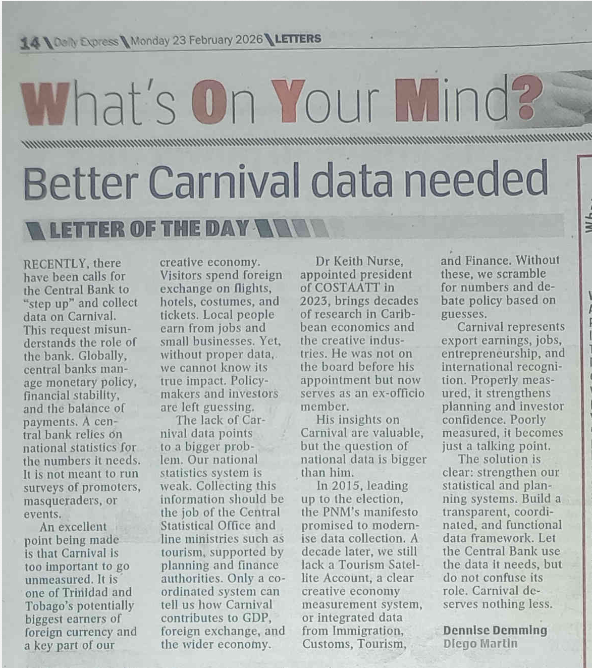
An excellent point made in a Sep 28, 2023 Saturday Express article “Carnival a forex earner”, is that Carnival is too important to go unmeasured. It is one of Trinidad and Tobago’s most significant earners of foreign currency and a key component of our creative economy. Visitors spend foreign exchange on flights, hotels, costumes, and tickets. Local people and small businesses earn from related seasonal jobs. Yet, without proper data, we cannot know its true impact. Policymakers and investors are left guessing. This is not the fault of the Central Bank; that’s not its job.

The lack of Carnival data points to a bigger problem. Our national statistics system is weak. Collecting this information should be the job of the Central Statistical Office and line ministries such as Tourism, supported by planning and finance authorities. Only a coordinated system can tell us how Carnival contributes to GDP, foreign exchange, and the wider economy.

Dr. Keith Nurse, appointed President of COSTAATT in 2023, brings decades of research in Caribbean economics and the creative industries. He was not on the Board before his COSTAATT appointment, but now serves as an ex officio member. His insights on Carnival are valuable, but the question of national data is bigger than even his skill set.

In 2015, leading up to the elections, the PNM’s manifesto promised to modernise data collection.  A decade later, we still lack a clear creative economy measurement system or integrated data from Immigration, Customs, Tourism, and Finance. Without these, we scramble for numbers and debate policy based on guesses.

Carnival represents export earnings, jobs, entrepreneurship, and international recognition. Properly measured, it strengthens planning and investor confidence. Like so many important issues, it remains poorly measured and is just a talking point. The solution is clear: strengthen our statistical and planning systems. Build a transparent, coordinated, and functional data framework.

Carnival is significant enough to require careful, thoughtful curation, not haphazard management.
From Managing Traffic to Transforming Transportation in Chaguaramas

February 12 – Letter to the Editor

We cannot continue to rely almost exclusively on private vehicles in areas that were never designed to accommodate them on a large scale. The time has come to move from managing traffic to transforming transportation.

The congestion following the Stink + Dutty fete in Chaguaramas has understandably generated concern. Assistant Commissioner Garvin Henry is correct in highlighting the structural realities of the western peninsula: a single access route, limited parking, and geography that naturally constrains traffic flow. Under such conditions, delays were predictable, regardless of how robust the operational plan may have been.

Rather than debating whether large events should be hosted in Chaguaramas, we should treat this as an opportunity to address a deeper systemic issue. The peninsula is an ideal location to pilot a modernised transportation framework.

For major events, access passes could be limited to residents and essential services, while patrons utilise organised park-and-ride facilities supported by scheduled shuttle services. Reducing private vehicle volume would significantly ease congestion and demonstrate the value of coordinated public transport planning.

Importantly, this approach should not be limited to event days. Daily traffic in and out of Chaguaramas is already challenging. Residents face routine delays, schoolchildren encounter transportation difficulties, and workers—including members of the Defence Force and Coast Guard—are affected by the persistent bottleneck.

A structured system with reliable bus scheduling, designated pick-up points, managed peak-hour access, and consistent enforcement could improve daily mobility and safety. The western peninsula could serve as a demonstration zone for how disciplined systems, structures, and processes can produce measurable change.

Too often, we respond to congestion tactically—with police deployments and temporary controls. These are necessary but reactive measures. Sustainable improvement requires systemic reform and coordinated implementation.

Chaguaramas offers a practical opportunity to model that change. If we can implement a functioning transport framework there, it could serve as a blueprint for Carnival, major festivals, and other high-density activities across the country.

The disruption was inconvenient, but it has highlighted a larger truth: we must rethink how we move. The question is whether we will continue managing traffic—or commit to transforming transportation.

Crime is not a community problem; it’s a national failure …

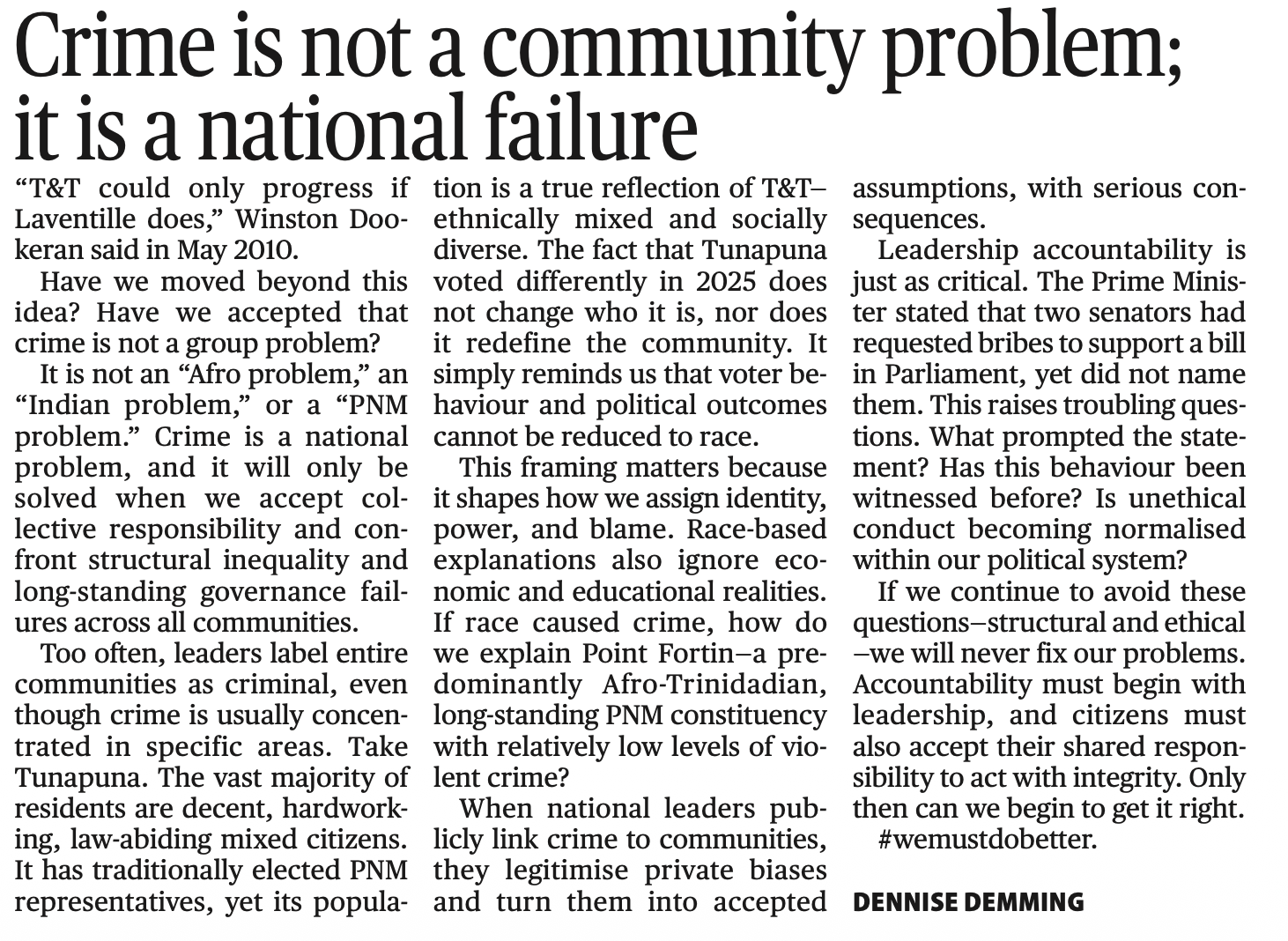
Trinidad and Tobago could only progress if Laventille does,” Winston Dookeran said in May 2010. Have we moved beyond this idea? Have we accepted that crime is not a group problem? It is not an “Afro problem,” an “Indian problem,” or a “PNM problem.” Crime is a national problem, and it will only be solved when we accept collective responsibility and confront structural inequality and long-standing governance failures across all communities.

Too often, leaders label entire communities as criminal, even though crime is usually concentrated in specific areas. Take Tunapuna. The vast majority of residents are decent, hardworking, law-abiding mixed citizens. It has traditionally elected PNM representatives, yet its population is a true reflection of Trinidad and Tobago — ethnically mixed and socially diverse. The fact that Tunapuna voted differently in 2025 does not change who it is, nor does it redefine the community. It simply reminds us that voter behaviour and political outcomes cannot be reduced to race.

This framing matters because it shapes how we assign identity, power, and blame.

Race-based explanations also ignore economic and educational realities. If race caused crime, how do we explain Point Fortin — a predominantly Afro-Trinidadian, long-standing PNM constituency with relatively low levels of violent crime? When national leaders publicly link crime to communities, they legitimise private biases and turn them into accepted assumptions, with serious consequences.

Leadership accountability is just as critical. The Prime Minister stated that two senators had requested bribes to support a Bill in Parliament, yet did not name them. This raises troubling questions. What prompted the statement? Has this behaviour been witnessed before? Is unethical conduct becoming normalised within our political system?

If we continue to avoid these questions — structural and ethical — we will never fix our problems. Accountability must begin with leadership, and citizens must also accept their shared responsibility to act with integrity. Only then can we begin to get it right.

 #wemustdobetter.