I sat in this hall years ago, wondering what my future would bring. For five years, Holy Name Convent was my safe space, a refuge from the challenges I faced at home. Growing up on Quarry Street in East Dry River, Holy Name provided me with the environment I needed to grow and dream.
In this presentation at the Prize Distribution ceremony, I encouraged the young women to reflect on their futures and recognize their potential to make meaningful contributions to Trinidad and Tobago, despite societal challenges and stereotypes. I emphasized the critical role of women in minimizing criminality and corruption, urging them to reclaim their voices and leadership roles. By doing so, women can drive positive change and help rebuild the nation.
I also highlighted the importance of personal well-being, including physical fitness, balanced living, and intentional decision-making, as foundational to this transformation. Drawing from my overcoming adversity and achieving academic and professional success, I hope to inspire young women to take charge of their futures with truth and purpose. They were challenged to commit to their communities, embrace change, and lead by example, fostering a vision of empowered women driving progress and unity in Trinidad and Tobago. Ending on a hopeful note, I underscored the importance of balance, transformation, and truth in shaping a better future.
John Acton’s (1834-1902) famous quote, “Power tends to corrupt, and absolute power corrupts absolutely,” serves as a stark reminder of the risks of unchecked authority.
In Trinidad and Tobago, Prime Minister Dr. Keith Rowley has drawn growing criticism for his increasingly harsh and at times, derogatory language—a significant shift from the more respectful tone he maintained as Leader of the Opposition from 2010 to 2015. His rhetoric as Prime Minister raises important questions about the role of language in leadership.
During his tenure as Leader of the Opposition, Dr. Rowley’s public comments were mostly respectful, allowing for civil discourse. However, since becoming Prime Minister, his language has at times taken a more troubling turn. In one notable exchange with businessman Inshan Ishmael, Dr. Rowley responded to criticism by saying, “kiss my ar**” and, “You GO TO HELL!!!” Many citizens, who expect dignity from their leaders, expressed disappointment, noting the lack of courtesy expected from a national figure.
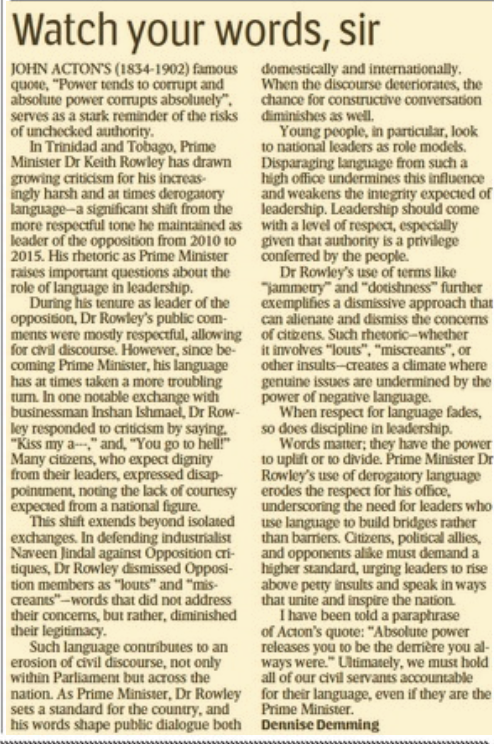
This shift extends beyond isolated exchanges. In defending industrialist Navin Jindal against opposition critiques, Dr. Rowley dismissed opposition members as “louts” and “miscreants”—words that did not address their concerns but rather diminished their legitimacy. Such language contributes to an erosion of civil discourse, not only within Parliament but across the nation. As Prime Minister, Dr. Rowley sets a standard for the country, and his words shape public dialogue both domestically and internationally. When the discourse deteriorates, the chance for constructive conversation diminishes as well.
Young people, in particular, look to national leaders as role models. Disparaging language from such a high office undermines this influence and weakens the integrity expected of leadership. Leadership should come with a level of respect, especially given that authority is a privilege conferred by the people.
Dr. Rowley’s use of terms like “jammetry” and “dotishness” further exemplifies a dismissive approach that can alienate and dismiss the concerns of citizens. Such rhetoric—whether it involves “louts,” “miscreants,” or other insults—creates a climate where genuine issues are undermined by the power of negative language.
When respect for language fades, so does discipline in leadership. Words matter; they have the power to uplift or to divide. Prime Minister Dr. Rowley’s use of derogatory language erodes the respect for his office, underscoring the need for leaders who use language to build bridges rather than barriers. Citizens, political allies, and opponents alike must demand a higher standard, urging leaders to rise above petty insults and speak in ways that unite and inspire the nation.
I have been told a paraphrase of Acton’s quote: “Absolute power releases you to be the derrière you always were.” Ultimately, we must hold all of our civil servants accountable for their language, even if they are the Prime Minister.
In this interview, Brian Lewis, the past president of the Trinidad and Tobago Olympic Committee (TTOC), shares his commitment to sports volunteerism, background, and passion for fostering gender equality and empowering women in sports. He explains how he has never been financially compensated for his decades-long involvement in sports, emphasizing his commitment to improving the sector.
Lewis discusses the importance of bridging the gap between governance and management in sports and acknowledges the challenges that volunteer leaders face, such as burnout and the difficulty of effecting change within a culture that sees sports as recreational rather than essential. He highlights the need for cultural change, advocating for sports to be viewed as an investment in youth, rather than just a hobby. His ideal transformation would integrate physical education within the educational system, supported by trained PE teachers, as seen in Jamaica, to build a healthier, socially adjusted population.
A significant part of his legacy is the “Future is Female” initiative, inspired by his mother and dedicated to promoting gender equality. This program aims to increase female representation in sports leadership and support for female athletes.
Addressing Trinidad and Tobago’s Olympic prospects, Lewis stresses the long-term effort required to produce elite athletes and the impact of challenges like crime, the COVID-19 pandemic, and societal attitudes toward sports on youth participation. He believes in the need for better community-based talent development systems and innovative support to retain young people in sports. For sustained progress, he emphasizes the importance of setting ambitious goals, such as TTOC’s “10 Goals.
Dr. Brian Copeland shared his work in sound engineering on Power Conversations focusing on enhancing sound systems in Roman Catholic churches in Trinidad and Tobago. His recent projects include installations in churches at Tortuga, Belmont, and St. Joseph. He emphasizes “intelligibility” in sound, noting that clarity, rather than loudness, enhances listeners’ experiences and reduces mental fatigue from reverberation.
As chairman of COSTAATT and Cipriani College of Labour and Cooperative Studies, Dr. Copeland advocates for an education system that builds national resilience, preparing citizens for economic challenges and natural disasters.
Inspired by Germany’s model and Costa Rica’s success, he envisions an economy strengthened by small and medium-sized enterprises, with COSTAATT playing a central role. His vision includes democratizing education to enable more people to contribute to Trinidad and Tobago’s economy and adapt to technological changes, such as AI.
Dr. Copeland also highlights the importance of societal engagement on issues like social justice and recidivism. Through accessible education and inclusive dialogue, he believes Trinidad and Tobago can create a more resilient, equitable society, helping individuals reintegrate and contribute meaningfully to national growth.
As a music sociologist, Dr. Meagan Sylvester delves into Calypso, Soca, and Kaiso Jazz music, genres deeply rooted in Trinidad and Tobago’s culture and Carnival. Her research examines how these genres reflect societal issues like race, class, and identity, as they emerge through lyrics, rhythms, and performance in festivals worldwide, from Notting Hill to Caribana.
In her doctoral research, Dr. Sylvester analyzed Ragga Soca as a continuation of Calypso’s tradition of social commentary. Calypso has historically voiced public concerns, challenging the status quo. From Singing Sandra’s “Voices from the Ghetto” to Bunji Garlin’s “In the Ghetto,” these songs echo similar themes across generations, highlighting societal struggles that remain relevant. Sylvester underscores that Ragga Soca maintains this tradition, mirroring Calypso’s earlier role as a voice of resistance against societal injustices.
In addition to her research, Dr. Sylvester is committed to educating youth on the cultural importance of these art forms. As a former education officer for the Trinbago Unified Calypsonians Organization (TUCO), she visited schools, collaborating with teachers to expose students to Calypso. However, she notes ongoing challenges, such as resistance from some school administrators who view Calypso negatively. Despite these barriers, she continues advocating for Calypso’s inclusion in school curricula, citing its potential as a literary device in subjects like history and social studies.
Dr. Sylvester emphasizes the power of music to reflect and influence society. By examining lyrics, she believes we can gain insights into pressing issues like violence and social inequality. Her hope is that these stories, embedded in Calypso and Soca, will inspire positive change and a deeper understanding of Caribbean identity.
Despite allocating 14% of the national budget to the Ministry of National Security, crime poses significant challenges, affecting sectors such as tourism, agriculture, and small businesses. In this Power Conversation on August 30, 2024, Indera Sagewan discusses the complex issues facing Trinidad and Tobago, with a focus on crime and the economy. She suggests exploring international support to complement ongoing local efforts, recognizing the strain that crime places on business costs, operating hours, and industries like entertainment. Indera also highlights the importance of enhancing accountability and developing key performance indicators within the police force to improve resource management. On a regional scale, Indera suggests the potential for greater efficiency within CARICOM and advocates for thoughtful reforms. Shifting to the economy, she emphasizes the need for more job creation to open up opportunities for the younger generation. She also acknowledges the burden of inflation and rising living costs. While some leaders propose planting kitchen gardens to address food prices, Indera points out the associated challenges and costs and proposes that increasing support for farmers could be a more effective strategy. Her overall message emphasizes the importance of structural changes, both locally and regionally, to address these evolving challenges.
Women comprise 60 per cent of the student body at the University of the West Indies (UWI), but they recently appointed four men to executive management roles. This action was stated in a recent news release. Two things concern me: gender equality and the appointment of Robert Riley, who is under public scrutiny for his role at Massy.
The appointment of the four men raises serious concerns about gender balance and representation. Interestingly, two of these men are succeeding women. This marks a shift in leadership and appears to disregard the progress made toward gender equality. The appointed men are Mr. Robert Riley, Professor Derek Chadee, Campus Bursar Mr. Kevin Kalloo and Pro Vice-Chancellor for the Board of Undergraduate Studies, Professor Canute Thompson.
What message is UWI sending to its students, particularly the young women who aspire to leadership roles? Why has UWI, under the leadership of a female principal chosen to fill these key positions exclusively with men? One would have thought that she had broken the glass ceiling but she appears to be on a glass cliff.
To my mind, this decision reflects a male-dominated, autocratic approach that dismisses the contributions and potential of women. It perpetuates outdated stereotypes, suggesting that women should be limited to following instructions rather than stepping into leadership. Yet, beyond the walls of UWI St. Augustine, times have changed, and gender equality is no longer just an ideal but an expectation.
When Chancellor Dr. The Most Honourable Dodridge D. Miller appointed Mr. Robert Riley as Chair of the St. Augustine Campus Council for a five-year term, did he fully consider Riley’s track record? Beyond Riley’s role at Massy Holdings, he was also on the Petrotrin Board when the refinery was shut down in 2018. Six years later, this vital national asset remains closed with no clear plan for reopening or sale.
These decisions prompt a critical inquiry: is this the kind of leadership UWI wants for its students? Were there no other qualified candidates with a stronger track record and a commitment to inclusive leadership? The choice to exclude women from these senior roles is especially troubling given that women have outnumbered men among UWI graduates for over a decade. This lack of female representation at the executive level seems incompatible with UWI’s historical commitment to equal opportunity and progress.
As a UWI graduate and a former adjunct lecturer for 18 years, I find this development deeply disheartening. A university’s role extends beyond education; it should embody and reflect the values it seeks to instil in society. In an era when gender parity in leadership is widely recognized as essential, UWI’s actions send a conflicting and discouraging message. For UWI to remain relevant, it must align its leadership practices with the principles of equality and inclusion it claims to uphold. Only then can it truly serve as a leader in shaping the future.
It’s concerning that a public hospital would serve a meal as nutritionally poor as Crix crackers and sardines to patients, especially in a country that leads the Caribbean in non-communicable diseases (NCDs). This choice shows a lack of care for patient health, and the fact that the CEO finds this acceptable raises questions about his suitability to lead an institution responsible for promoting wellness and recovery.
Traditionally, a balanced meal is made up of one-third carbohydrates, one-third protein, and one-third vegetables. I learned this in primary school.
This hospital meal falls short of this basic standard, which is essential for proper healing and overall health. When hospitals—places meant for healing—serve meals with little nutritional value, they not only risk the health of patients but also set a poor example. Patients may leave the hospital thinking that such inadequate meals are acceptable, and some may even adopt these unhealthy habits in their own lives.
On top of this, we import 92% of our food, which shows our heavy reliance on foreign products. By serving imported sardines, the hospital is supporting this unfortunate trend, rather than choosing healthier, locally sourced options. We need leaders who set a strong example by prioritizing nutrition and promoting sustainable practices. Hospitals have an opportunity to lead the way and offer meals that support good health and reflect the values we need as a nation. Come on, Minister of Health and CEO Davlin Thomas, we must do better, and having been awarded the largest budget allocation this year you have no excuse to move away from Crix and Sardine.
As we grapple with increasing violence and crime, I wonder about the use of alcohol. This thought brought to my mind the late Noor Mohamed Hassanali, who served as the second president of TT from 1987 to 1997. Known for his conservative approach, Hassanali made a conscious decision to prohibit the consumption of alcohol at President’s House during his tenure – a policy that no one ever complained about.
Hassanali’s legacy as a devout Muslim and a leader committed to moral and fiscal responsibility is evident in this stance. During his presidency, state functions at President’s House were alcohol-free. Instead of offering alcoholic beverages, guests were served a refreshing fruit drink made from five-finger, a fruit grown on the grounds of President’s House. While some guests may have quietly grumbled, they ultimately accepted and even enjoyed the alternative.
This decision not only reflected Hassanali’s personal and religious values but also underscored his commitment to leading by example. By eliminating alcohol from official functions, he saved the country significant sums of money – funds that could have been redirected to more pressing needs. In a time when the country is facing economic and social challenges, perhaps this approach deserves reconsideration.
The sight of public officials indulging in alcohol sends mixed messages, particularly to younger generations who are often told to avoid drinking. It raises the question: why should we tell children not to drink alcohol, only to show them adults, especially leaders, celebrating with it? This disconnect between the messages we give to our children and the actions of our leaders is concerning.
In the current climate, where economic belts are tightening and social issues are on the rise, rethinking the role of alcohol in state functions could be a small but meaningful change. Imagine if the money saved from not purchasing alcohol for government events was redirected to help those in need. It would be a symbolic yet powerful statement of prioritizing the well-being of the nation over maintaining certain luxuries.
The transformation of TT will only occur when we start making conscious decisions that reflect the values we want to promote. Removing alcohol from government activities may seem like a small issue, but it could have a significant impact. It represents an opportunity to lead by example, promote fiscal responsibility, and send a clear message that public officials are committed to making a positive difference in society.
If we truly want change, it starts with the small things – like choosing a non-alcoholic toast to celebrate our nation’s milestones.