PATRIOTISM AND ITS VULGAR APPLICATION

By Professor SELWYN CUDJOE, Originally published in the Trinidad Express on January 8, 2023

OVER the past two weeks Minister Stuart Young has proclaimed his patriotism and his commitment to the central tenet of our National Anthem: ‘Here every creed and race find an equal place.’ Anyone who objects to his interpretation of this aspect of the anthem is accused of being a racist or, as he said recently, of playing ‘the unsavoury race card’. He has accused me of attacking him ‘on the basis of race’ ( Express, January 2).

Anyone who has read my articles carefully would agree that I said nothing disparaging about Young, nor did I attack his character. I am inclined to accept that he is a hard worker and is committed to ‘the positive growth and continued development’ of our society. He has been cordial and respectful to me on the three occasions that I have met him. While I commend those attributes, I am more concerned about the capacity of our leaders to think logically and coherently about the problems that face our society.

Young joined the People’s National Movement (PNM) in 2014. I have supported PNM from its inception in 1956 and have been an active party member since the 1960s. On April 22, 1960, I marched in the rain on that famous journey from Chaguaramas to Woodford Square where Dr Eric Williams announced our country’s right to reclaim Chaguaramas. He also condemned the seven deadly sins of colonialism (Williams, ‘The Chaguaramas Declaration’).

In 1996 when Dr Keith Rowley challenged Patrick Manning for the leadership of the PNM, I assisted in composing his oppositional manifesto in which we used the arguments of William Julius Wilson, When Work Disappears (1996), as the central premise of his candidacy. When Rowley lost his fight against Manning and party members began to heckle him at the bar of the Chaguaramas Convention Hall, I took him to the home of Jackie Lazarus to shield him from their taunts.

In 2002, Joel Krieger, a Harvard-trained political scientist, and I spent ten days with Patrick Manning as we crafted PNM’s Vision 2020 statement. After we finished our work we dined at Soong’s Great Wall Restaurant in San Fernando, as Joan Yuille-Williams and Hazel Manning can testify. They were also present at the dinner. Just for the record: we produced this massive document without charging PNM a cent.

When the United National Congress (UNC) defeated the PNM in 2010, I was among about 150 people who went to Curepe Junior Secondary (now St Joseph Secondary) to lick our wounds and to prepare for the next election at which we were successful. Keith Rowley can attest to the truth of this statement.

Minister Young does not possess a patent to the central meaning of the National Anthem. When one asserts that every creed and race finds an equal place in our society, it implies that there are various groups within the society and that each group presents its own challenges and has its own demands.

To say that the needs of the black group have been left unattended or neglected, as I have argued, is a proposition that may be contested. It cannot be placed under a rubric called racism. More importantly, the injunction, ‘Here every creed and race find an equal place’ is more an aspirational statement than an accomplished fact. It is a goal to which we must aspire, hence our national motto: ‘Together we aspire, together we achieve.’ Therein lies the promise of our society.

How do we achieve this objective?

At the very least, we can begin to think about these goals in a nuanced and forthright manner. Even in thinking about this we ought to be careful of the benefits that some citizens achieve by virtue of their position in the society. That is why I am so concerned about the special advantages that Young is given by virtue of his special relationship to the prime minister and why some thinkers, more experienced than I, warn that without the necessary guardrails some party members can become ‘more equal than others’.

One of the most precious commodities in any democracy is the exercise of free critical thought. Necessarily, these thoughts must be accompanied by actions. Still, when one person is given multiple tasks (chairmanship of the party, Minister of Energy, Minister in the Office of the Prime Minister, and constituency representative) without the necessary preparation, one wonders if one can pay enough attention to any of these functions.

When Minister Young accuses me of racism, I am inclined to think of Samuel Johnson’s injunction, ‘Patriotism is the last refuge of the scoundrel.’ Aakar Patel, chair of Amnesty International India, explained what Johnson meant by this statement: ‘Any crime and any misbehaviour was tolerated as long as it was committed by one who kept shouting that he loved his country. And, on the other hand, the individual who questioned the behaviour of the country or government was a traitor, no matter how noble he/she was.’ (Outlook, October 29, 2019).

Young has to be careful about his protestation of ultra-patriotism. It would have been much better if he responded to the questions that I raised rather than deal with clichés that need to be contextualised and examined. The PNM has always thrived and prospered because of the quality of its ideas, not only by the amount of money any individual or corporation contributes to the party’s coffers.

As the new year begins, the PNM is called upon to offer creative solutions to the problems that affect the country. Therefore, it would be wise if the party chairman heeded Dr Johnson’s notion about the pitfalls of patriotism and remember that calling someone a racist, in societies such as ours, is disingenuous and dishonourable. It is really the last port of call of resistance for someone who may not possess the noblest motives.

-Prof Cudjoe’s e-mail address is scudjoe@wellesley.edu. He can be reached @ Professor Cudjoe.

SELWYN CUDJOE

Time for deep reflection, PM

‘WHAT the flood is wrong with our Prime Minister’s brain?’ is the question a friend asked me recently. Of course, I don’t know, but a review of some of his responses in the recent Ria Taitt interview in the Express raises a concern about references made to ‘Ted Cruz’, ‘Maduro’, and ‘flood politics’.

What the ‘flood’ do ‘Maduro’ and ‘Ted Cruz’ have to do with the Prime Minister being functionally absent in supporting any of the 100,000 citizens who suffered from the flooding?

Texas Senator Ted Cruz (renamed Fled Cruz) was fiercely criticized on social media when he left Houston with his children to get away from his freezing home caused by an electrical failure that left hundreds of homes bitterly cold during winter.

Nicolás Maduro Moros is the contentious president of Venezuela. After the elections in 2018, the word ‘usurper’ of authority was used by the Supreme Tribunal of Justice in Venezuela to describe the National Assembly he leads.

About 320,000 people voted for the PNM in 2015 and 2020, and all you can say as Prime Minister is: ‘Not me and flood politics… I not in dat.’

In Keith-speak this might well be interpreted, ‘I have put in all the infrastructure and instructed my four ministers to do what is necessary, so I am off to the golf course where I often spend a lot of my time.’

On November 26, 2022, the OCHA website (the United Nations Office for the Coordination of Humanitarian Affairs) reported that as a result of floods ‘100,000 people have been affected with 15,000 in need of support which represents approximately 5,100 households in five key municipalities in Trinidad and Tobago’.

The following is the list of affected areas: (Area affected and a number of households.)

• Tunapuna/Piarco Regional Corporation 2,700; • El Carmen, St Helena, Madras Road – 1,200; • Kelly Village – 300; • Caroni – 200; • Real Spring, Valsayn South – 200; • Bamboo #2 and #3 –

800;

• San Juan/Laventille Regional Corporation – 200; • Sangre Grande Regional Corporation – 1,000; • Mayaro/Rio Claro Regional Corporation – 500; • Penal/Debe Regional Corporation – 700.

Despite this data, our Prime Minister is locked into the view that showing up for flood victims is using flood politics to gain a photo opportunity. Or is it that he is so disconnected that he can comfortably say ‘flood you’ to 100,000 flood-affected citizens?

Several years ago, Ataklan sang, ‘Flood on de Main Road’ as a white lie to excuse his tardiness in arriving late to meet his girlfriend. Today that is no longer a white lie-it is the reality we all live in. In the slightest rain, there is a ‘flood on the main road’ in every part of our country.

Men who have been fathers, husbands, and grandfathers, experience family members needing to feel their presence. Well, this is exactly what the sufferers, flood victims, and 100,000 voters needed to feel the presence of our leader.

When the empathy part of your humanity has shut down, it is time for deep reflection and re-work. Make the right choice!

Thanks “Auntie Tantie”

Goodbye, Auntie Tantie.  May our country continue to benefit from your wisdom and fervour. As you depart, I wonder what has changed during your service as the first female President of the Republic of Trinidad and Tobago. 

Early in your tenure, I was inspired by your visit to Sea Lots on that Friday evening. Then you embraced Auntie Tantie as a “badge of honour” and had the Tantie courage to pelt bouf at our parliamentarians whenever you had the opportunity.

Throughout your term in office, you have shown empathy for our people, and I recall being stunned by your statement, “People are hurting, and they feel parliamentarians are not listening.” 

‘If you are seen to treat each other with respect, courtesy, and good humour, there can be a trickle-down effect and eventual cascade. But when acrimony, contempt, and divisiveness is the example you set, you cannot be surprised when those attitudes and behaviours are replicated on the nation’s roads, in our schools and homes, and on social media.

You continued in that address and said to the Parliamentarians:

Unfortunately, it seems that your messages have fallen on the ears of 41 tone-deaf Parliamentarians who are focused on how they can benefit personally yet have zero empathy for the daily pain citizens are experiencing.

You are leaving office and the country continues to be in deep crisis as captured by your statement: “I fear we have become a savage people. Lines drawn between ethnicities, political affiliations, the haves, and the have-nots, worker, and employer, citizens and migrants have solidified into intolerance, impatience, unkindness, vitriol, and in many cases, downright nastiness…”

In that single statement, you have captured the key issues which our politicians should be addressing. 

As the population awaits the selection of your successor, I am hopeful that the new President will be able to use his/her office and weekly meetings to encourage the Prime Minister to focus on the need to redesign our antiquated and mal-functioning systems and processes.

Although your departure provides another opportunity for a new beginning, I would prefer that your successor takes your lead, and carries forward the message that politicians should allow the plight of people to be the impetus for policy change.  

Auntie Tantie … Thanks for your service and may your universe unfold exactly as you wish.

Regional Airfares too high

The airfare to Miami is less than to Barbados, so tell me, why should I visit Barbados? If Caricom is to realize the goal of promoting economic integration and cooperation among Caribbean people, then we must have access to each other.  High regional airfares between countries act as a disincentive to regional travel.  Taxes, Fees, and Charges (TFC) account for 40% of airfares.  Imagine the boost to intra-regional travel which would occur if airfare went down by 40%!

Newsday, Thursday 22nd December 2022

In 2019, over 20,000 citizens in the Caribbean and the Diaspora signed a petition asking Caribbean leaders to review the current TFC regime on intra-regional travel and take action to reduce the high travel taxes applied to regional travel.  The petition was championed by the lobby group – “Citizens Against High Intra-Regional Caribbean Travel Taxes (CAHIRTT)”.  So far there has been no response to those tens of thousands of citizens who have tried to make their voices heard. In seeking support for their petition CAHIRTT commented that “Over-taxing regional travel is counter-productive to regional connectivity and the growth and productivity of our economies.”

The region’s annual hotel occupancy averages 60% which means that in a 100-room hotel, 40 rooms are continuously empty.  Imagine if another 20 or 30 rooms could be occupied continuously.  Decreased airfare is one way to stimulate intra-regional travel for both business and leisure. 

Studies have shown that increased visitor arrivals lead to increased economic activity, more tax collection, increased employment, and general stimulation of economies.  If the region ever needed economic stimulation the time is now.

A recent article in the Trinidad Express by Asha Javeed reported Caribbean Airlines Limited (CAL) as commenting that: ‘As part of our strategic plan, we continue to focus on improving regional connectivity. Caribbean Airlines enjoys the largest network in the region, with plans to expand, within the ambit of our resources.’  I welcome this focus because regional connectivity is important for our region to thrive.

It is our reality that measured on a per-mile flown basis the Caribbean region tops world airfares. As the primary owners of CAL, the Trinidad and Tobago Government must lead the charge and reduce the 40 percent TFC on airline tickets in the region.  Such bold action will help CAL achieve its strategic objective of “improving regional connectivity” and provide support for Caricom to achieve its main purpose of promoting “economic integration and cooperation among its members”.

So, we must aim for the day when a ticket to Barbados is lower than the price of a ticket to Miami.  This Barbados/Miami analogy is being used to make the point that the price of intra-regional travel must inspire citizens to travel both for business and pleasure. 

Wellness includes balance

Paul Richards recently earned his Ph.D. in Educational Psychology.

In this interview, he discusses the significance of having a supportive community when faced with children’s learning challenges. Accepting the notion that “everyone can learn” is the first hurdle to be overcome. He comments that Trinidad and Tobago’s educational system is not as bad as often described and points out the need to focus on the lowest 30th percentile of students to transform the system.

He also shares his opinion on personal wellness and the need to prioritize a person’s well-being and not wait for crises to occur.

A display of Incompetence

Shame and empathy are the two words that best describe my feelings while listening to the Commission of Inquiry into the incident when four divers lost their lives while trapped in a pipeline belonging to the Paria Fuel Trading Company.  On 25 February 2022, just 8 months prior to the time of writing, this incident rocked our country and wrenched at the bellies of citizens, particularly those former Petrotrin employees.

Watching the man who was the sole surviving diver, crying while presenting his evidence during the inquiry was difficult, but experiencing him incorrectly blaming himself for the death of his colleagues puts your mind at a different level.  While his bravery and courage are acknowledged, one would hope that he’s in the hands of an experienced therapist to help him through this difficult period.

I feel ashamed because this is another example of a leadership decision that has not been in the interest of the citizens of our country.  No matter how this one is sliced, the bill for the taxpayer continues to rise. 

My recurring question has been: How did we get to this?  It is early days, but the evidence points to a complete collapse in the systems and procedures which create a safe working environment. 

In 2018, when asked about the number of employees to be sent home because of the shutdown of the Petrotrin Refinery, then Chairman Espinet responded “All … All … All.”  The refinery’s closure affected some 2,600 jobs including 1,700 jobs in the refinery.   Among those discontinued jobs were the jobs carried out by a well-trained Safety Department which kept the refinery and its workers safe for many years.  In one act, the institutional knowledge was removed and replaced by a level of incompetence which brought us to this tragedy. 

What was the procedure to select LMCS Limited as the service provider for diving services?   If the report that only “two members of the dive team were in possession of commercial diving certification while the others were certified for recreational scuba diving” is accurate, this supports my conclusion about the incompetence of the leadership team.

The world is looking on and coming to its own conclusions about this tragedy.  How can a country which has been in the oil business for over 100 years exhibit such indifference about this level of incompetence?  No matter the investment opportunity, why should an investor put his money in a place where the systems and processes are so broken?

In the same way that company directors are held liable for poor financial decisions and can face jail terms, shouldn’t the Board of Directors of Paria be held personally liable for the deaths of those four divers?  Can we anticipate the passage of relevant legislation?

Published on November 25, 2022 – Newsday

https://secure.mediafiles.fi/newsday/221125074410_public-U3Sw1xfVqeSzEtVZnd8aosRL62KJrQoOYcJfFXezJRA/Newsday-Friday-November-25th-2022-Issue-No-10658/#p=14

Asking for help is a sign of strength

ROSE Hill RC Primary School is the first ‘big school’ I attended 60 years ago. It was about half a mile from my home on Quarry Street.

One day, a man chased another through the schoolyard with a cutlass, and I couldn’t wait to tell this story to my mother when I got home. Her immediate response was, ‘Ah moving yuh from dey!’ My next clear memory is wearing the Nelson Street Girls’ blue uniform and walking two miles to and from school.

The recent story about gunshots in the neighbourhood of Rose Hill RC brought back this memory, and I asked: ‘What has changed in 60 years?’ The weapons are no longer cutlasses but now AK-47s, and both sides in the argument are well-armed. My mother’s response was to find a way to escape the reality of the environment and move her child to what she felt was a safer environment.

Published in the Trinidad Express, Wednesday 16th November 2022

About 50 years later, Despers Steel Orchestra, ‘The pride of Laventille’, ran away from their home of more than 60 years to find safety away from gun violence. Over the years, families have abandoned the area in search of safety and security but many residents have no option and no support to transform it, so they remain and survive as best as possible. This is no longer the exclusive narrative of Laventille; there are many ‘Laventilles’ all over the country.

It is time for us to accept that our country is on a slippery path toward total collapse. Unfortunately, accepting this narrative means acknowledging that not only are our country’s systems broken but that this occurred because the execution of our responsibilities for managing our country has been lazy or even absent. We have given one political party a free hand to preside over that destructive process for more than two-thirds of our life as an independent nation. Our brokenness may also be seen as an opportunity to change the way we do business. Maybe the time has come for our country to seek outside help to de-escalate the mindset behind the gun violence which is killing us. About 20 years ago, the country of Colombia was known for drugs and guns, and with the help of the United States, they were able to transform their country. If a country like Colombia can reach out for help, why can’t we?

Asking for help is not a sign of weakness; sometimes, it is the bravest move you can make.

Water Woes everywhere

Why are we unable to supply our citizens with a continuous supply of water? In 1960, our production was 50 million gallons of water per day. Sixty years later, production has quadrupled to 240 million gallons per day.  What has gone wrong?

Urgent need to improve transportation system

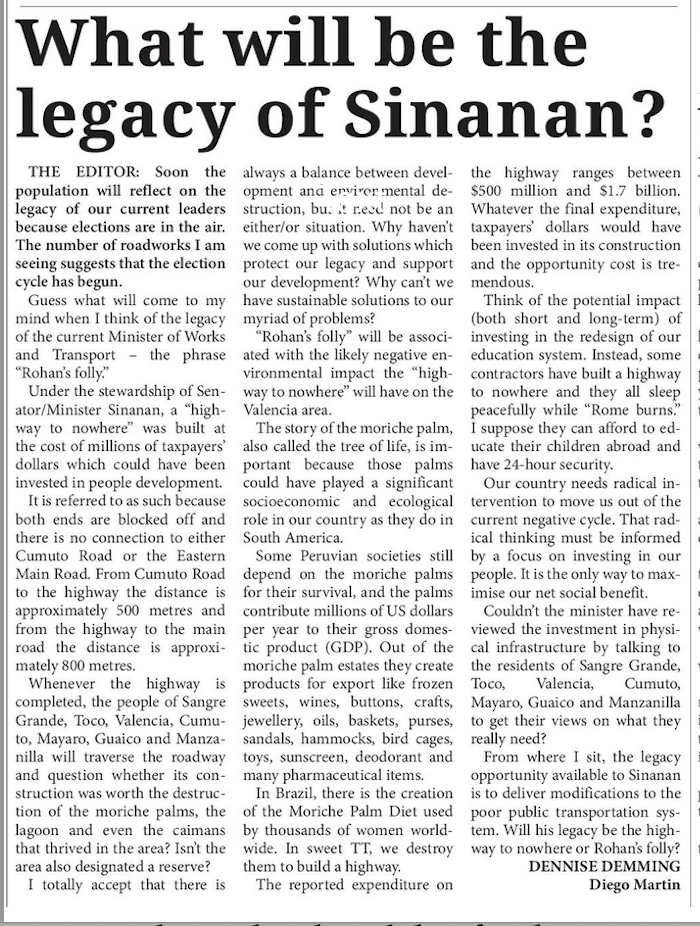
Do you know that notification sound of an incoming text on a cell phone? That’s what happens in my head whenever I read about transportation plans or anything to do with public transport.  In this instance, I was excited to read that Works and Transport Minister Rohan Sinanan told Parliament’s Standing Finance Committee (SFC), that tenders will soon go out for the development of a transportation plan for Trinidad and Tobago.  My excitement increased because I remembered that one of the selling points in the lead-up to the 2015 general elections was that transportation was a way of life issue and we were encouraged to dream of the 4+ hours we could save every day when an efficient transportation system was put in place if the PNM was elected to lead the government.

My excitement withered when I remembered a public statement by former Minister of Works Jack Warner who boasted that he used the box containing the rapid rail report as a footstool.  During a discussion in Parliament in 2010, then Minister Warner reminded the population that a former PNM administration had spent $27 million on the Comprehensive National Transportation Study (CNTS) and Mass Transit System Study.  All we have is a memory of the disappearance of $27 million.

My excitement transformed to cynicism because we are ignoring the recent work of Dr. Trevor Townsend and Katherine Agong, research assistant and Ph.D. student who carried out a scientific survey of households and developed a suite of travel demand models that can tell us about the daily travel behaviour of commuters.  

My cynicism became mistrust when I recalled the political model for awarding contracts.  This is my understanding of that political model: begin with selecting the intended awardee, craft the need to suit their stated competence, develop the invitation to tender, issue the tender, award the tender to the firm, wait for the variation or scope creep, and waste taxpayers’ money.

Of course, this political model for awarding contracts is never implemented because our politicians always act in the best interest of our country and the most transparent process will be utilized to procure these services. For those not paying attention, that sentence is sarcasm.

Minister Sinanan, there will be a long timeline between the award of the tender, the submission of the report, and the implementation of the recommendations.  Is it your expectation that the population will continue to silently suffer the daily grind of an unreliable transportation system?  We need some quick solutions to alleviate our transportation pain.

From my “ringside” seat you had a big spat with Transportation specialist Dr. Rae Furlonge so you are unlikely to engage him for professional advice.  PTSC may have some history with Dr. Trevor Townsend so we could run a redline through him as a subject matter expert.   So, your next best bet would be to engage Katherine Agong, a Ph.D. student who appears to be our most recent transportation advocate.  She is quoted in the Express Newspaper of August 02, 2022, as saying that the study found that a major need for improved transportation, was “more reliable and convenient public transportation systems to replace the use of the private car.”

I sincerely hope that some action will be taken quickly to improve our transportation system.