PNM, evolve or risk becoming history …

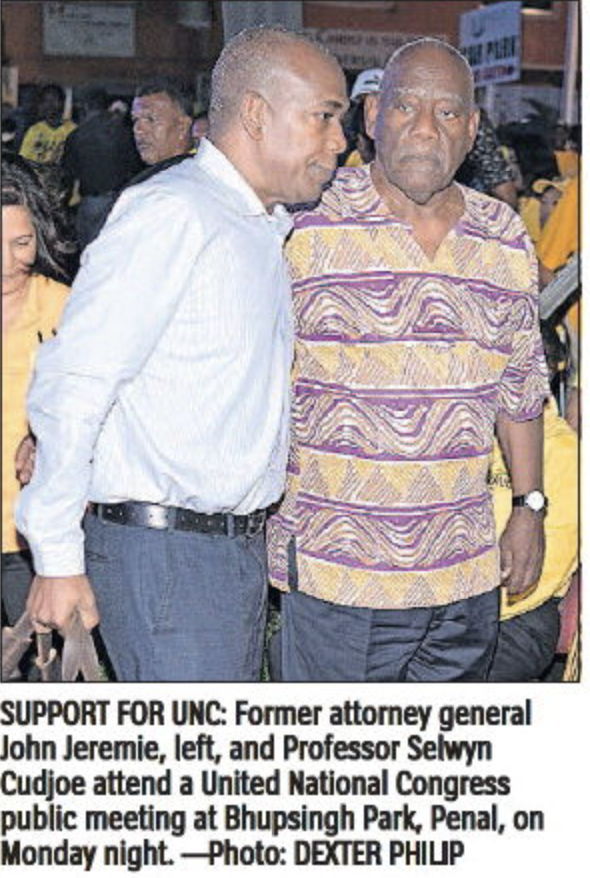
Former Attorney General John Jeremie’s public endorsement of the United National Congress (UNC) has reignited national conversation about the People’s National Movement (PNM) and the direction in which it is heading. Once a senior figure in the PNM, Jeremie’s presence on a UNC platform was more than symbolic—it reflected growing discontent within the party’s ranks, which has been in administration for the past decade and most of our country’s history.

Jeremie, who served twice as AG and was also appointed High Commissioner to London, is not one to make casual political moves. His actions suggest something has gone deeply wrong in the party he once loyally served.

Foreign Affairs Minister Dr. Amery Browne expressed surprise at Jeremie’s switch but acknowledged his right to make such a choice. Meanwhile, former PNM minister Karen Nunez-Tesheira, herself now at odds with the party, went further, suggesting that the PNM’s leadership is out of touch and that time in opposition may be necessary to allow the party some time ‘out’ (of office) to ‘regroup and recalibrate’.

These concerns are not isolated. A friend and long-time resident of Diego Martin, now 78, expressed a sentiment shared by many loyal supporters: “The thinking is that a change is possible in 2025 because of the current poor leadership of a good political party. The party needs to reboot, reset, and redesign its goals and objectives—and it will not do that if it remains in power.”

Diego Martin has been a traditional PNM stronghold, only shaken in 1986 and significantly challenged in 2010 when Rocky Neil Garcia got 7,996 votes versus the 9,042 which retired Prime Minister Keith Rowley received.

Disappointment is growing across the country. I recall former Prime Minister Patrick Manning’s warnings about the current PNM leader when he said: “Dr. Rowley is a very aggressive individual. When he gets angry, he becomes dangerous.” Having been led for the past 15 years by a disrespectful autocrat, the party must move away. Many of us who helped elect him in 2010 now understand how right Manning was.

The current crisis created by PNM leadership could hand the UNC a victory—but that’s not the solution either. I hope minor parties win a few seats and the Tobago party holds its two. Then real politics—negotiation, coalition, and accountability—must take place, as happens in many European countries.”

Perhaps the final comment of my Diego Martin friend is the most sobering: He said, “I am ready for the oven, so I could not care less. Hope you are young enough to fight for justice for all. Unfortunately, our people are not sufficiently evolved—they need 100 years more.”

Yet there is hope.  Honest voices, from inside and outside the party, are calling for a better future. If the PNM is to remain relevant, it must listen, reflect, and evolve—or risk becoming a memory of what once was. 2025 is an opportunity to step away.

Fariness necessary in Sandals deal …

The return of Sandals to the headlines, through the recent statement by Minister Stuart Young SC, is a reminder that we’ve learned little from the mistakes of the past. As someone who once served as Chairman of the Tourism Development Company (TDC), I speak from personal experience. I was asked to resign from that post—not because I had done anything wrong, but because I stood by a simple, fair principle: that whatever incentives and benefits were offered to Sandals should also be made available to local hoteliers and guesthouse owners.

When I refused to resign on principle, I was advised by the then Minister of Finance to cite “family matters” as my reason, or as he put it, to “take one for the boys.” I rejected both suggestions. I had done nothing wrong.

What I had done was advocate for fairness and transparency in tourism development. Unfortunately, that advocacy was inconvenient to the powers pushing the Sandals deal. The now-infamous Memorandum of Understanding (MoU), exposed thanks to Afra Raymond’s successful legal challenge, showed a lopsided agreement. The state was to fund and build the resort on public land, while Sandals would enjoy sweeping concessions—tax holidays, duty-free status, unlimited work permits for foreigners, and no obligations to local employment. All risk, all cost, all burden—carried by the public.

Is that development, or is it a handover?

The rejection of the project by Tobagonians was not arbitrary. As THA Chief Secretary Farley Augustine noted, it was undemocratic, economically unsound, and environmentally questionable. The proposed site—No Man’s Land—is a Ramsar-listed wetland. Yet, to date, there has been no public disclosure about environmental safeguards or updated assessments.

Development cannot happen in darkness. It cannot bypass stakeholders or sideline local businesses. If we are to believe that lessons have been learned, then this new approach must:

  1. Ensure full transparency, including the release of all agreements before they are finalized.
  2. Require rigorous environmental scrutiny.
  3. Treat local hoteliers and guesthouses with the same regard as international chains.
  4. Involve real public and stakeholder consultation—not after the fact, but from the start.

Tourism is critical to Tobago’s future, but not on any terms and certainly not at any cost. Fairness and public accountability should not be punished—they should be the minimum standard. The core elements that shape a successful and sustainable tourism experience are Culture, Conversation and Community.  Are these 3 C’s included in the Sandals meeting of April 7?

Creative Director Kirk Langton shares his experiences with Legendary @PeterMinshall

In this video, Kirk Langton, a creative director, discusses his career journey and the pivotal moments that shaped it. He recalls an impactful meeting 36 years ago with Peter Minshall, a renowned contemporary artist, which propelled him into the creative field. In this video, Kirk Langton, a creative director, discusses his career journey and the pivotal moments that shaped it. He recalls an impactful meeting 36 years ago with Peter Minshall, a renowned contemporary artist, which propelled him into the creative field. Langton shares his experiences working on various projects, including designing costumes for Carnival and redesigning a cemetery in Point Fortin. He emphasizes the importance of collaboration and drawing on diverse skill sets. Langton also reflects on his work rebranding QRC and highlights the need to expose young people to different experiences and honor past generations. He underscores that true fulfillment comes from contributing to the betterment of spaces and communities.He emphasizes the importance of collaboration and drawing on diverse skill sets. Langton also reflects on his work rebranding QRC and highlights the need to expose young people to different experiences and honor past generations. He underscores that true fulfillment comes from contributing to the betterment of spaces and communities.

Richard Ragoobarsingh. Navigating Law and the Arts

In this episode, Trinidadian actor, director, and lawyer Richard Ragoobarsingh takes us through his remarkable journey of balancing two distinct yet equally demanding careers.

With over 40 years in theater, he reflects on his deep love for literature and the performing arts, the challenges faced by creatives in Trinidad and Tobago, and the resilience required to sustain a life in both law and the arts. Richard highlights the power of passion, the need for greater support for the arts, and his hopes for a future where creativity is valued as much as any profession.

His story is a testament to the idea that with dedication and vision, it is possible to thrive in multiple worlds.

Let the people decide on PM, not the party!

Trinidad and Tobago operates under a first-past-the-post electoral system, where the political party winning the majority of parliamentary seats forms the government. How can a new government be formed without holding a General Election? Is this a breach of our constitution? Why have we not seen any challenges by our constitutional lawyers?

Historically every government has been formed after eletions when the leader of the victorious party is appointed Prime Minister he then selets the Attorney General. After 62 years of independence a PNM leader has moved away from that system and is changing the government without an election.

This raises the serious question of whether our democracy is being manipulated for political convenience. Prime Minister Dr. Keith Rowley, rather than allowing the electorate to determine the country’s leadership through a General Election, instead facilitated an internal process where his party’s Members of Parliament (MPs) elected his successor who will now appoint a new Attorney General.

This maneuver, which bypasses the voice of the people, is deeply troubling. It challenges not only fairness but potentially the legality of such a transition. The fundamental principle of democracy is that governments derive their legitimacy from the will of the electorate. How can a new government be formed without holding a General Election?

Surprisingly, no constitutional lawyer or legal expert has come forward to challenge this move. But silence does not equate to legality or fairness. The implications are significant:

  • Does the Constitution allow for a Prime Minister to unilaterally facilitate a transfer of power through internal party mechanisms?
  • Should the people not have a say in their governance?
  • Is this setting a dangerous precedent for future leaders to sidestep democratic elections?

If this move stands unchallenged, what other violations of our democracy have taken place under Dr. Rowley’s leadership?

Dr. Rowley’s departure should have been an opportunity for reflection and renewal through the ballot box. Instead, it sends a disturbing message to the people of Trinidad and Tobago:

“Power corrupts, and absolute power corrupts absolutely.”

If the outgoing Prime Minister can facilitate a process where his party selects his successor without the people’s approval, what does that say about our democracy? Are we to accept that leaders can manipulate the system to suit their own agenda rather than respecting the will of the electorate?

The democratic process exists for a reason—to ensure that power remains with the people, not political elites. The legitimacy of a government should be determined through elections, not internal party selections. The people of Trinidad and Tobago deserve transparency, fairness, and above all, a government that upholds the spirit and letter of our Constitution.

Dr. Rowley, thank you for your service, but this is not how democracy should function. The people—not a party’s internal process—should decide the next leader of our nation.

David Boothman chats with Dennise Demming

David Boothman: The Artistic Journey and Societal Reflections

Join us as we dive into the mind of David Boothman, a reflective and philosophical artist. In this episode, David discusses his understanding of what it means to be an artist, exploring the dichotomy between human nature’s ‘angelic’ and ‘brute’ aspects and how these manifest in our societal behaviors. He critiques the impact of Western capitalism on culture and art, emphasizes the importance of the seven liberal arts, and underscores the need for decolonization and a cultural renaissance, particularly in the Caribbean. David also reflects on the implications of today’s media and industry on young artists and the preservation of artistic integrity. An insightful dialogue that merges art, science, spirituality, and history.

Rhythm and Tech: The Rodney Harris Story

Unlocking the Secrets of Success: Proven Strategies and Expert Insights

Join us in this engaging episode with Rodney Harris.  We discuss the keys to success with expert tips, practical strategies, and inspiring stories. Discover his thoughts on how to overcome challenges and set and achieve goals.

Whether you’re looking to boost your career, personal growth, or entrepreneurial ventures, this episode provides actionable advice and profound insights to help young people on their journey to success.