Melissa Comeau and Culturally Informed Caribbean EFT

Melissa Comeau discusses her journey into Emotionally Focused Therapy (EFT) after discovering Dr. Paul Guillory’s,EFT work which focuses on black and brown people and people of color. She highlights the importance of his resources, including his book, which is a case study collection on African American couples.

Melissa emphasizes the significance of Caribbean EFT, which culturally tailors EFT processes for black and Caribbean clients, and recounts her valuable experiences in their four-day training program. She appreciates the sense of community and culturally specific training provided by Caribbean EFT, and how it has influenced her practice as a solo practitioner in Florida.

She plans to integrate more culturally focused questions in her assessments and expresses strong support for Caribbean EFT, urging other therapists interested in culturally informed EFT to engage with the organization.
Protecting Our Waters: An Interview with Judith Gobin

Gobin calls for addressing environmental issues at their source, particularly in reducing plastic waste. She also discusses the importance of balancing career and family, emphasizing the need for support networks for working women.

From Cycling to Singing: Michael Phillips’ Unconventional Odyssey

video

Michael Phillips shares his life journey, highlighting his multifaceted talents and achievements. As a national cyclist, artist, and musician, Phillips discusses his upbringing in a family passionate about cycling, his mother’s influence on his artistic side, and how art helped fund his cycling endeavors. Unexpectedly, music became a significant part of his life during the COVID-19 lockdown, leading him to compose and perform songs.

Despite his diverse interests, Phillips grapples with procrastination and constantly strives to push his limits. He reflects on Trinidad and Tobago’s culture, noting a lack of support for sports and the arts, which is influenced by societal tendencies towards alcohol consumption.

Phillips emphasizes the importance of resilience, personal growth, and pursuing one’s passions, regardless of external validation.

He concludes by encouraging others to learn new skills and embrace activities that challenge them.

Amanda Thomas on the Impact of Culture in Therapy

Amanda Thomas shares her experience attending an EFT externship program, highlighting how the program exceeded her expectations by focusing on culture and race in relationships.

She appreciates the global applicability of the EFT model and its specific relevance to the Caribbean context, particularly in fostering nonjudgmental listening and understanding between partners. Amanda notes the importance of cultural influences in couple dynamics, underscoring the need for therapists to consider these factors during counseling. As a counseling psychologist, she finds joy in helping couples achieve deeper connections through understanding and sharing their emotions.

Amanda recommends the EFT externship for therapists seeking to improve their skills and encourages both therapists and couples to persevere in their efforts, emphasizing that the work is worth it if done with love.

Dr. Jo-Anne Tull’s BluePrint for Caribbean Creatives

In this video, Dr. Jo-Anne Tull — educator and cultural industries consultant—explores the many roles she balances and her impactful work in arts administration and entrepreneurial development. She sheds light on the opportunities and obstacles Caribbean artists face, particularly the policy gaps that limit standardized earnings and access to financial systems.

Drawing on models from countries like Canada and Ireland, Tull illustrates how sound policy can empower the arts. She advocates for greater financial literacy and structural support for emerging creatives, emphasizing the Caribbean’s vast and untapped cultural wealth. Despite the pressure to pursue conventional careers, she notes a growing enthusiasm for arts education among young people.

Tull also highlights the importance of dreaming and strategic thinking for creative success, closing with an encouraging message: pursue your passion, trust your talent, and never stop imagining what’s possible.

Interviewing Workshop with Jomo Phillips

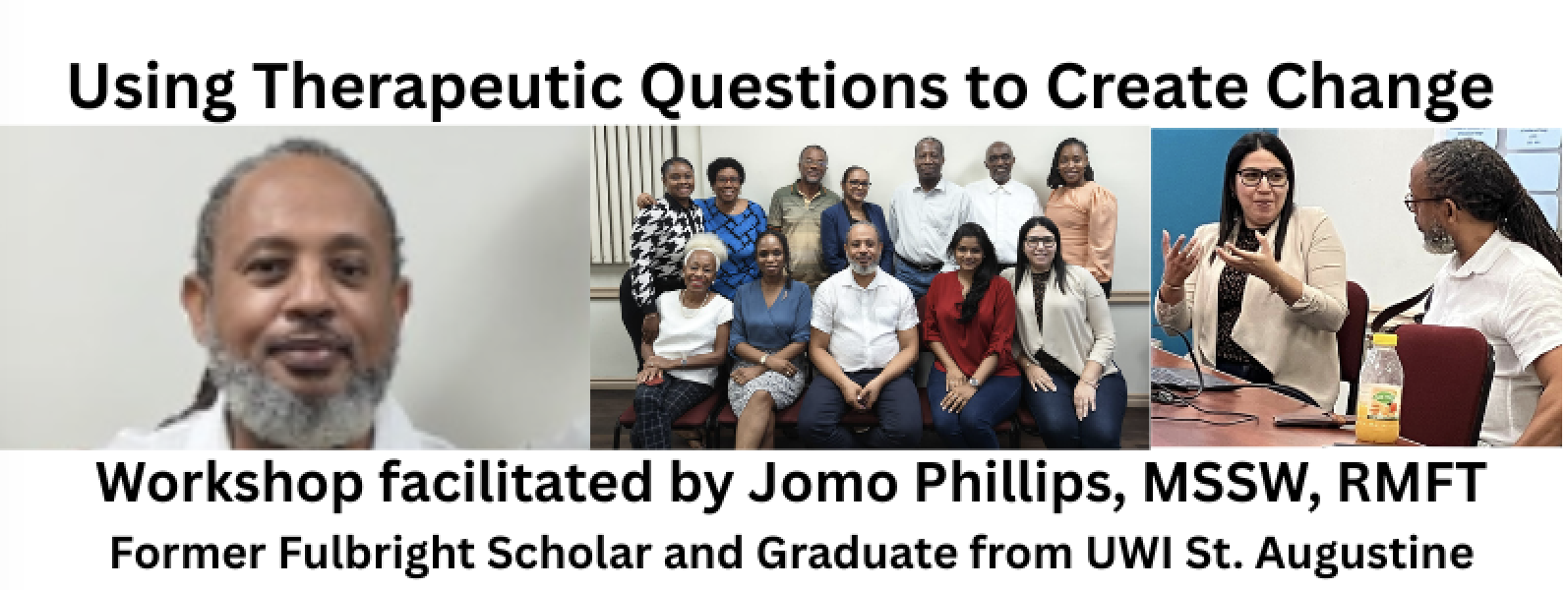
I recently experienced a nourishing and eye-opening workshop on Interventive Interviewing, led by the brilliant Jomo Phillips, MSSW, RMFT (Canada). His teaching style blended warmth and expertise, making every concept feel practical and human.

Three Central Learnings

  1. Questions as interventions
    Every question we choose is more than information gathering — it has the potential to spark insight, shift negative patterns, and foster change.
  2. Circular & reflexive questioning
    These styles broaden perspective, inviting clients to see their relationships and dynamics in new ways and tap into their strengths.
  3. Presence over force
    How we ask matters: tone, curiosity, and genuineness can transform a question into an invitation for growth.

This workshop reaffirmed for me that healing and connection often unfold in the questions we ask — and the spaces we hold when we ask them. I left inspired to integrate these practices into my work with couples, families, and individuals.

About Jomo Phillips, MSSW, RMFT.
Jomo is a Fulbright Scholar and ICEEFT-certified Emotionally Focused Therapist and Supervisor with over 25 years in systemic therapy, couples and family practice, social work, and EMDR. An Approved Supervisor with the AAMFT, he is Founder and Clinical Director of The Relational Practices Ltd., co-founder of the Caribbean EFT Community, and leads the Caribbean EFT Project. Known for his clinical skill, cultural insight, and inclusive approach, Jomo mentors across the region and creates affirming spaces for all.

Why We Shouldn’t Just Say ‘Kamla …

There has been a noticeable increase in the casual reference to the Honourable Kamla Persad-Bissessar as simply “Kamla” in both print and broadcast media. While informality may seem harmless or relatable, it becomes problematic when used by individuals who have held — or currently hold — high public office.

Titles such as “Prime Minister,” “Opposition Leader,” and “The Honourable” are not optional niceties. They acknowledge public service, constitutional responsibility, and the dignity of office. Referring to a national leader by first name alone, especially in serious political analysis, undermines the office and may suggest a lack of respect, intentional or not.

“The Honourable” is typically used in formal first references, official documents, and ceremonial contexts — for example: “The Honourable Kamla Persad-Bissessar, former Prime Minister…” Thereafter, “Prime Minister Persad-Bissessar” or “Mrs. Persad-Bissessar,” depending on context, is more appropriate.

As someone who lectured for 18 years in Business Communication at The University of the West Indies, including modules on protocol and professional presentation, I know that language shapes perception. The media’s tone sets an example, especially for younger audiences who learn how to show (or withhold) respect based on what they see and hear in public discourse.

Perhaps it is time for editors and commentators to revisit training in protocol and public communication. Maintaining consistency and professionalism in how we refer to public figures reinforces civility in our national conversation.

Words matter — and so does the tone we set for the next generation.

The Honourable Kamla Persad-Bissessar, SC, MP — Prime Minister of the Republic of Trinidad and Tobago

Marsha Walker’s Journey to Activism

In this interview, Marsha Walker, a devoted Christian, wife, mother, and homeschooling advocate, shares her journey from homeschooling her daughter with sensory processing challenges to becoming an accidental activist.

She highlights the shortcomings of the traditional education system and advocates for a more personalized, interest-driven approach to learning. Walker discusses her activism, inspired by the poor conditions in various schools she visited while promoting her children’s book, ‘If I Can You Can Too,’ which shares the stories of successful individuals who overcame hardships. She calls for less government involvement in education and healthcare, emphasizing free-market solutions and good governance as means to reduce corruption.

Walker stresses the importance of public involvement in politics and fostering a moral society to ensure a better future for the next generation.

Karen Blackman (Young Mama Bear) shares her 21-year experience as a yoga teacher

Karen Blackman, known as ‘yoga mama bear’ shares her 21-year experience as a yoga teacher.
Initially, in TV sales and promotions, she transitioned to yoga for a fulfilling life change. Despite early obstacles, including her temper and job-related stress, yoga transformed her perspective. She emphasizes the holistic nature of yoga, focusing on the Eight Limbs of Yoga, and how they helped her manage anger.
She advocates for inclusivity in yoga, ensuring everyone feels seen, regardless of their body type or background.
Karen’s mission extends to making yoga accessible with free and affordable classes, and her ongoing vision is to remain present and impactful. She distinguishes between being an instructor and a true teacher, emphasizing the importance of authenticity and commitment.

Concluding, she urges others not to let anyone kill their dreams, celebrating the 20th anniversary of her yoga community in Trinidad and Tobago.