Coaching persons to speak is one thing, actually delivering a speech is another. Thanks for the opportunity.
THE POWER OF THE PEOPLE …
 The folklore at a factory I worked for is that a former General Manager frequently dispensed doses of cod liver oil to workers and they had no choice, either drink-up or find a new job. Maybe he was onto a good thing because good health is at the core of profitability. Of course he was acting in his own best interest with the underlying assumption that a healthy work force would be productive and contribute to larger profit margins for the owners of the business.
This memory popped into my mind recently when I came across the following definition of Corporate Social Responsibility in the publication Making Good Business Sense: “Corporate Social Responsibility is the continuing commitment by business to behave ethically and contribute to economic development while improving the quality of life of the workforce and their families as well as of the local community and society at large … “
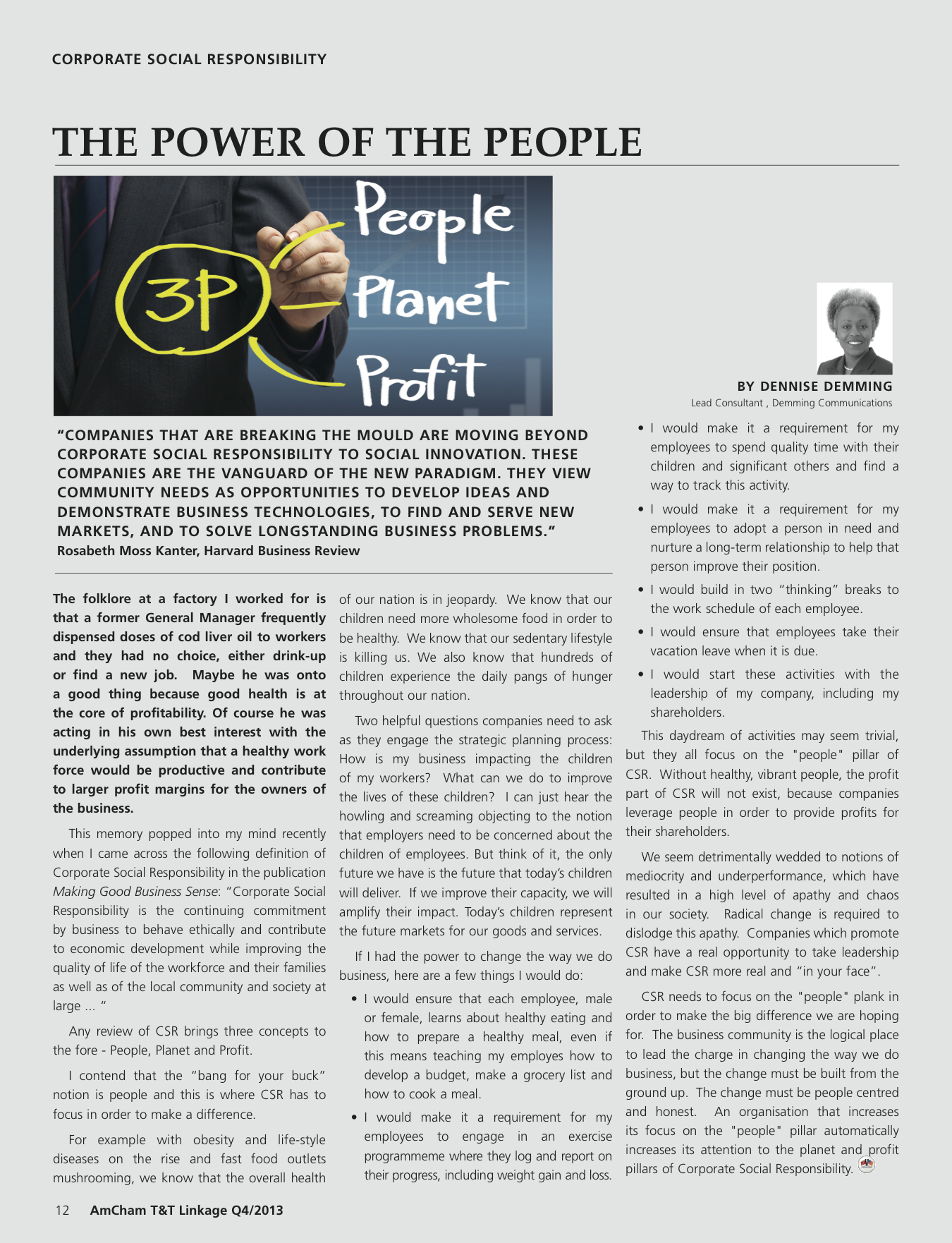
Any review of CSR brings 3 concepts to the fore – People, Planet and Profit.
I contend that the “bang for your buck” notion is people and this is where CSR has to focus in order to make a difference.
With obesity and life style diseases on the rise and fast food outlets mushrooming, we know that the overall health of our nation is in jeopardy. We know that our children need more wholesome food in order to be healthy. We know that our sedentary lifestyle is killing us. We also know that hundreds of children experience the daily pangs of hunger throughout our nation.
Two helpful questions companies need to ask as they engage the strategic planning process: How is my business impacting the children of my workers? What can we do to improve the lives of these children? I can just hear the howling and screaming objecting to the notion that employers need to be concerned about the children of employees but think of it, the only future we have is the future that today’s children will deliver. If we improve their capacity, we will amplify their impact. Today’s children represent the future markets for our goods and services.
If I had the power to change the way we do business, here are a few things I would do:
- I would ensure that each employee male and female learn about healthy eating and how to prepare a healthy meal even if this means teaching my employes how to develop a budget, make a grocery list and how to cook a meal.
- I would make it a requirement for my employees to engage in an exercise programme where they log and report on their progress including weight gain and loss.
- I would make it a requirement for my employees to spend quality time with their children and significant others and find a way to track this activity.
- I would make it a requirement for my employees to adopt a person in need and nurture a long term relationship to help that person improve their position.
- I would build in 2 “thinking” breaks to the work schedule of each employee.
- I would ensure that employees take their vacation leave when it is due.
- I would start these activities with the leadership of my company including my shareholders.
This daydream of activities may seem trivial but they all focus on the people pillar of CSR. Without healthy, vibrant people, the profit part of CSR will not exist because companies leverage people in order to provide profits for their shareholders.
We seem detrimentally wedded to notions of mediocrity and underperformance which have resulted in a high level of apathy and chaos in our society. Radical change is required to dislodge this apathy. Companies which promote CSR have a real opportunity to take leadership and make CSR more real and “in your face”.
CSR needs to focus on the people plank in order to make the big difference we are hoping for. The business community is the logical place to lead the charge in changing the way we do business but the change must be built form the ground up. The change must be people centred and honest. An organization which increases its focus on the people pillar automatically increases its attention to the planet and profit pillars of Corporate Social Responsibility.
Rosabeth Moss Kanter, Harvard Business Review provides this insight:
“Companies that are breaking the mould are moving beyond corporate social responsibility to social innovation. These companies are the vanguard of the new paradigm. They view community needs as opportunities to develop ideas and demonstrate business technologies, to find and serve new markets, and to solve longstanding business problems.”
Police Breaking the Law

2:54 pm Friday 9th May, 2014 – Drivers of 2 police vehicles have a chat on Ariapita Avenue for about 4 mins!
Police Sergeant Mystar made a passionate plea to young drivers to obey the traffic laws and drive responsibly. This plea will amount to nothing unless there are consequences for breaking the law. As I go about my daily business I see drivers break the law and sometimes in full sight of a Police Officer. What is worse Police Officers themselves break the law.
On Friday 9th May, 2014 I had to wait for 4 minutes while these 2 police vehicles stopped to have a conversation on Ariapita Avenue. I honked my horn but to no avail, the conversation in their mind warranted this behaviour.
The tension in the society continues to mount as people feel their rights are being trampled and might is right. An urgent intervention is needed to bring calm to this small town. One easy leverage point exists where Police interact with Citizens but this interaction must be based on trust and respect. I asked 10 friends if they believe the Police murdered the young man in Bagatelle. SEVEN SAID YES!
Couple this perception with the continuous violations seen on the road and we have volatile situation. Each Police Officer has to exhibit exemplary behaviour and stop breaking the law. Remember the old saying “Your actions speak so loudly, I can’t hear your words”!
http://www.guardian.co.tt/news/2014-05-06/us%E2%80%88embassy-calls-swift-justice
http://www.guardian.co.tt/news/2014-05-06/us%E2%80%88embassy-calls-swift-justice
This statement which was made by the US Embassy is interesting and worries me for what is not being said. In the context of the escalating crime in Trinidad and Tobago, I wander what is being implied. Have we lost a champion in Dana or a champion in the Embassy? Either way … we need to keep our eye on the ball!
Etienne Charles at TEDxPortofSpain
My gem from this talk is Etienne’s plea … “Commit yourself to supporting the arts in your community and ensure that young people are involved on all front” …
A Man of Dignity – The Late Audley L. Walker
 I met the late Audley Lawson Walker in 1989 when I joined the West Indian Tobacco Company Ltd.
For the next 10 years of my life he was a larger than life influence.
I am a better person for having been tutored by him. I learned strategy and tactics about the art of war as he guided our responses to the anti-tobacco lobby. I learned how to love selflessly as he guided my interactions with the members of Despers and I learned respect as we shaped the work of the Witco Sports Foundation.
Audley, though not a Trinidadian by birth felt deeply for this country and served in many different capacities. He served selflessly on the Trinidad and Tobago Chamber of Commerce and CAIC.
If there is a legacy to his living it would be one of respect for all. Oh! How I miss his dignity when I look around at current captains of industry. Men of his calibre seem to be disappearing. Hopefully his passing will provide a moment for reflection on the importance of values like dignity and respect.
On my mind …
The challenge of leadership is to be strong, but not rude; be kind, but not weak; be bold, but not bully; be thoughtful, but not lazy; be humble, but not timid; be proud, but not arrogant; have humor, but without folly. —Jim Rohn, American Entrepreneur.
Is the shade of black a deal breaker?
Raffique Shah’s article “Judge Not by Colour” comments on the race issue which many of us choose not to acknowledge but which is important to our development.
Why fathers should be present at birth
A deep dive into a little discussed area. It occurred to me that this idea could have a significant impact on our crime problem. In the same way that the court summons men to pay child maintenance, we could summon fathers to be present at the birth of their children even if in handcuffs.
 Dennise Demming