Another While Running conversation. #whilerunning @ruthosman
Urgent attention is needed for digitalization in our country …
Richard Ragoobarsingh. Navigating Law and the Arts
In this episode, Trinidadian actor, director, and lawyer Richard Ragoobarsingh takes us through his remarkable journey of balancing two distinct yet equally demanding careers.
With over 40 years in theater, he reflects on his deep love for literature and the performing arts, the challenges faced by creatives in Trinidad and Tobago, and the resilience required to sustain a life in both law and the arts. Richard highlights the power of passion, the need for greater support for the arts, and his hopes for a future where creativity is valued as much as any profession.
His story is a testament to the idea that with dedication and vision, it is possible to thrive in multiple worlds.
Let the people decide on PM, not the party!
Trinidad and Tobago operates under a first-past-the-post electoral system, where the political party winning the majority of parliamentary seats forms the government. How can a new government be formed without holding a General Election? Is this a breach of our constitution? Why have we not seen any challenges by our constitutional lawyers?
Historically every government has been formed after eletions when the leader of the victorious party is appointed Prime Minister he then selets the Attorney General. After 62 years of independence a PNM leader has moved away from that system and is changing the government without an election.
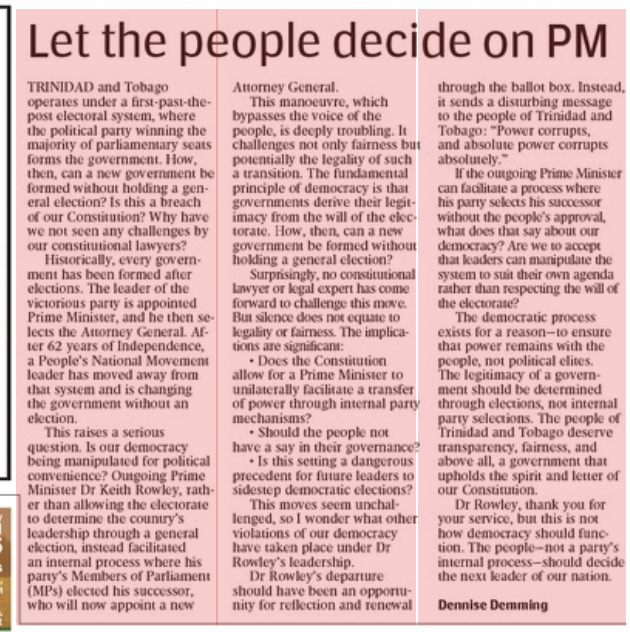
This raises the serious question of whether our democracy is being manipulated for political convenience. Prime Minister Dr. Keith Rowley, rather than allowing the electorate to determine the country’s leadership through a General Election, instead facilitated an internal process where his party’s Members of Parliament (MPs) elected his successor who will now appoint a new Attorney General.
This maneuver, which bypasses the voice of the people, is deeply troubling. It challenges not only fairness but potentially the legality of such a transition. The fundamental principle of democracy is that governments derive their legitimacy from the will of the electorate. How can a new government be formed without holding a General Election?
Surprisingly, no constitutional lawyer or legal expert has come forward to challenge this move. But silence does not equate to legality or fairness. The implications are significant:
- Does the Constitution allow for a Prime Minister to unilaterally facilitate a transfer of power through internal party mechanisms?
- Should the people not have a say in their governance?
- Is this setting a dangerous precedent for future leaders to sidestep democratic elections?
If this move stands unchallenged, what other violations of our democracy have taken place under Dr. Rowley’s leadership?
Dr. Rowley’s departure should have been an opportunity for reflection and renewal through the ballot box. Instead, it sends a disturbing message to the people of Trinidad and Tobago:
“Power corrupts, and absolute power corrupts absolutely.”
If the outgoing Prime Minister can facilitate a process where his party selects his successor without the people’s approval, what does that say about our democracy? Are we to accept that leaders can manipulate the system to suit their own agenda rather than respecting the will of the electorate?
The democratic process exists for a reason—to ensure that power remains with the people, not political elites. The legitimacy of a government should be determined through elections, not internal party selections. The people of Trinidad and Tobago deserve transparency, fairness, and above all, a government that upholds the spirit and letter of our Constitution.
Dr. Rowley, thank you for your service, but this is not how democracy should function. The people—not a party’s internal process—should decide the next leader of our nation.

David Boothman chats with Dennise Demming
David Boothman: The Artistic Journey and Societal Reflections
Join us as we dive into the mind of David Boothman, a reflective and philosophical artist. In this episode, David discusses his understanding of what it means to be an artist, exploring the dichotomy between human nature’s ‘angelic’ and ‘brute’ aspects and how these manifest in our societal behaviors. He critiques the impact of Western capitalism on culture and art, emphasizes the importance of the seven liberal arts, and underscores the need for decolonization and a cultural renaissance, particularly in the Caribbean. David also reflects on the implications of today’s media and industry on young artists and the preservation of artistic integrity. An insightful dialogue that merges art, science, spirituality, and history.
Rhythm and Tech: The Rodney Harris Story
Unlocking the Secrets of Success: Proven Strategies and Expert Insights
Join us in this engaging episode with Rodney Harris. We discuss the keys to success with expert tips, practical strategies, and inspiring stories. Discover his thoughts on how to overcome challenges and set and achieve goals.
Whether you’re looking to boost your career, personal growth, or entrepreneurial ventures, this episode provides actionable advice and profound insights to help young people on their journey to success.
Dr Rowley leaves disappointing legacy, despite “attempts to rewrite history”
A Journey through Music and Photography with Fitzgerald Gary Cardinez Afroman
In this revealing episode, we delve into the life and career of Gary Cardinaz, a seasoned photojournalist and former DJ with deep roots in music and photography.
Gary shares his journey from the 1970s, his passion for documenting cultural moments, and his commitment to preserving Trinidad and Tobago’s rich cultural heritage through his extensive photo collection. He discusses the challenges of organizing and managing such a vast repository, as well as the importance of proper management, passion, and providing platforms for young artists.
Join us as Gary offers insights and solutions to bolster the cultural industry, emphasizing the need for better archiving, youth opportunities, and collaborative efforts among stakeholders.
Sonya Dumas: Celebrating Caribbean Heritage Through Multidimensional Art
Join us in this insightful episode where multi-dimensional artist Sonya Dumas, who thrives in the realms of dance and film, shares her journey and passion for exploring Caribbean cultural identity. From her beginnings in dance inspired by calypso music to her establishment of a children’s museum focused on Caribbean culture, Sonya delves into the unique nuances of Caribbean dance, cultural expression, and the sense of community. She also addresses the challenges facing the cultural and creative industries and provides practical advice for budding Caribbean creatives. This episode offers a deep dive into the rich tapestry of Caribbean culture through Sonya’s experiences and expertise.
Public figures must expect scrutiny, welcome debate
Our country continues to fail in terms of accountability, and citizens are continuously discouraged from expressing their views on any matter. Those who comment are often accused of being politically motivated.
In any democratic society, media freedom and public discourse are essential pillars of accountability. The recent statement by Prime Minister Dr. Keith Rowley, in which he dismissed criticisms from Mr. Paul as “talking foolishness” and implied that a $2.5 million payment could have influenced Paul’s stance, raises serious concerns about the government’s relationship with the media and critics. Mr. Anthony Paul has over 40 years of experience as an energy, policy, and strategy advisor and has worked with the government under every Political party.
Dismissing criticism outright, rather than engaging with the substance of concerns, sets a troubling precedent. Public figures must expect scrutiny and welcome debate to signify a healthy democracy. When political leaders resort to attacking critics personally instead of addressing their claims, it can create a culture of fear and discourage individuals from speaking out against government actions, while simultaneously increasing distrust of the government. Without regular, quality investigative journalism, the role of the media as a watchdog for the people is significantly undermined. This, in turn, weakens transparency, which is important because the government must at all times remember that they are employed by the citizenry, and must answer to them for all actions taken on behalf of the country, just as in any employer-employee relationship.
The Prime Minister’s remark also suggests that financial incentives may influence public opinion. Here is a quote: “Let me tell you something, if we had paid Mr. Paul the $2.5 million he had requested for a little job that we had asked him to do way up in the early part of the last administration which I led, he might not have been on television now talking foolishness and trying to cast aspersions on the people who are doing decent, effective work on behalf of the people of Trinidad and Tobago. And I take a serious umbrage at people like that, with their personal grouse, going on television and misrepresenting the facts of the governance of this country because you wouldn’t know when he’s talking there, that he was in fact very early in our tenure in the last government, one of the geologists who could have done something for this country but his price was too high…”
This raises ethical concerns about the relationship between financial dealings and political discourse. Should contractors or professionals fear that their work—or lack of government funding—could dictate whether they have a right to criticize public officials?
Further, the reference to a “little job” costing $2.5 million raises questions about transparency in government contracts. How was this amount determined? Why was the payment not made? Was the decision based on merit, financial constraints, or political considerations? The public deserves clear answers to ensure that procurement processes are fair and that public funds are managed responsibly.
Politically, the Prime Minister’s statement may have mixed effects. His supporters may view it as a strong defense against baseless criticism, while his detractors may see it as an inappropriate response that exposes deeper governance issues. Regardless of perspective, such statements contribute to a growing perception that political discourse in Trinidad and Tobago is becoming more combative rather than constructive.
A government committed to transparency should address criticisms with facts, not insults. If leaders want to foster a culture of respect and accountability, they must rise above personal attacks and instead welcome scrutiny as an essential part of governance. The Prime Minister’s words have sparked a conversation, and how he chooses to respond going forward will determine whether this moment is one of division or an opportunity for greater openness.

3–4 minutes
 Dennise Demming