Watch Your Words, Mr Prime Minister

John Acton’s (1834-1902) famous quote, Power tends to corrupt, and absolute power corrupts absolutely,” serves as a stark reminder of the risks of unchecked authority.

In Trinidad and Tobago, Prime Minister Dr. Keith Rowley has drawn growing criticism for his increasingly harsh and at times, derogatory language—a significant shift from the more respectful tone he maintained as Leader of the Opposition from 2010 to 2015. His rhetoric as Prime Minister raises important questions about the role of language in leadership.

During his tenure as Leader of the Opposition, Dr. Rowley’s public comments were mostly respectful, allowing for civil discourse. However, since becoming Prime Minister, his language has at times taken a more troubling turn. In one notable exchange with businessman Inshan Ishmael, Dr. Rowley responded to criticism by saying, “kiss my ar**” and, “You GO TO HELL!!!” Many citizens, who expect dignity from their leaders, expressed disappointment, noting the lack of courtesy expected from a national figure.
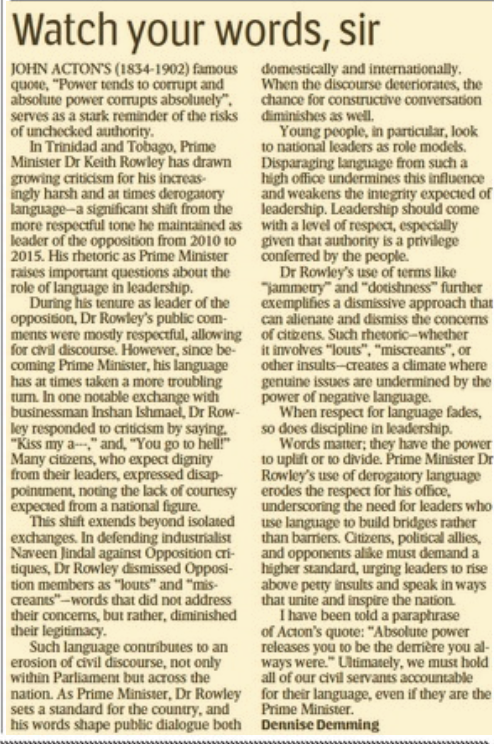
This shift extends beyond isolated exchanges. In defending industrialist Navin Jindal against opposition critiques, Dr. Rowley dismissed opposition members as “louts” and “miscreants”—words that did not address their concerns but rather diminished their legitimacy. Such language contributes to an erosion of civil discourse, not only within Parliament but across the nation. As Prime Minister, Dr. Rowley sets a standard for the country, and his words shape public dialogue both domestically and internationally. When the discourse deteriorates, the chance for constructive conversation diminishes as well.

Young people, in particular, look to national leaders as role models. Disparaging language from such a high office undermines this influence and weakens the integrity expected of leadership. Leadership should come with a level of respect, especially given that authority is a privilege conferred by the people.

Dr. Rowley’s use of terms like “jammetry” and “dotishness” further exemplifies a dismissive approach that can alienate and dismiss the concerns of citizens. Such rhetoric—whether it involves “louts,” “miscreants,” or other insults—creates a climate where genuine issues are undermined by the power of negative language.

When respect for language fades, so does discipline in leadership. Words matter; they have the power to uplift or to divide. Prime Minister Dr. Rowley’s use of derogatory language erodes the respect for his office, underscoring the need for leaders who use language to build bridges rather than barriers. Citizens, political allies, and opponents alike must demand a higher standard, urging leaders to rise above petty insults and speak in ways that unite and inspire the nation.

I have been told a paraphrase of Acton’s quote: “Absolute power releases you to be the derrière you always were.” Ultimately, we must hold all of our civil servants accountable for their language, even if they are the Prime Minister.

Vote based on shared principles

VOTING has evolved into a commercial enterprise within our twin-island republic. Over the past six decades, it has shifted from a genuine act of civic engagement to a mere transactional activity.

My mother-in-law (the late Hannah Demming) and her contemporaries lobbied for universal adult suffrage and for women to be given the right to vote. They understood the true significance of participating in the democratic process. They were also proud champions of women’s rights.

Sadly, our society has transformed and, in today’s world, there are people who promote political parties because they are being paid; some for cash and a T-shirt, while others expect to get a house, or a contract, or a job. Our two race-based political parties are allegedly guilty of purchasing votes.

In 2010, the coalition of the People’s Partnership, made up of five political parties-the United National Congress, the Congress of the People, the Tobago Organisation of the People, the Movement for Social Justice and the National Joint Action Committee-won the general election.

An Express article of July 7, 2015, reported a statement by then-opposition leader Dr Keith Rowley that ‘government ministers are handing out hundreds of thousands of dollars in cash to buy votes in the upcoming general election’.

Another disconcerting example of voter purchasing was highlighted in a television interview featuring a woman who openly admitted to attending a protest solely for financial gain.

In these instances, individuals were paid to lend their presence to political events, neither with genuine commitment to the party they support nor an understanding of the value systems to which they ascribe. The disconcerting truth is that our leaders and their close-support circle begin their journey with corruption and expect that when they get into office, they will somehow transform these supporters.

These payments from political parties extend beyond mere cash transactions. The phrase ‘who has more food feeds more fowl’ sadly captures the prevailing sentiment in our society, reflecting a transactional approach to civic engagement.

The deeply disheartening issue is that we do not understand this is an artificially created situation engineered over decades to benefit a few people, among whom are members of the government and opposition alike.

We have been artificially kept in a state of lack for decades. We should have been the most developed Caribbean country, but our income has frequently been diverted to places unknown.

Critical infrastructure has been ignored; major water lines, healthcare services, education systems, even traffic control have not been adequately maintained, even though we made billions of dollars of foreign currency reserves. Because this has happened, politicians now have a condition where they can buy votes to stay in power while delivering nearly nothing to their employers (the general public).

The true impact of voter buying is that it has diminished the fundamental democratic right for citizens to express their civic duty.

As a society, we stand at a crossroads, with an opportunity to redefine our values and practices. Initiating this change at the political level is where we need to begin. We must encourage citizens to vote for a party based on shared principles, rather than inducements. This shift in perspective can pave the way for more genuine and principled democratic participation, restoring the true spirit of voting as a powerful tool for civic expression.

We owe it to ourselves and our children to shift voting from a transactional activity to a genuine act of civic engagement. It is time to take back the power we surrendered (our votes) so that we can, for ourselves, decide how our country should grow.