Security Needs Answers, Not Drama

National security is being reduced to political drama.  Many of us followed the recent parliamentary debate on the proposed United States–linked radar installation in Tobago, simply hoping for a clearer explanation. What exactly is being built? Why Tobago? And how will this affect us? Unfortunately, those basic questions were never properly answered, leaving many citizens more uncertain than informed.

It has been widely stated that Trinidad and Tobago has, for many years, participated in Caribbean and hemispheric security cooperation under different governments. It is also worth asking whether our country already operates coastal surveillance radar systems in both Trinidad and Tobago as part of wider regional information-sharing arrangements aimed at tracking illegal drugs, weapons, and human trafficking. Similar systems reportedly exist across the Caribbean and are supported through long-standing regional agreements and partnerships with international allies.

This broader context was missing from the parliamentary debate. Instead of helping citizens understand how this installation fits into existing arrangements, the discussion focused narrowly on secrecy.

What many citizens really want answered are practical questions. Who will control the data collected in Tobago? Will local agencies have full access? Which authority will provide oversight and ensure compliance with our laws? And do we actually have the boats, trained personnel, and resources to act when threats are detected?

These questions go to the heart of sovereignty and public trust. Citizens of Trinidad and Tobago deserve calm explanation, honest engagement, and clear accountability. National security is too important to be reduced to political drama.

Unveiling Giselle Singh: Innovator, Scientist, and Musician


Giselle Singh introduces herself as an inventive creator and empath, drawing inspiration from the divine. She discusses her multifaceted identity as a scientist, innovator, and musician, emphasizing her contributions to soul music. She shares her focus on genuine storytelling and cultivating meaningful relationships.

Giselle advocates for a living wage for artists in Trinidad and encourages aspiring creatives to follow their dreams. She reflects on the importance of creative freedom, effective listening, and the transformative power of imagination from a young age.

Protecting Our Waters: An Interview with Judith Gobin

Gobin calls for addressing environmental issues at their source, particularly in reducing plastic waste. She also discusses the importance of balancing career and family, emphasizing the need for support networks for working women.

Richard Ragoobarsingh. Navigating Law and the Arts

In this episode, Trinidadian actor, director, and lawyer Richard Ragoobarsingh takes us through his remarkable journey of balancing two distinct yet equally demanding careers.

With over 40 years in theater, he reflects on his deep love for literature and the performing arts, the challenges faced by creatives in Trinidad and Tobago, and the resilience required to sustain a life in both law and the arts. Richard highlights the power of passion, the need for greater support for the arts, and his hopes for a future where creativity is valued as much as any profession.

His story is a testament to the idea that with dedication and vision, it is possible to thrive in multiple worlds.

Minister Sinanan … How many more must die?

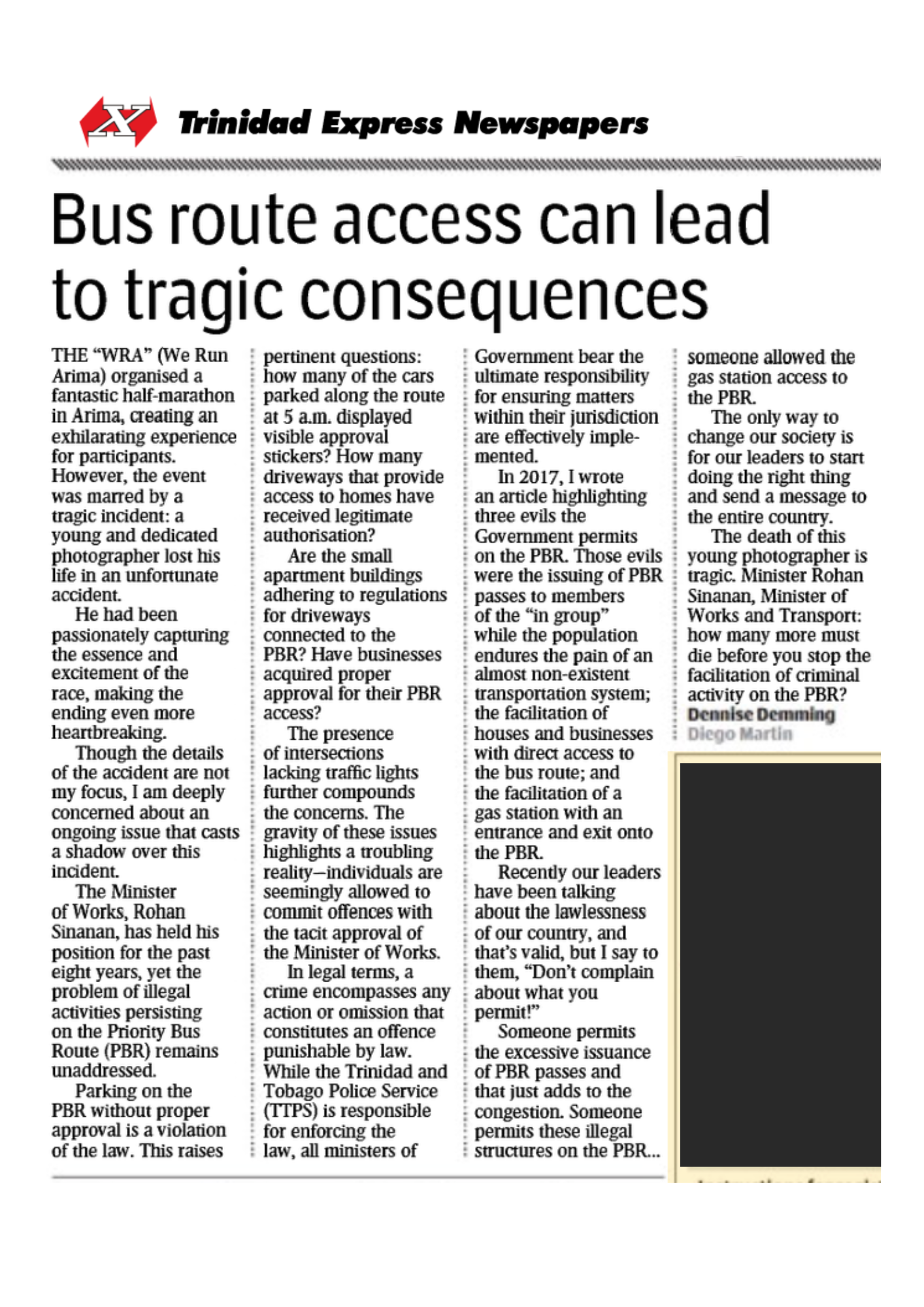
The “WRA” (We Run Arima) organized a fantastic half-marathon in Arima, creating an exhilarating experience for participants. However, the event was marred by a tragic incident: a young and dedicated photographer lost his life in an unfortunate accident. He had been passionately capturing the essence and excitement of the race, making the ending even more heartbreaking.

Though the details of the accident are not my focus, I am deeply concerned about an ongoing issue that casts a shadow over this incident. The Minister of Works, Rohan Sinanan, has held his position for the past eight years, yet the problem of illegal activities persisting on the priority bus route remains unaddressed.

Parking on the Priority Bus Route (PBR) without proper approval is a violation of the law. This raises pertinent questions: How many of the cars parked along the route at 5:00 am displayed visible approval stickers? How many driveways that provide access to homes have received legitimate authorization? Are the small apartment buildings adhering to regulations for driveways connected to the PBR? Have businesses acquired proper approval for their PBR access?

The presence of intersections lacking traffic lights further compounds the concerns. The gravity of these issues highlights a troubling reality – individuals are seemingly allowed to commit offences with the tacit approval of the Minister of Works. In legal terms, a crime encompasses any action or omission that constitutes an offence punishable by law. While the Trinidad and Tobago Police Service (TTPS) is responsible for enforcing the law, all ministers of Government bear the ultimate responsibility for ensuring that matters within their jurisdiction are effectively implemented.

In 2017, I wrote an article highlighting 3 evils that the Government of Trinidad and Tobago permits on the PBR.  Those evils were the issuing of PBR passes to members of the “in-group” while the population endures the pain of an almost non-existent transportation system; the facilitation of houses and businesses with direct access to the bus route and the facilitation of a gas station with an entrance and exit onto the PBR.  

Recently our leaders have been talking about the lawlessness of our country, and that’s valid, but I say to them, “Don’t complain about what you permit!”  Someone permits the excessive issuance of PBR passes and that just adds to the congestion. Someone permits these illegal structures on the PBR … someone allowed the gas station access to the PBR.

The only way to change our society is for our leaders to start doing the right thing and send a message to the entire country.  The death of this young photographer is tragic.  Minister Rohan Sinanan, Minister of Works and Transport: How many more must die before you stop the facilitation of criminal activity on the PBR?

Thanks “Auntie Tantie”

Goodbye, Auntie Tantie.  May our country continue to benefit from your wisdom and fervour. As you depart, I wonder what has changed during your service as the first female President of the Republic of Trinidad and Tobago. 

Early in your tenure, I was inspired by your visit to Sea Lots on that Friday evening. Then you embraced Auntie Tantie as a “badge of honour” and had the Tantie courage to pelt bouf at our parliamentarians whenever you had the opportunity.

Throughout your term in office, you have shown empathy for our people, and I recall being stunned by your statement, “People are hurting, and they feel parliamentarians are not listening.” 

‘If you are seen to treat each other with respect, courtesy, and good humour, there can be a trickle-down effect and eventual cascade. But when acrimony, contempt, and divisiveness is the example you set, you cannot be surprised when those attitudes and behaviours are replicated on the nation’s roads, in our schools and homes, and on social media.

You continued in that address and said to the Parliamentarians:

Unfortunately, it seems that your messages have fallen on the ears of 41 tone-deaf Parliamentarians who are focused on how they can benefit personally yet have zero empathy for the daily pain citizens are experiencing.

You are leaving office and the country continues to be in deep crisis as captured by your statement: “I fear we have become a savage people. Lines drawn between ethnicities, political affiliations, the haves, and the have-nots, worker, and employer, citizens and migrants have solidified into intolerance, impatience, unkindness, vitriol, and in many cases, downright nastiness…”

In that single statement, you have captured the key issues which our politicians should be addressing. 

As the population awaits the selection of your successor, I am hopeful that the new President will be able to use his/her office and weekly meetings to encourage the Prime Minister to focus on the need to redesign our antiquated and mal-functioning systems and processes.

Although your departure provides another opportunity for a new beginning, I would prefer that your successor takes your lead, and carries forward the message that politicians should allow the plight of people to be the impetus for policy change.  

Auntie Tantie … Thanks for your service and may your universe unfold exactly as you wish.

My April 7th, 2019 letter to P.M. Rowley

This is one of the letters which I have written to
Prime Minister Rowley over the past 5 years.

Dear Dr. Rowley

Congratulations on your 43rd month as Prime Minister of the Republic of Trinidad and Tobago.

I commend the recent attempt by the Airports Authority to introduce ATM payments for parking at the Airport despite the initial problems.  May I suggest the aggressive implementation of online payments for all government business.  It is sad that I can purchase an item in China using a digital device while having coffee in my home but I cannot conduct any government business in the same manner.

Yours in the interest of development.

Dennise Demming (Mrs.)
MBA, BSc., Cert-Mass Communications
Citizen 

Mr. Mayor – praise in public, criticize in private …

When a mayor resorts to angrily scolding a roomful of more than 80 adults (all of whom can vote), it tells me that he has forgotten the road travelled to the office he holds. It tells me that he should not be the mayor of anything; he should really return to the ‘block’ from whence he came.

Photo: San Fernando Mayor Junia Regrello (via newsday.co.tt)

There is a long-standing human relations principle, which is also practised in bringing up children: praise in public, criticize in private. San Fernando Mayor Junia Regrello’s recent outburst indicates the extent to which the party he represents disregards the people they should be serving and feel empowered to not think twice about verbally abusing us.

There was a time when the standard practice was that the organisers and the mayor’s office would have met and worked out the details prior to the function, therefore ensuring seamless execution. If the master of ceremonies made a faux pas, a quiet word would have been sufficient. If there was chatter from the audience while the mayor was speaking, a simple pause could have been enough to quiet the audience. But maybe the mayor was so boring that the crowd was totally disengaged. Maybe he lacks credibility to such an extent that the audience felt no compulsion to even listen to what he had to say.

Such verbal expression of anger is aggressive, violent, abusive and lacks the grace and dignity we expect from the holders of high office. I am not surprised because Mayor Regrello represents a party that perpetuates such hatred toward the population that the leader had no difficulty likening women to golf courses that needed to be groomed; the minister of finance had no difficulty jeering at the population when he boasted that there was no riot despite frequent increases in the price of gasoline; the attorney general suggested that a victim of sexual harassment said: “ah want money.” I can go on ad nauseam with the examples of abuse being perpetrated upon the very people who continue to vote them into office.

The mayor should have heeded his own advice that ‘the children are looking on’ and found the grace and dignity to de-escalate the situation so that what happened would have been publicly unnoticed, but privately dealt with. Instead, he chose to mar the celebration of the accreditation of a laboratory.

I long for the day when officials exercise their duties so that we all feel inspired and hold our heads proudly because they are representing us well. For now, many of us sit and cringe as mediocrity, bacchanal and disquiet prevail at all levels of our society. I keep asking, when did we get to this level of incompetence? But I live in hope that a new normal will be established based on mutual respect, grace and dignity.