Security Needs Answers, Not Drama

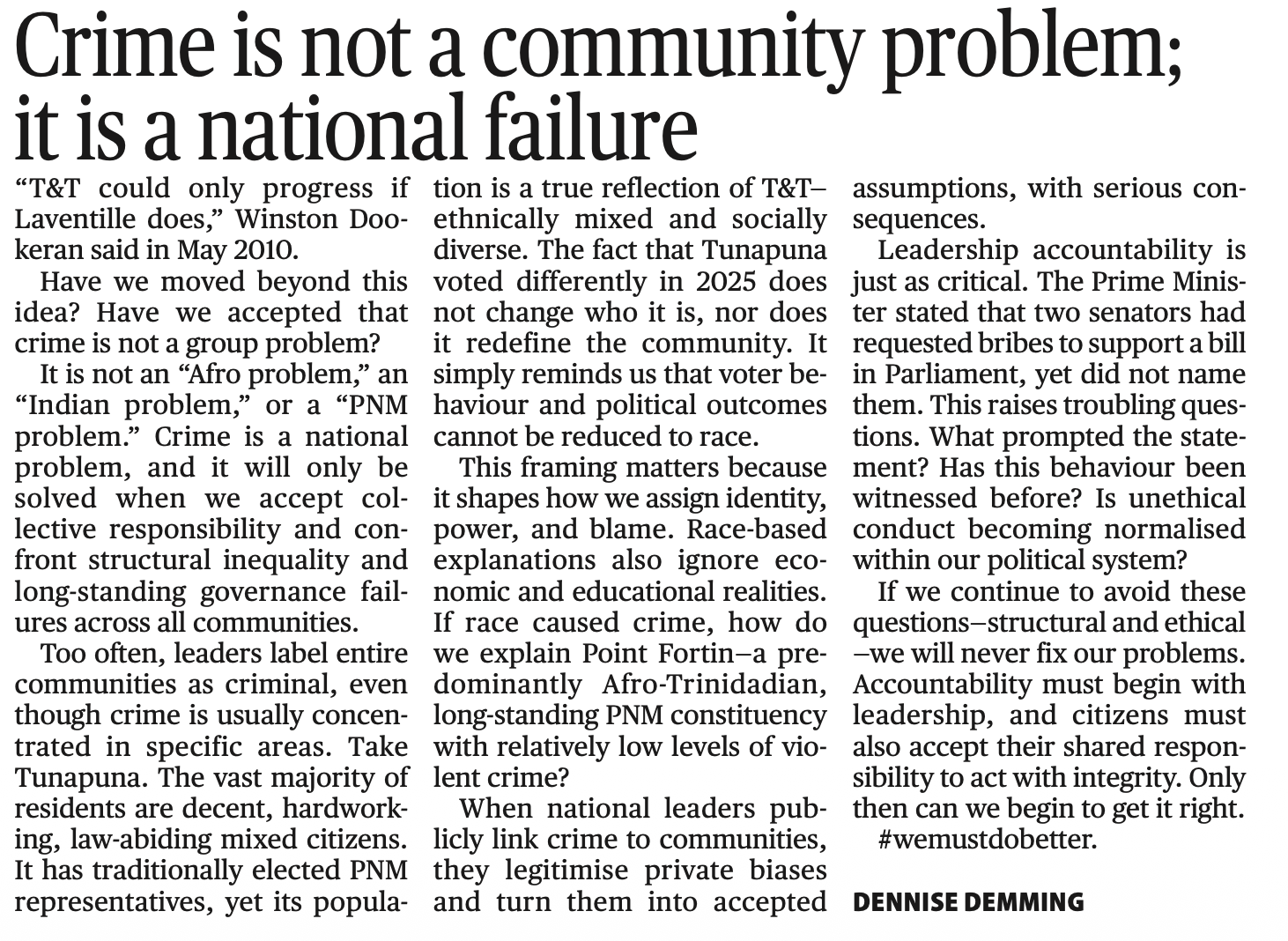
National security is being reduced to political drama.  Many of us followed the recent parliamentary debate on the proposed United States–linked radar installation in Tobago, simply hoping for a clearer explanation. What exactly is being built? Why Tobago? And how will this affect us? Unfortunately, those basic questions were never properly answered, leaving many citizens more uncertain than informed.

It has been widely stated that Trinidad and Tobago has, for many years, participated in Caribbean and hemispheric security cooperation under different governments. It is also worth asking whether our country already operates coastal surveillance radar systems in both Trinidad and Tobago as part of wider regional information-sharing arrangements aimed at tracking illegal drugs, weapons, and human trafficking. Similar systems reportedly exist across the Caribbean and are supported through long-standing regional agreements and partnerships with international allies.

This broader context was missing from the parliamentary debate. Instead of helping citizens understand how this installation fits into existing arrangements, the discussion focused narrowly on secrecy.

What many citizens really want answered are practical questions. Who will control the data collected in Tobago? Will local agencies have full access? Which authority will provide oversight and ensure compliance with our laws? And do we actually have the boats, trained personnel, and resources to act when threats are detected?

These questions go to the heart of sovereignty and public trust. Citizens of Trinidad and Tobago deserve calm explanation, honest engagement, and clear accountability. National security is too important to be reduced to political drama.

Unveiling Giselle Singh: Innovator, Scientist, and Musician


Giselle Singh introduces herself as an inventive creator and empath, drawing inspiration from the divine. She discusses her multifaceted identity as a scientist, innovator, and musician, emphasizing her contributions to soul music. She shares her focus on genuine storytelling and cultivating meaningful relationships.

Giselle advocates for a living wage for artists in Trinidad and encourages aspiring creatives to follow their dreams. She reflects on the importance of creative freedom, effective listening, and the transformative power of imagination from a young age.

Richard Ragoobarsingh. Navigating Law and the Arts

In this episode, Trinidadian actor, director, and lawyer Richard Ragoobarsingh takes us through his remarkable journey of balancing two distinct yet equally demanding careers.

With over 40 years in theater, he reflects on his deep love for literature and the performing arts, the challenges faced by creatives in Trinidad and Tobago, and the resilience required to sustain a life in both law and the arts. Richard highlights the power of passion, the need for greater support for the arts, and his hopes for a future where creativity is valued as much as any profession.

His story is a testament to the idea that with dedication and vision, it is possible to thrive in multiple worlds.

Minister Sinanan … How many more must die?

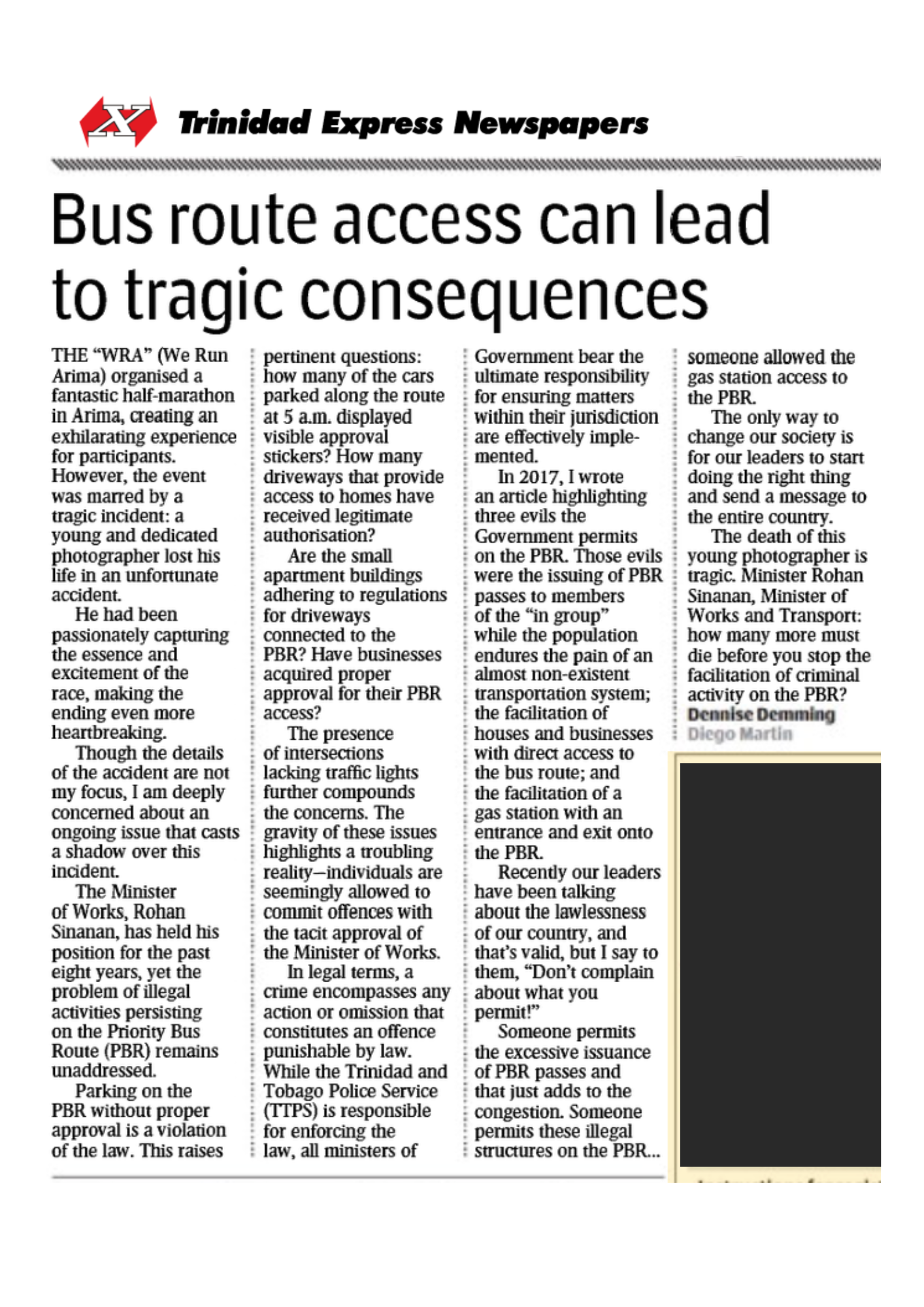
The “WRA” (We Run Arima) organized a fantastic half-marathon in Arima, creating an exhilarating experience for participants. However, the event was marred by a tragic incident: a young and dedicated photographer lost his life in an unfortunate accident. He had been passionately capturing the essence and excitement of the race, making the ending even more heartbreaking.

Though the details of the accident are not my focus, I am deeply concerned about an ongoing issue that casts a shadow over this incident. The Minister of Works, Rohan Sinanan, has held his position for the past eight years, yet the problem of illegal activities persisting on the priority bus route remains unaddressed.

Parking on the Priority Bus Route (PBR) without proper approval is a violation of the law. This raises pertinent questions: How many of the cars parked along the route at 5:00 am displayed visible approval stickers? How many driveways that provide access to homes have received legitimate authorization? Are the small apartment buildings adhering to regulations for driveways connected to the PBR? Have businesses acquired proper approval for their PBR access?

The presence of intersections lacking traffic lights further compounds the concerns. The gravity of these issues highlights a troubling reality – individuals are seemingly allowed to commit offences with the tacit approval of the Minister of Works. In legal terms, a crime encompasses any action or omission that constitutes an offence punishable by law. While the Trinidad and Tobago Police Service (TTPS) is responsible for enforcing the law, all ministers of Government bear the ultimate responsibility for ensuring that matters within their jurisdiction are effectively implemented.

In 2017, I wrote an article highlighting 3 evils that the Government of Trinidad and Tobago permits on the PBR.  Those evils were the issuing of PBR passes to members of the “in-group” while the population endures the pain of an almost non-existent transportation system; the facilitation of houses and businesses with direct access to the bus route and the facilitation of a gas station with an entrance and exit onto the PBR.  

Recently our leaders have been talking about the lawlessness of our country, and that’s valid, but I say to them, “Don’t complain about what you permit!”  Someone permits the excessive issuance of PBR passes and that just adds to the congestion. Someone permits these illegal structures on the PBR … someone allowed the gas station access to the PBR.

The only way to change our society is for our leaders to start doing the right thing and send a message to the entire country.  The death of this young photographer is tragic.  Minister Rohan Sinanan, Minister of Works and Transport: How many more must die before you stop the facilitation of criminal activity on the PBR?

Thanks “Auntie Tantie”

Goodbye, Auntie Tantie.  May our country continue to benefit from your wisdom and fervour. As you depart, I wonder what has changed during your service as the first female President of the Republic of Trinidad and Tobago. 

Early in your tenure, I was inspired by your visit to Sea Lots on that Friday evening. Then you embraced Auntie Tantie as a “badge of honour” and had the Tantie courage to pelt bouf at our parliamentarians whenever you had the opportunity.

Throughout your term in office, you have shown empathy for our people, and I recall being stunned by your statement, “People are hurting, and they feel parliamentarians are not listening.” 

‘If you are seen to treat each other with respect, courtesy, and good humour, there can be a trickle-down effect and eventual cascade. But when acrimony, contempt, and divisiveness is the example you set, you cannot be surprised when those attitudes and behaviours are replicated on the nation’s roads, in our schools and homes, and on social media.

You continued in that address and said to the Parliamentarians:

Unfortunately, it seems that your messages have fallen on the ears of 41 tone-deaf Parliamentarians who are focused on how they can benefit personally yet have zero empathy for the daily pain citizens are experiencing.

You are leaving office and the country continues to be in deep crisis as captured by your statement: “I fear we have become a savage people. Lines drawn between ethnicities, political affiliations, the haves, and the have-nots, worker, and employer, citizens and migrants have solidified into intolerance, impatience, unkindness, vitriol, and in many cases, downright nastiness…”

In that single statement, you have captured the key issues which our politicians should be addressing. 

As the population awaits the selection of your successor, I am hopeful that the new President will be able to use his/her office and weekly meetings to encourage the Prime Minister to focus on the need to redesign our antiquated and mal-functioning systems and processes.

Although your departure provides another opportunity for a new beginning, I would prefer that your successor takes your lead, and carries forward the message that politicians should allow the plight of people to be the impetus for policy change.  

Auntie Tantie … Thanks for your service and may your universe unfold exactly as you wish.

Enlightened Leadership is needed!

Amcham and Cipriani Labour College recently demonstrated what enlightened leadership can look like when they hosted a conversation about the closure of the Petrotrin refinery. The numbers presented at that session painted a grim picture and a persuasive argument for the closure of the Petrotrin refinery. That information is not new – we knew that the Pointe a Pierre Refinery was a disaster since Texaco left but successive governments chose to operate a failed model and keep up the lie that TnT was a key energy player while they presided over this make-believe scenario that a small country of 1.3 million people was big in the petroleum dance. We did have a “moment of glory” in the natural gas sector. From the presentation of the Chairman of the Board, it is clear to me that their decision making has gone beyond the closure of the refinery. I am sure that the Prime Minister is waiting for the right timing to announce the new arrangements.

Closing the Petrotrin Refinery is not simply a matter of dividing up two billion dollars by 2,800 and “calling that George”. This decision will haunt us for a long time and deepen the groove of “learnt helplessness” further into our collective psyche.

I marvel at the absence of any sociocultural analyses of the potential impact of this closure. I expected that the closure of Caroni would be used as a case study to not repeat any mistakes. So I expected some analysis of its impact on fence-line communities; to be directed to a report showing how the land use has impacted the communities; to be advised how the absence of Caroni has impacted small business, maxi drivers, schools, sports fields etc. Such reports would have made me think that we are learning from past experiences and ensuring that we do not repeat the same mistakes of the past.

Instead the population is left waiting for the next round of announcements and workers don’t even have a worked example of what their severance package would look like. More importantly, 3,500 families go to bed every night thinking about their next move but not being able to plan anything because they simply do not know how or where to begin.

My deep concern is the impact of the closure of Petrotrin the on our human capital. This is a human development issue which if not addressed positively, will spell the continuation of our poor work habits and the lack of a shared vision of our future self. No matter how this dice is rolled, we’re in for hard times and the government will not have the money to sprinkle on the rough seas.

UWI professor Dr. Roger Hosein said: “We are all to blame, as after 3.7 billion barrels of oil and gas equivalent between 2007 and 2018, we are basically back to 2007 GDP”. I disagree with Dr. Hosein and place the blame squarely at the feet of our politicians, both PNM and UNC derivatives. They have both facilitated unsustainable governance structures; pretended that corruption did not occur under their watch and kicked the problems down the road. The chickens have now come home to roost and it falls to the current Prime Minister, Dr. Keith Rowley to provide the inspired leadership that is needed to help us change our behaviours.

The late Andrew Carnegie said: “Take away my people, but leave my factories and soon grass will grow on the factory floors … Take away my factories, but leave my people and soon we will have a new and better factory.” Well, The Man From Mason Hall now has a monumental task on his hands. His success and our success or failure is inextricably bound. For him to begin to solve this problem he must be accountable to the entire nation for the decisions which have been made about Petrotrin. For him to make the right decision he must demonstrate an ability to be collaborative and transparent. Mr. Prime Minister … may you be haunted by the notions of accountability, collaboration and transparency as we cure this “Dutch Disease” once and for all. That’s the job you applied for, so just do it!


Petrotrin – A Sociocultural Fiasco …

glass half fullI’m a “glass half full” kind of person, which is why I see the Petrotrin closure as an opportunity for inspired leadership on one hand, and the transformation of our people on the other. Leadership and transformation both require a willingness to change the way we see things. The behaviourists talk about changing our mental models, but before we change those mental models we have to engage in a deep conversation about how and why we need to change. And this is where my “glass half full” notion becomes fragile and even smashes to smithereens. All I see before me is confrontation … one-upmanship … winners [those who think they are] and  losers [many who know they are]. This is too important a decision for fragile egos to prevail. It requires inspirational leadership and communication. Businesses go “belly-up” every day but what makes a difference is the capacity of the people involved to see the opportunity in the crisis, and their willingness to roll around in the mud and come out with clear action plans which will be honoured by gentlemen.

The closure of Petrotrin goes way beyond the disappearance of the flare which has brightened the skyline for more than 75 years. The closure will see the darkening of more than 35 fence line communities which thrived because of the business generated by employees at the Refinery. Gasparillo, Marabella, Plaisance Park, Claxton Bay will change because the refinery no long exists. The delivery of medical services to 20,000 persons annually will also change. The positive outcomes derived from the company’s support for sport and culture will change if not disappear. These are not hard economic arguments but sociocultural considerations.  Indeed; the loss of activity in the area will cause loss of business to the area – from fruit and snack vendors to stores and gas stations – all will be affected. These business owners might go from contributing to the economy, to being a drain on it. The loss of healthcare might financially finish off some families, who also might end up having to rely on government handouts.

From a Leadership viewpoint, we will see the extent to which this Rowley led administration can use this as an opportunity to change governance structures at state enterprises. We will see if there is the capacity to transform the public service. We will see if a model emerges which can make WASA into a productive enterprise. This situation has been played out before – the loss of the sugar cane industry which is thriving in other parts of the world (not just for sugar, but alcohol as fuel and other products).  If none of these happen then it will be fair to conclude that another opportunity for transformation has been squandered and perhaps the leadership capacity just does not exist.

So, the jury will be out for some time with regard to leadership but with regard to communications, the murkiness in the environment confirms to me that it is a textbook example of how “not” to handle communication of a major decision. In today’s mediated communications world, leaders have a responsibility to shape their narrative by telling their story. The story of the closure of the refinery has not been told and if anything has raised a level of mistrust which will take a long time to change.

What we are seeing is an “old power” approach in which the Prime Minister and a select few hoard resources like a dam holding back water, flooding some areas to destruction, while causing drought elsewhere. What is actually needed is a new power approach which is “open, participatory and distributed”, the way rain and rivers distribute water in a forest, so everything grows and thrives. Countries like Qatar, Saudi Arabia and Norway are successfully doing this, so this is not a pie-in-the-sky idea.

The big question remains: Is the T&T leadership grown-up enough to do this, and are the T&T citizens responsible enough to handle the resources?

Mr. PM … Be a Builder not a Destroyer!

In the lead-up to the 2015 general elections, the then Leader of the Opposition “went to bed” with the Trade Union Movement and they birthed an agreement. Post 2015, the now Prime Minister has crept away from his partners and abandoned the product of that union. Today, he is in essence saying: “If you want the child, then put down your money.”

Trinidad & Tobago has abandoned Coffee, Cocoa, Sugar, Citrus, Coconut and now Oil Refining. The late Walton James, former Managing Director of Trintoc et al must be turning in their graves, because when they approached the late Prime Minister Dr. Eric Williams to purchase Texaco, this was not the outcome they expected. They may have dreamed of a T&T where we are operating a fully integrated energy sector, spanning exploration, production and marketing. The several refinery upgrades have all been in an attempt to strengthen the refining sector but the politics keeps getting in the way, because we systematically destroy what each previous government administration does, then populate the space with square pegs. The Union is not blameless because they have taken the position of, “We too, deserve to live ‘high off the hog.’” The twin problem of puerile politics and lack of productivity is finally on our doorsteps. We can see it as an opportunity to fix both, but that requires leadership with a macro or is it “maco” vision.

Instead, Prime Minister Rowley has continued the negative messaging that we cannot build and grow, we can only destroy. Except for the Pt. Lisas Estate, the slash and burn philosophy continues. This murky Petrotrin decision smacks of either lack of clarity of the intended outcome, ineffective communications or the need to reward favoured supporters. Here was an opportunity to hammer out an arrangement with the Trade Union for the successful operation of the Refinery. There is no shortage of “young” retirees with the knowledge to change the culture of Petrotrin, but we continue to judge capacity on the basis of political leanings. If we are able to collaborate with the most ferocious trade union to take the journey toward culture change, we can change the entire country. If high productivity and innovation became the core values at Petrotrin under a collaboration with the Oilfields Workers’ Trade Union leadership, all other unions would follow and indeed, the entire society.

This lack of productivity and wastage is not confined to Petrotrin and the State sector but is just as prevalent in the private sector which continues to survive and not thrive. What is needed is a leader who can inspire us to strive towards a higher ideal, instead what we continue to be told is that we have failed, while what is needed is the inspiration for us to rise from failure and strive for a higher standard.

We learned the plantation model well and it is time to unlearn it. We are reviving the cocoa industry, but it is still on the basis of exporting the raw product, why couldn’t we invest in chocolate manufacturing on a global scale so that the sector is really stimulated. Doesn’t anyone in TT dream of this?

We abandoned Caroni, but just a 90-minute flight away, the sugar estates in Guadeloupe continue to thrive and their several rum distilleries conduct daily tours teaching the world how to assess a good quality rum. Can we not envision this for ourselves?

We abandoned coffee and there is an unprecedented revival in the coffee industry.  For each example I have used we made the wrong decision.

Once again, we have taken the easy way out. Shut it down, sell it off and send the message that our citizens should continue to be hewers of wood and drawers of water. Maybe there can be a make-up of the busted relationship between the Prime Minister and the Labour Movement. Such a make-up could birth a new age of productivity and national pride in Trinidad and Tobago. The excitement of such a possibility  would leave me feeling that my cohort inspired our nation to be doers as well as dreamers!