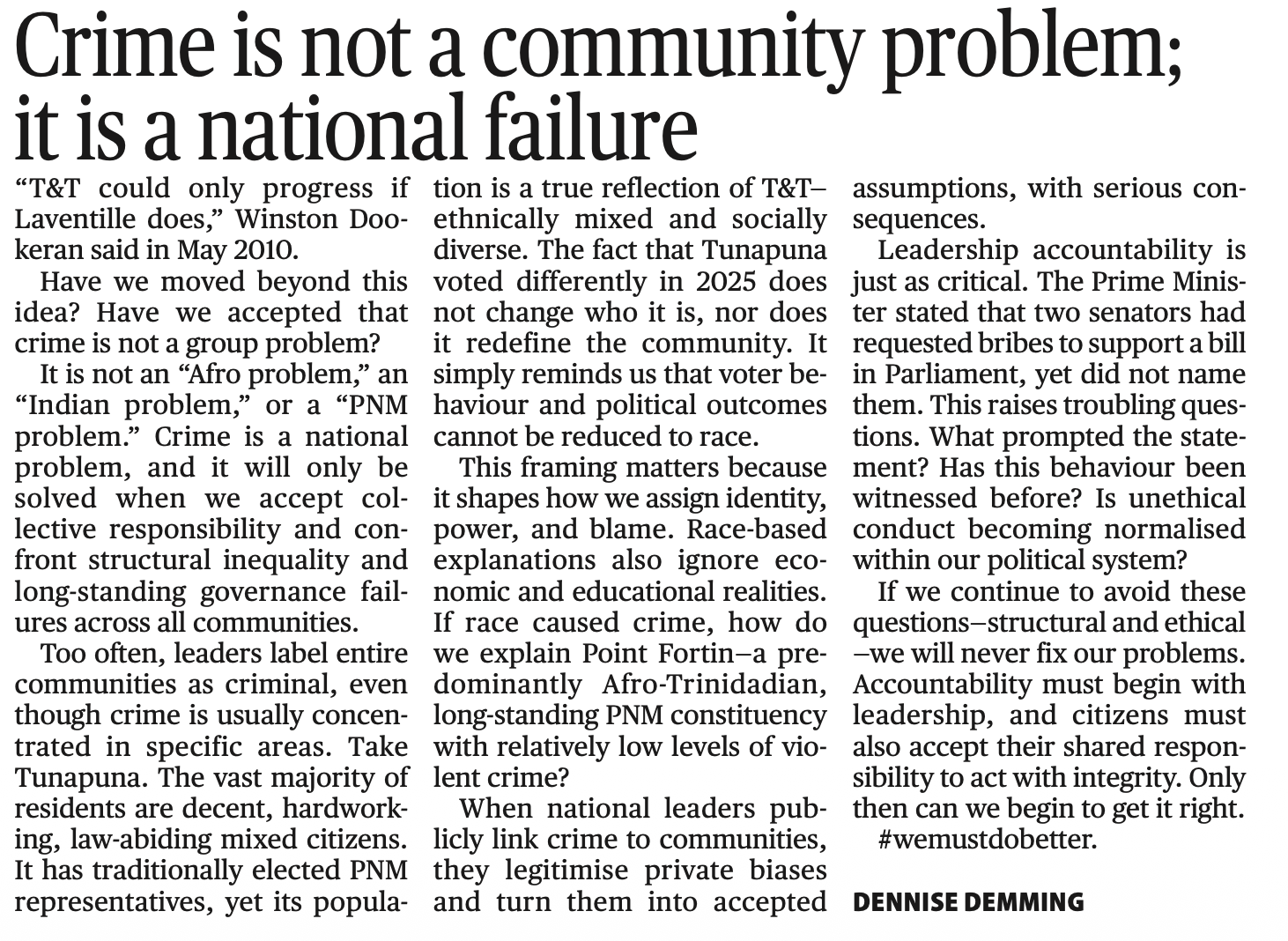
Crime is not a community problem; it’s a national failure …

Trinidad and Tobago could only progress if Laventille does,” Winston Dookeran said in May 2010. Have we moved beyond this idea? Have we accepted that crime is not a group problem? It is not an “Afro problem,” an “Indian problem,” or a “PNM problem.” Crime is a national problem, and it will only be solved when we accept collective responsibility and confront structural inequality and long-standing governance failures across all communities.

Too often, leaders label entire communities as criminal, even though crime is usually concentrated in specific areas. Take Tunapuna. The vast majority of residents are decent, hardworking, law-abiding mixed citizens. It has traditionally elected PNM representatives, yet its population is a true reflection of Trinidad and Tobago — ethnically mixed and socially diverse. The fact that Tunapuna voted differently in 2025 does not change who it is, nor does it redefine the community. It simply reminds us that voter behaviour and political outcomes cannot be reduced to race.

This framing matters because it shapes how we assign identity, power, and blame.

Race-based explanations also ignore economic and educational realities. If race caused crime, how do we explain Point Fortin — a predominantly Afro-Trinidadian, long-standing PNM constituency with relatively low levels of violent crime? When national leaders publicly link crime to communities, they legitimise private biases and turn them into accepted assumptions, with serious consequences.

Leadership accountability is just as critical. The Prime Minister stated that two senators had requested bribes to support a Bill in Parliament, yet did not name them. This raises troubling questions. What prompted the statement? Has this behaviour been witnessed before? Is unethical conduct becoming normalised within our political system?

If we continue to avoid these questions — structural and ethical — we will never fix our problems. Accountability must begin with leadership, and citizens must also accept their shared responsibility to act with integrity. Only then can we begin to get it right.

 #wemustdobetter.

Security Needs Answers, Not Drama

National security is being reduced to political drama.  Many of us followed the recent parliamentary debate on the proposed United States–linked radar installation in Tobago, simply hoping for a clearer explanation. What exactly is being built? Why Tobago? And how will this affect us? Unfortunately, those basic questions were never properly answered, leaving many citizens more uncertain than informed.

It has been widely stated that Trinidad and Tobago has, for many years, participated in Caribbean and hemispheric security cooperation under different governments. It is also worth asking whether our country already operates coastal surveillance radar systems in both Trinidad and Tobago as part of wider regional information-sharing arrangements aimed at tracking illegal drugs, weapons, and human trafficking. Similar systems reportedly exist across the Caribbean and are supported through long-standing regional agreements and partnerships with international allies.

This broader context was missing from the parliamentary debate. Instead of helping citizens understand how this installation fits into existing arrangements, the discussion focused narrowly on secrecy.

What many citizens really want answered are practical questions. Who will control the data collected in Tobago? Will local agencies have full access? Which authority will provide oversight and ensure compliance with our laws? And do we actually have the boats, trained personnel, and resources to act when threats are detected?

These questions go to the heart of sovereignty and public trust. Citizens of Trinidad and Tobago deserve calm explanation, honest engagement, and clear accountability. National security is too important to be reduced to political drama.

Unveiling Giselle Singh: Innovator, Scientist, and Musician


Giselle Singh introduces herself as an inventive creator and empath, drawing inspiration from the divine. She discusses her multifaceted identity as a scientist, innovator, and musician, emphasizing her contributions to soul music. She shares her focus on genuine storytelling and cultivating meaningful relationships.

Giselle advocates for a living wage for artists in Trinidad and encourages aspiring creatives to follow their dreams. She reflects on the importance of creative freedom, effective listening, and the transformative power of imagination from a young age.

Protecting Our Waters: An Interview with Judith Gobin

Gobin calls for addressing environmental issues at their source, particularly in reducing plastic waste. She also discusses the importance of balancing career and family, emphasizing the need for support networks for working women.

Richard Ragoobarsingh. Navigating Law and the Arts

In this episode, Trinidadian actor, director, and lawyer Richard Ragoobarsingh takes us through his remarkable journey of balancing two distinct yet equally demanding careers.

With over 40 years in theater, he reflects on his deep love for literature and the performing arts, the challenges faced by creatives in Trinidad and Tobago, and the resilience required to sustain a life in both law and the arts. Richard highlights the power of passion, the need for greater support for the arts, and his hopes for a future where creativity is valued as much as any profession.

His story is a testament to the idea that with dedication and vision, it is possible to thrive in multiple worlds.

Thanks “Auntie Tantie”

Goodbye, Auntie Tantie.  May our country continue to benefit from your wisdom and fervour. As you depart, I wonder what has changed during your service as the first female President of the Republic of Trinidad and Tobago. 

Early in your tenure, I was inspired by your visit to Sea Lots on that Friday evening. Then you embraced Auntie Tantie as a “badge of honour” and had the Tantie courage to pelt bouf at our parliamentarians whenever you had the opportunity.

Throughout your term in office, you have shown empathy for our people, and I recall being stunned by your statement, “People are hurting, and they feel parliamentarians are not listening.” 

‘If you are seen to treat each other with respect, courtesy, and good humour, there can be a trickle-down effect and eventual cascade. But when acrimony, contempt, and divisiveness is the example you set, you cannot be surprised when those attitudes and behaviours are replicated on the nation’s roads, in our schools and homes, and on social media.

You continued in that address and said to the Parliamentarians:

Unfortunately, it seems that your messages have fallen on the ears of 41 tone-deaf Parliamentarians who are focused on how they can benefit personally yet have zero empathy for the daily pain citizens are experiencing.

You are leaving office and the country continues to be in deep crisis as captured by your statement: “I fear we have become a savage people. Lines drawn between ethnicities, political affiliations, the haves, and the have-nots, worker, and employer, citizens and migrants have solidified into intolerance, impatience, unkindness, vitriol, and in many cases, downright nastiness…”

In that single statement, you have captured the key issues which our politicians should be addressing. 

As the population awaits the selection of your successor, I am hopeful that the new President will be able to use his/her office and weekly meetings to encourage the Prime Minister to focus on the need to redesign our antiquated and mal-functioning systems and processes.

Although your departure provides another opportunity for a new beginning, I would prefer that your successor takes your lead, and carries forward the message that politicians should allow the plight of people to be the impetus for policy change.  

Auntie Tantie … Thanks for your service and may your universe unfold exactly as you wish.