Reclaiming Our Capital City Port of Spain

Our capital city, Port of Spain (POS), is losing its place as the capital of the nation, and the current government appears to have no interest in maintaining POS as a beautiful space filled with high standards.  At the last Diwali celebration, the Prime Minister invited U.S. representatives to her personal home instead of the official residence. Small as it seemed, this moment highlighted a bigger problem, which to me is the Prime Minister’s continued attempt to disassociate with the capital city.  This was once a vibrant hub of politics, business, and culture, and it now faces aging roads, neglected buildings, and fewer people living in the city center.

Based on a 2019 planning report UN-Habitat, the city of Port of Spain has about 48,000 people compared to about 94,000 in 1962.  At that time, the city was a place to visit because it was filled with entertainment and restaurants.  Today, Port of Spain is a place where people are afraid to be once it is dark.  Port of Spain must be restored as long as it is the capital city, or change the capital, especially if you wish to make our new capital San Fernando, Chaguanas, or Siparia.

In 2016, Afra Raymond commented on his website that “our capital has been severely depopulated in the past 50 years”.  He further commented that: “Given that there has been no natural disaster, war or plague, it is sobering to consider this steady population loss and its causes during that period of relative peace and prosperity.”

While there are several things that need to be done to reestablish POS, it would be effective if we began by focusing on improving the quality of the roads.  Secondly, there are several buildings that should be restored and/or redesigned to attract more residents to the city. These priorities are mutually connected. Without good roads, life and business in the city are difficult. Without well-maintained buildings, the city loses its character. Without residents, it becomes just a place of offices rather than a living community.

Roads are the lifeblood of any city. Congestion, potholes, and poor maintenance make commuting frustrating for residents and visitors. Upgrading streets would improve daily life and show that the capital is valued.

Buildings carry history and identity. From the Red House to the Magnificent Seven, near Queen’s Park Savannah, Port of Spain has architectural treasures. Many are deteriorating or underused. Renovating them would preserve heritage, boost civic pride, and attract visitors.

Port of Spain should not be only an administrative center. It should be the heart of Trinidad and Tobago — a place where people live, work, and enjoy city life. By improving roads, restoring buildings, and bringing more residents back to the city, Port of Spain can reclaim its status and vibrancy. Either invest in improving our capital city or let us vote on selecting a new capital city.  Whichever is selected, the bottom line is that POS needs to be upgraded by the Government.

Fariness necessary in Sandals deal …

The return of Sandals to the headlines, through the recent statement by Minister Stuart Young SC, is a reminder that we’ve learned little from the mistakes of the past. As someone who once served as Chairman of the Tourism Development Company (TDC), I speak from personal experience. I was asked to resign from that post—not because I had done anything wrong, but because I stood by a simple, fair principle: that whatever incentives and benefits were offered to Sandals should also be made available to local hoteliers and guesthouse owners.

When I refused to resign on principle, I was advised by the then Minister of Finance to cite “family matters” as my reason, or as he put it, to “take one for the boys.” I rejected both suggestions. I had done nothing wrong.

What I had done was advocate for fairness and transparency in tourism development. Unfortunately, that advocacy was inconvenient to the powers pushing the Sandals deal. The now-infamous Memorandum of Understanding (MoU), exposed thanks to Afra Raymond’s successful legal challenge, showed a lopsided agreement. The state was to fund and build the resort on public land, while Sandals would enjoy sweeping concessions—tax holidays, duty-free status, unlimited work permits for foreigners, and no obligations to local employment. All risk, all cost, all burden—carried by the public.

Is that development, or is it a handover?

The rejection of the project by Tobagonians was not arbitrary. As THA Chief Secretary Farley Augustine noted, it was undemocratic, economically unsound, and environmentally questionable. The proposed site—No Man’s Land—is a Ramsar-listed wetland. Yet, to date, there has been no public disclosure about environmental safeguards or updated assessments.

Development cannot happen in darkness. It cannot bypass stakeholders or sideline local businesses. If we are to believe that lessons have been learned, then this new approach must:

  1. Ensure full transparency, including the release of all agreements before they are finalized.
  2. Require rigorous environmental scrutiny.
  3. Treat local hoteliers and guesthouses with the same regard as international chains.
  4. Involve real public and stakeholder consultation—not after the fact, but from the start.

Tourism is critical to Tobago’s future, but not on any terms and certainly not at any cost. Fairness and public accountability should not be punished—they should be the minimum standard. The core elements that shape a successful and sustainable tourism experience are Culture, Conversation and Community.  Are these 3 C’s included in the Sandals meeting of April 7?

Engineering Clarity and Resilience: Dr. Brian Copeland on Sound, Education, and Trinidad & Tobago’s Future

Dr. Brian Copeland shared his work in sound engineering on Power Conversations focusing on enhancing sound systems in Roman Catholic churches in Trinidad and Tobago. His recent projects include installations in churches at Tortuga, Belmont, and St. Joseph. He emphasizes “intelligibility” in sound, noting that clarity, rather than loudness, enhances listeners’ experiences and reduces mental fatigue from reverberation.

As chairman of COSTAATT and Cipriani College of Labour and Cooperative Studies, Dr. Copeland advocates for an education system that builds national resilience, preparing citizens for economic challenges and natural disasters.

Inspired by Germany’s model and Costa Rica’s success, he envisions an economy strengthened by small and medium-sized enterprises, with COSTAATT playing a central role. His vision includes democratizing education to enable more people to contribute to Trinidad and Tobago’s economy and adapt to technological changes, such as AI.

Dr. Copeland also highlights the importance of societal engagement on issues like social justice and recidivism. Through accessible education and inclusive dialogue, he believes Trinidad and Tobago can create a more resilient, equitable society, helping individuals reintegrate and contribute meaningfully to national growth.

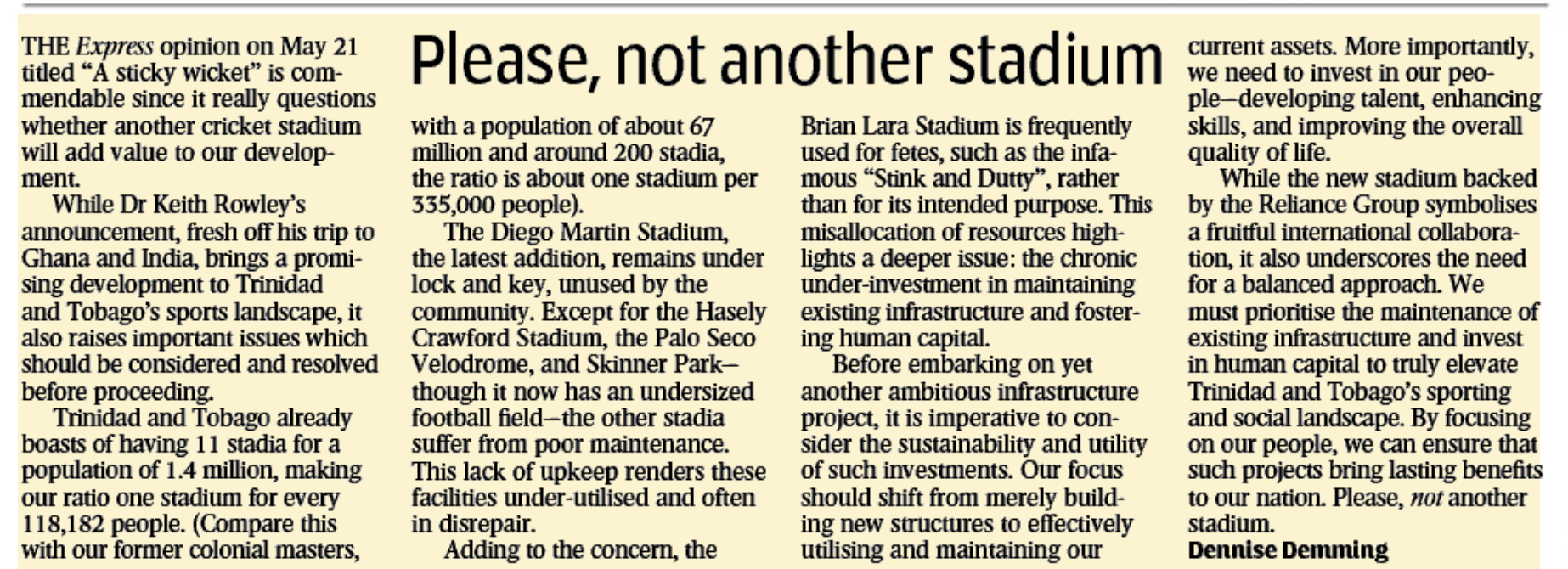
Not Another Stadium

The Express opinion on May 21 titled “A sticky wicket” is commendable since it questions whether another cricket stadium will add value to our development.

While Dr. Rowley’s announcement, fresh off his trip to Ghana and India, brings a promising development to Trinidad and Tobago’s sports landscape it also raises important issues which should be considered and resolved before proceeding.

Trinidad and Tobago already boast of having 11 stadia for a population of 1.3 million making our ratio 1 stadium for every 118,182 people. (Compare this with our former colonial masters with a population of about 67 million and around 200 stadiums the ratio is about 1 stadium per 335,000 people).

The Diego Martin Stadium, the latest addition, remains under lock and key, unused by the community. Except for the Hasely Crawford Stadium, the Palo Seco Velodrome, and Skinner Park—though it now has an undersized football field—the other stadiums suffer from poor maintenance. This lack of upkeep renders these facilities under-utilized and often in disrepair.

Adding to the concern, the Brian Lara Stadium, is frequently used for fetes, such as the infamous “Stink and Dutty,” rather than for its intended purpose. This misallocation of resources highlights a deeper issue: the chronic under-investment in maintaining existing infrastructure and fostering human capital.

Before embarking on yet another ambitious infrastructure project, it is imperative to consider the sustainability and utility of such investments. Our focus should shift from merely building new structures to effectively utilizing and maintaining our current assets. More importantly, we need to invest in our people—developing talent, enhancing skills, and improving the overall quality of life.

While the new stadium backed by the Reliance Group symbolizes a fruitful international collaboration, it also underscores the need for a balanced approach. We must prioritize the maintenance of existing infrastructure and invest in human capital to truly elevate Trinidad and Tobago’s sporting and social landscape. By focusing on our people, we can ensure that such projects bring lasting benefits to our nation. Please, NOT another stadium.

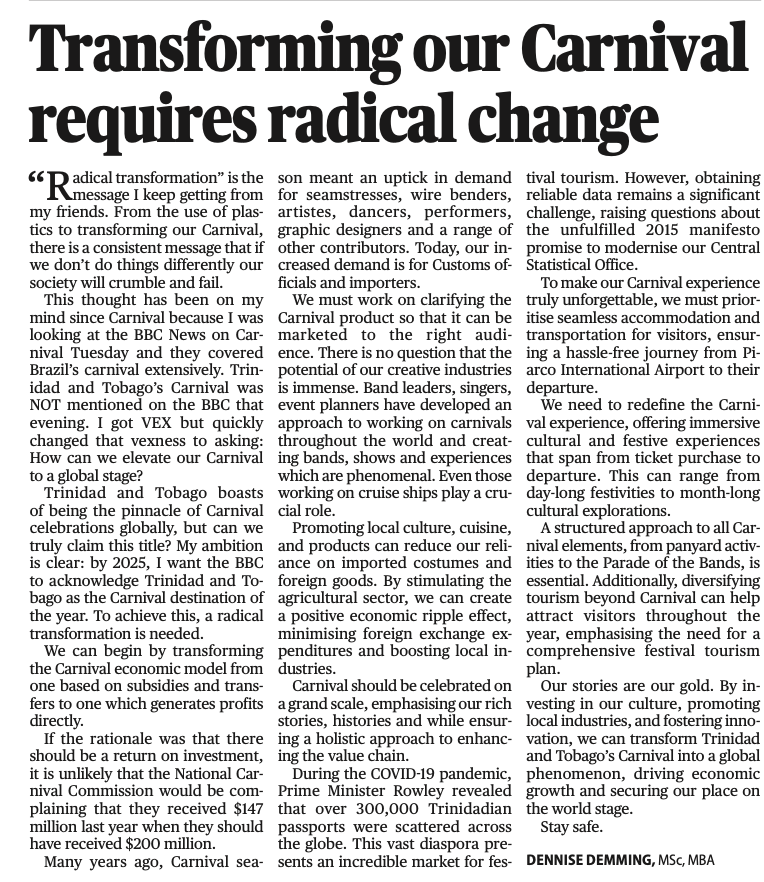
Transforming our Carnival Requires Radical Change

“Radical transformation” is the message I keep getting from my friends. From the use of plastics to transforming our carnival, there is a consistent message that if we don’t do things differently our society will crumble and fail.

This thought has been on my mind since carnival because I was looking at the BBC News on Carnival Tuesday and they covered Brazil’s carnival extensively. Trinidad and Tobago’s carnival was NOT mentioned on the BBC that evening. I got VEX but quickly changed that vexness to asking: How can we elevate our Carnival to a global stage?

Sunday Guardian, Sunday 28th April, 2024

Trinidad and Tobago boasts of being the pinnacle of Carnival celebrations globally, but can we truly claim this title? My ambition is clear: by 2025, I want the BBC to acknowledge Trinidad and Tobago as the Carnival destination of the year. To achieve this, a radical transformation is needed.

We can begin by transforming the Carnival economic model from one based on subsidies and transfers to one which generates profits directly.  If the rationale was that there should be a return on investment, it is unlikely that the National Carnival Commission would be complaining that they received $147 million last year when they should have received $200 million.

Many years ago, Carnival season meant an uptick in demand for seamstresses, wire benders, artists, dancers, performers, graphic designers, and a range of other contributors.  Today our increased demand is for Customs officials and importers.

We must work on clarifying the Carnival product so that it can be marketed to the right audience.  There is no question that the potential of our creative industries is immense. Band leaders, singers, and event planners have developed an approach to working on Carnivals throughout the world and creating bands, shows and experiences which are phenomenal. Even those working on cruise ships play a crucial role.

Promoting local culture, cuisine, and products can reduce our reliance on imported costumes and foreign goods. By stimulating the agricultural sector, we can create a positive economic ripple effect, minimizing foreign exchange expenditures and boosting local industries.

Carnival should be celebrated on a grand scale emphasizing our rich stories, histories and while ensuring a holistic approach to enhancing the value chain. 

During the COVID-19 pandemic, Prime Minister Rowley revealed that over 300,000 Trinidadian passports were scattered across the globe. This vast diaspora presents an incredible market for festival tourism. However, obtaining reliable data remains a significant challenge, raising questions about the unfulfilled 2015 manifesto promise to modernize our Central Statistical Office.

To make our Carnival experience truly unforgettable, we must prioritize seamless accommodation and transportation for visitors, ensuring a hassle-free journey from Piarco International Airport to their departure.

We need to redefine the Carnival experience, offering immersive cultural and festive experiences that span from ticket purchase to departure. This can range from day-long festivities to month-long cultural explorations.

A structured approach to all Carnival elements, from pan-yard activities to the parade of the bands, is essential. Additionally, diversifying tourism beyond Carnival can help attract visitors throughout the year, emphasizing the need for a comprehensive festival tourism plan.

Our stories are our gold. By investing in our culture, promoting local industries, and fostering innovation, we can transform Trinidad and Tobago’s Carnival into a global phenomenon, driving economic growth and securing our place on the world stage.