
At it’s core the challenge of establishing an organization’s HSSE excellence agenda as a path-way to sustainability is walking a tight-rope which balances short term and long term requirements. This challenge is made even more intense because the culture which surrounds the organization is characterized by lawlessness, short termism and perfecting the art of the “work around”.
Caribbean societies and those defined as developing countries were organized to focus on the immediate exploitation of natural resources. Our societies were never organized with a longer term vision in mind. Unfortunately in the 50 odd years that we have taken charge of our development, little action has been taken to change this method of operation so we continue to operate in a manner that is not sustainable.
Global organizations have historically acted in their own interest and taken the minimalist approach to issues of sustainability. In the past 10-15 years, the compass has been shifting towards a more meaningful approach to sustainability and the global alignment of operating practices. There is now heightened demand for balancing economic outcomes with sustainable practices. In the Harvard Business School working paper “The Impact of a Corporate
Culture of Sustainability on Corporate Behaviour and Performance”
by Robert G. Eccles, Ioannis Ioannou, and George Serafeim, the authors provide evidence that: “High Sustainability companies significantly outperform their counterparts over the long-term, both in terms of stock market and accounting performance. The outperformance is stronger in sectors where the customers are individual consumers, companies compete on the basis of brands and reputation, and in sectors where companies’ products significantly depend upon extracting large amounts of natural resources”.
If we escalate this notion and look at national indicators, there is an exciting growing movement promoting the need to change the big national indicator from (Gross Domestic Product) GDP to (Gross National Happiness) GDH. This movement was given a significant boost when the former French President in 2008 established a Commission on the Measurement of Economic Performance and Social Progress. The headline from that report quotes President Sarkozy, as saying that GDP ignored other factors vital to the well-being. He urged business leaders “to shift emphasis from measuring economic production to measuring people’s well-being”.
A similar movement has been exploding in the small land locked country of Bhutan located between India and China, where they King has challenged the notion that the more we produce the happier we will be and is using GDH to determine the success of his country.
Household incomes in Bhutan remain among the world’s lowest however life expectancy increased by 19 years from 1984 to 1998, jumping to 66 years. The country which requires that at least 60 percent of its lands remain forested, welcomes a limited stream of wealthy tourists and exports hydropower to India.
“We have to think of human well-being in broader terms,” said Lyonpo Jigmi Thinley, Bhutan’s home minister and ex-prime minister. “Material well-being is only one component. That doesn’t ensure that you’re at peace with your environment and in harmony with each other.”
Herein lies a whole different notion of how to define sustainability and what are the key indicators. When workers connect the dots between their daily contribution, the firms profitability and their family’s long term happiness, their productivity is guaranteed to rise to unprecedented heights.
The current mode of mass consumption is simply driving consumers to want more and more. Why should one country use enough resources to power a ski slope in a dessert while another country struggles with greater than 60% unemployment figures?
A recent sound bite on television showed a former executive from the motor car industry questioning the evidence about global warming. A visit to another executive’s home showed a fully air conditioned house. With the launch of every new mobile device, you need a different charger, shell, etc. Business leaders have to re-design the consumption model and cater for cradle to cradle design and innovation. The world cannot continue to feed the consumption habit. At some point citizens will rail against the fact of 25% of global resources is being consumed by 5% of the population.
The major challenge is how to balance economic development with the emotional and spiritual well-being of people. That’s the real challenge of HSSE excellence as a path-way to sustainability.
Previously published in Newsday – May 2014




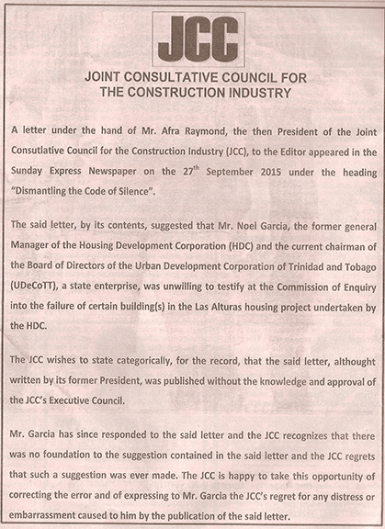 What is the underlying motive behind this advertisement by the JCC? Has the JCC been sued, threatened or otherwise? And isn’t it a fact that he did not appear before the Commission of Enquiry? Why do this 14 weeks later?
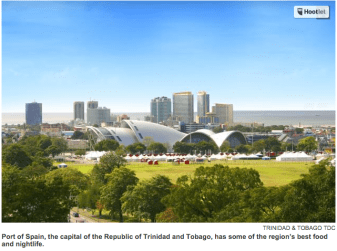 Whether you think it is a blessing or a curse, the current world oil crisis presents us with an opportunity to change the service paradigm in Trinidad and Tobago. Street vendors, car park attendants, taxi drivers, police officers, all .. we have an opportunity to secure our future by embracing tourism as our way out of this crisis but the road out will be long and arduous.
  Dennise Demming