Support Plastikeep!

This space was occupied by a Plastikeep bin!
In a short few days, it has been transformed to –
A dump …  An eyesore!

Responsible Minister, get your finger out and do what you were voted in to do – help us to make this a better place.  Otherwise, you stand accused of facilitating the complete degradation of our environment.

Plastikeep was doing a good job.  They encouraged us to separate and dispose of our plastics in a responsible manner.  With the absence of their collection bins now, our trash will revert to an “all in” approach which adds to our high level of plastic pollution.

What I don’t understand is  why the monies in the Green Fund are no longer available to Platikeep.  In addition, the green fund levy was increased in the last budget.  By way of explanation, “The green fund levy is payable by all companies and unincorporated entities, including partnerships” … taken from the Parliament Website.

Why is this not simply a process of drawing down on the available funds to carry out the project?

Plastikeep needs our support.  We can survive problematic politicians, corrupt decision makers but not a contaminated  environment.


Decision Making Requires Data …

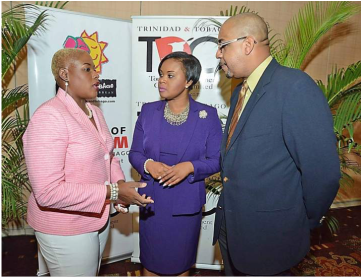
“In making a case for domestic tourism, Tourism Minister
Shamfa Cudjoe said Trinidadian residents vacationing in Tobago
spent over TTD 500 million, which translates to about 59 percent
of Total Domestic Travel Expenditure. Persons from Tobago
visiting Trinidad spent approximately TTD 250 million”.

Minister of Tourism, thanks for supporting the case for the need for a robust approach to data collection in this country.  A poor approach to data collection and analysis has paralysed several sectors over the years.   We are often making decisions based on bad data and false conclusions.  The Ministry of Tourism is no exception.  If someone with a small guest house, takes your $1billion statistic seriously and expands his/operation that person can suffer significant losses and be left asking what went wrong?Screen Shot 2016-07-27 at 14.03.24

If the Ministry of Tourism is using such data to boast about the impact on our economy, please take an open approach to your data and share it with the average citizen. Government as well as the person supplying food on Store Bay need to make decisions using robust data.

My biggest challenge with this data is that since we do not fill out landing cards between Trinidad and Tobago, reliable data collection becomes problematic and unreliable. I can’t even contemplate the period during which the data was collected because it “revealed that 263,300 overnight domestic trips were taken by Trinidad and Tobago households over the survey period”.  If on average there are 50 flights per day (and that’s generous) then simplistic maths reveal that your data collection period was at least one year and each passenger was surveyed.

In addition to providing us with the data, we need to know the distinction between the Trade strategy and the Tourism strategy.  Speak to the average Tobagonian and she will tell you that she shops in Trinidad because of the exorbitant prices in the supermarkets.  She will complain that if she needs a visa she still has to come to Trinidad and we’ve all heard the laments about Title Deeds.  There is significant inter island travel to satisfy a range of basic needs.  When I travel to Tobago to conduct a training programme, I hope I am not viewed as a tourist or when a lawyer travels to represent a client, this is not leisure.

There is an excellent case for domestic tourism and the “Stay to Get Away” campaign is a good one but please be careful with overpraising and sensationalising what is a business case.  We need data driven decision making not sensational headline grabbing data.

So here are three lessons in this:  Firstly, the citizens are interested in your trade strategy versus your domestic tourism strategy, secondly we must organise a robust method for data collection and thirdly, citizens are wary about taking official word as gospel.

Thank You Ingrid Lashley!

Hi Ingrid Lashley … You made me proud.  You are a champion black woman with the confidence and competence to continue making a difference.
Here’s what I learned from your experience and let me share these learnings with Corporation Sole and his Designates!

  1. Screen Shot 2016-06-22 at 15.58.21Appoint competent subject matter experts to lead organisations?
  2. Hire someone who is a team leader.
  3. Communicate your expectations as clearly as possible?
  4. Appoint a Board which understands their role?
  5. Give the CEO the space to develop the systems and procedures to manage the organization.
  6. Allow the CEO to hire best in class.
  7. Schedule your check in periods.
  8. Demonstrate your respect for CEO.
  9. Leave the CEO ALONE to do what he/she is hired to do.
  10. Go back to Parliament and do what you do best.


Interesting perspective from Tanzania!

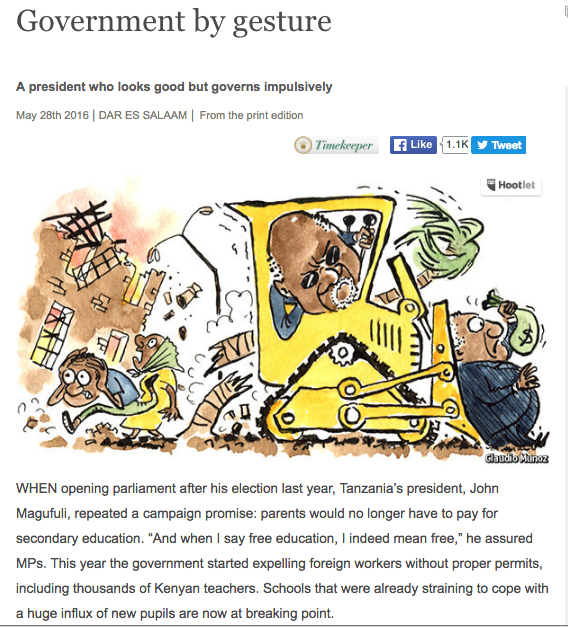
The Economist of May 28, 2016 carried an interesting article on the President of Tanzania.  Here’s a quote:

“The president, nicknamed “the Bulldozer”, has delighted Tanzanians with an anti-corruption drive and public displays of austerity. Within weeks of taking office last November he had banned all but the most urgent foreign travel for government officials. He spent Tanzania’s Independence Day picking up litter by hand. He has fired officials suspected of incompetence or dishonesty and purged 10,000 “ghost workers” from the public payroll. However, he has a worrying tendency not to think things through.

Screen Shot 2016-06-15 at 09.59.10


Here’s the full article: http://www.economist.com/news/middle-east-and-africa/21699470-president-who-looks-good-governs-impulsively-government-gesture?frsc=dg%7Cd


Measuring Happiness …

Trinidad and Tobago boy
Portrait of a boy with the flag of Trinidad and Tobago painted on his face. Courtesy Daman Gandhi, Flickr

At it’s core the challenge of establishing an organization’s HSSE excellence agenda as a path-way to sustainability is walking a tight-rope which balances short term and long term requirements. This challenge is made even more intense because the culture which surrounds the organization is characterized by lawlessness, short termism and perfecting the art of the “work around”.
Caribbean societies and those defined as developing countries were organized to focus on the immediate exploitation of natural resources. Our societies were never organized with a longer term vision in mind. Unfortunately in the 50 odd years that we have taken charge of our development, little action has been taken to change this method of operation so we continue to operate in a manner that is not sustainable.
Global organizations have historically acted in their own interest and taken the minimalist approach to issues of sustainability. In the past 10-15 years, the compass has been shifting towards a more meaningful approach to sustainability and the global alignment of operating practices. There is now heightened demand for balancing economic outcomes with sustainable practices. In the Harvard Business School working paper “The Impact of a Corporate
Culture of Sustainability on Corporate Behaviour and Performance”
by Robert G. Eccles, Ioannis Ioannou, and George Serafeim, the authors provide evidence that: “High Sustainability companies significantly outperform their counterparts over the long-term, both in terms of stock market and accounting performance. The outperformance is stronger in sectors where the customers are individual consumers, companies compete on the basis of brands and reputation, and in sectors where companies’ products significantly depend upon extracting large amounts of natural resources”.
If we escalate this notion and look at national indicators, there is an exciting growing movement promoting the need to change the big national indicator from (Gross Domestic Product) GDP to (Gross National Happiness) GDH. This movement was given a significant boost when the former French President in 2008 established a Commission on the Measurement of Economic Performance and Social Progress. The headline from that report quotes President Sarkozy, as saying that GDP ignored other factors vital to the well-being. He urged business leaders “to shift emphasis from measuring economic production to measuring people’s well-being”.
A similar movement has been exploding in the small land locked country of Bhutan located between India and China, where they King has challenged the notion that the more we produce the happier we will be and is using GDH to determine the success of his country.
Household incomes in Bhutan remain among the world’s lowest however life expectancy increased by 19 years from 1984 to 1998, jumping to 66 years. The country which requires that at least 60 percent of its lands remain forested, welcomes a limited stream of wealthy tourists and exports hydropower to India.
“We have to think of human well-being in broader terms,” said Lyonpo Jigmi Thinley, Bhutan’s home minister and ex-prime minister. “Material well-being is only one component. That doesn’t ensure that you’re at peace with your environment and in harmony with each other.”
Herein lies a whole different notion of how to define sustainability and what are the key indicators. When workers connect the dots between their daily contribution, the firms profitability and their family’s long term happiness, their productivity is guaranteed to rise to unprecedented heights.
The current mode of mass consumption is simply driving consumers to want more and more. Why should one country use enough resources to power a ski slope in a dessert while another country struggles with greater than 60% unemployment figures?
A recent sound bite on television showed a former executive from the motor car industry questioning the evidence about global warming. A visit to another executive’s home showed a fully air conditioned house. With the launch of every new mobile device, you need a different charger, shell, etc. Business leaders have to re-design the consumption model and cater for cradle to cradle design and innovation. The world cannot continue to feed the consumption habit. At some point citizens will rail against the fact of 25% of global resources is being consumed by 5% of the population.
The major challenge is how to balance economic development with the emotional and spiritual well-being of people. That’s the real challenge of HSSE excellence as a path-way to sustainability.

Previously published in Newsday – May 2014

VIDEO: TOO BIG TO HIDE?

AfraRaymond's avatarAfraRaymond.net

A five-minute clip on the CL Financial bailout, the State and the ‘Code of Silence’ around how $25 Billion of your taxpayers’ Dollars were spent.

At a time when we hear of falling State revenues and we know there is no soap or toilet paper in our public hospitals, this is the story of how $25 Billion of our money was used to bailout the wealthiest man in the Caribbean.

This is the story of the fight by the Ministry of Finance to conceal the details of that massive payout.

Expenditure of Public Money
Minus    Transparency
Minus     Accountability
Equals    CORRUPTION

View original post

Sagicor Phoenix Savannah Lap

The Sagicor Phoenix Savannah Lap attracted more than 2,500 runners and walkers on Saturday 16th April at the Queen’s Park Savannah starting at 6:30 pm opposite Victoria Avenue. 

It is the largest event organised by Demming Communications.  Big thanks to Sagicor and the tight team of Dev & Shena Singh and Anthony Stroude.  This tight foursome expanded to 15 during the week leading up to the race and then to 45 on race day.  Thanks to my team.

Congratulations to the winners and here’s their blistering times:

Male: 
1st Mathew Hagley  11:26
2
nd Lionel D’Andrade 11:29
3
rd Kelvin Johnson 11:33

Female:
1
st  Tonya Nero: 12:23
2
nd Dawnel Collymore: 13:24
3
rd April Francis: 14:10

Property Matters – Housing Issues – part 5

Thanks for bringing this information to the public.

AfraRaymond's avatarAfraRaymond.net

hdc-logo

SIDEBAR: CORRECTION

With apologies to readers, this is to correct my figures in relation to the amount of Public Money which TTMF received in relation to the 2% subsidised mortgage programme. The figures disclosed in TTMF’s Summary Financial Statements are actually liabilities, being the reducing balance on the original allocation of $200M for this programme.

The recalculated figures for TTMF’s recovery of 2% mortgage subsidy 2007 to 2014 are

YEARSUBSIDY (cumulative)
2007$.9M
2008$5.3M
2009$16.5M
2010$34.1M
2011$52.7M
2012$70.4M
2013$87.4M
2014$105.2M

These figures are far less than those I cited in my article, since only $105.2M has been drawn from the original allocation of $200M, as against my erroneous claim that $1,227.5M of Public Money had been spent on this subsidy.

Last week I examined housing subsidy to illustrate the ways in which Public Money is used to provide better housing opportunities.

The…

View original post 1,101 more words