From Territory Tax Leader to Minister of Finance

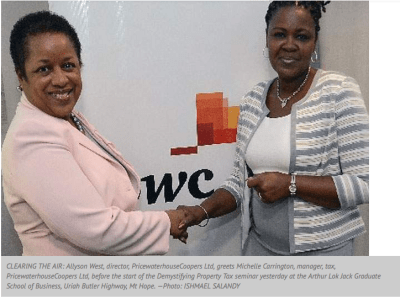
Screen Shot 2017-07-02 at 16.42.17The appointment of Miss Allyson West as Minister in the Ministry of Finance may have raised an eyebrow or two.  The raised eyebrows are understandable especially since several of us were appalled when former Judge Volney jumped into the political ring straight from the Bench.  We asked where was the cooling off period or the distance that is required for sober reflection?

Yesterday Miss West was the Territory Tax Leader of one of the biggest and most successful Accounting organizations in this country.  She would have been advising on tax issues where large businesses are seeking redress or resolution of Tax issues with the government.  Today she is on the other side!  She is directly responsible for assisting the Government with the collection of Taxes.
In PWc’s Pre-Budget Bulletin 2017, and referring to the Sandals deal, Miss West’s document stated:
“While we appreciate that agreements of this nature require some level of confidentiality, we would encourage GORTT (ME) to be as transparent as possible on the fundamentals of the arrangement, with particular emphasis on the costs GORTT 
has to bear and the incentives granted vis a vis the expected returns to be enjoyed by T&T”. 

By putting her hat in the ring, Miss West is now impaled on the horns of a dilemma where on the one hand, her latent memory will trigger issues she had been working on or providing advice for and on the other hand she could be asked to provide advice and or guidance to Officials on the way forward with the very same matters.
Further, PWc has a consultancy arm and the new Minister is now in close proximity to decisions about arrangements which could benefit her employer as of yesterday.  In whose interest will Miss West ultimately act? Of course she is a professional and will serve the best interest of Trinidad and Tobago.
I would like to believe that but must express my feeling of unease.  The jury will be out for a while!  Until then, congratulations to Miss Allyson West, yesterday’s Territory Tax Leader for PWc and today’s Minister of Finance with responsibility for Revenue Collection.

Sans Website?

office-of-the-prime-ministerLong time ago, when the internet was in the toddler stage, I asked a “techie guru” why do I need a website?  His response – “it’s like your home address”.  In today’s world everything on social media pivots to your website where you essence is communicated.  It is the place where you invite people to learn about you and  decide if they want to do business with you.  That rationale has not changed.
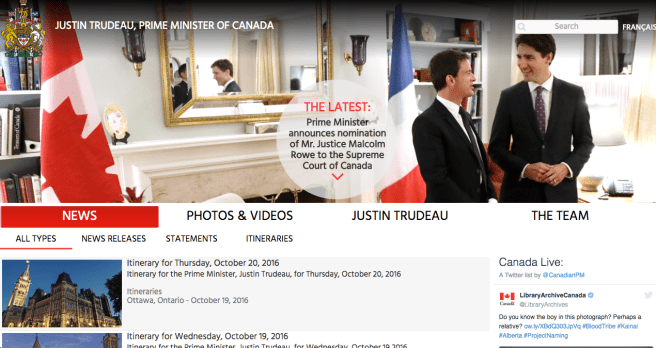
Why then when I google “Office of the Prime Minister of Trinidad and Tobago” I get an under construction message.  But when I google “Office of the Prime Minister of Canada” I get a dynamic website which even includes his itinerary.

office-of-the-prmie-minister-of-canada

In today’s world if you are interested in communicating with your population, you have to use the internet and the range of online tools which it offers.  Inviting yourself to a radio programme just allows you to speak to 18 percent of the population.  What about the other 82 percent?  And what about the youth cohort for whom the internet is their sand box?  Recently I was able to hear the Valedictorian on Facebook Live broadcast from one of the the graduation ceremonies at the University of the West Indies.  This just shows the power of the internet if used sensibly.

I can’t think of one reason why the Office of the Prime Minister of Trinidad and Tobago does not have a functioning website.  It must be a new deliberate strategy to not communicate.  It must be because my Prime Minister and his advisers have no desire to engage  “Pradeep Public”.  It must be because they are have no interest in being inclusive.  It must be because they think they have all the answers.  It must be that the Government just does not understand that the future we must create requires an ICT strategy which enables our people to have information at their finger tips.

We keep talking about diversification.  If ICT does not form the backbone of the diversification strategy then we’ll be saying welcome to the past”. 

Our country has the potential, the people and the creativity.  What we lack is the leadership!

Some Sorrel Juice Please Mr. President!

no_alcoholThere was a time, not so long ago when the only juices you could enjoy at President’s House were sorrel juice, grapefruit juice, mauby, star apple juice and any juice that could be made using local fruits.  I am told the fruits also came from the gardens on the premises. That was a period when the office still held some awe and mystique.  Today, the “The Hassanali’s” are still spoken of in glowing tones as part of the good “ole” days.  For that time, the serving of “home made juice” at President’s House was seen as disruptive.  Fast forward to today and the Office has its own wine label at the expense of the citizens.  There is inconsistency in the messaging here.  On one hand we are saying that there is need for austerity while on the other, we commission a private label wine for the President’s House.

The recent budget announced an increase in the sin taxes (meaning alcohol and tobacco) which is a good initiative but if we are aiming to change the alcohol palette of the Trinbagonian, it didn’t go far enough. It should really have been a one hundred percent charge for all imported alcohol.

If we’re serious about reducing the foreign exchange drain, why not temporarily  ban the use of alcohol at all government functions and on all government premises including the Diplomatic Centre and President’s House. At least we could implement this tax while the country moves towards economic stability. An old saying comes to mind: “People do what you do and not what you say”.   There is a tremendous move to authenticity in today’s world and people are looking for behaviour which they can pattern.  They do not respond to instruction. If you want to call out the best of others you have to be the best you possible.  If we want the population to understand the dire straights we are in, then our actions must be consistent.  The focus at the moment is on the Presidential label for his special wine but it is only a matter of time before someone leaks the bill for the Diplomat Centre and Household.  

How it go look?

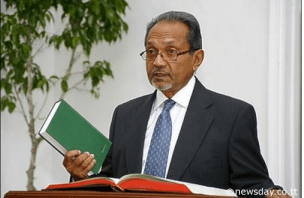
Justice Zainiool Hosein What does new installed Chairman of the Integrity Commission,  Retired Justice Zainool Hosein, Watson Duke and Ian Alleyne have in common?       

A total disregard for media workers and consequently the people of Trinidad and Tobago.  At his swearing-in, Justice Hosein responded to a legitimate question posed by the Media by hurtling this insult at the Reporter: “You don’t either understand English or you’re not prepared to hear what I’m saying, I’m not dealing with the Retired Judges Association business at this interview, this interview is in relation to the Integrity Commission, okay?”

The reporter’s question was justified and deserved an appropriate answer.  It is my view that the Justice should have resigned from being head of such a powerful lobby group before accepting the position of Chairman of the Integrity Commission.  Instead he chose to hold on to two offices and hurl an insult at the media person who dared to inquire.  This behaviour is yet another example of a person being placed in a position of responsibility and immediately acting irresponsibly. 

One can ague that one position does not materially affect another but we have all witnessed the daily abuses by officials in our country.  If they are not overpaying their family, they are hiring friends with manufactured credentials.  It is a period of low trust for public officials from Captain to Cook!  In order to regain the trust and confidence of the population office holders must reach for the moral high ground.  In this case, Justice Hosein was not presiding over his court, he was responding to the media and ought to have demonstrated a keener understanding of the role the media plays acting on behalf of the people.

Our history is replete with examples of office holders using one position as leverage to achieve objectives in another.  The position of head of the retired Judges association is important and cannot be easily ignored by any office holder.  Let us imagine that there is a matter before the Integrity Commission involving the person who can make a decision about the Pensions of retired Judges.  In the person’s mind, it is the same person with the authority and opportunity to make a particular decision.  It is easy to perceive that their action in one area will be influenced by an outcome they expect in another and vice versa.

If Justice Hosein has not yet resigned from one of these positions then I urge him to act with haste. Otherwise “How it go look?”

Agree or perish …

Imagine the outcome if all government decisions were made on the basis of unanimity.  The people would benefit in unimaginable ways.  Instead what exists is government based on consensus which for some leaders means “I’ve listened to your views and will let you know what is your opinion”.  This happens in business organizations of varying sizes and objectives as well.  The difference is that in commercial organizations the business owner operates in his own interest, with his own funding, but in government, you are operating on behalf of the people who elected you so your decisions have intergenerational implications.

A world based on unanimity means we would all be of one mind.  It will make compliance so much easier.  The Greek philosopher Marcus Cicero said, “Great is the power, great is the authority of a senate that is unanimous in its opinions.”  Substitute senate with government. Unanimity means total agreement before we move on whereas  consensus means we have general agreement or accord.   Time and time again we have seen decision making by consensus fall apart and when it falls apart there are dire consequences. Coalition governments are notorious for decision making by consensus and it leads to weak decisions.

Dream with me for a moment: how would crime be impacted if the government, meaning party in power and the opposition agreed on a crime plan?  I guarantee you that crime would be reduced in a short time. Or if they agreed a method for party financing.  Then no financier would be able to hold anyone to ransom.

Unanimity as a method of operating is difficult.  Just imagine, planning your family vacation on the basis of unanimity.  It will be nightmarish but when you come to agreement it will make sense and be binding.  Our country has suffered tremendously because there is no mechanism for agreeing on the imperatives for development.  A Bajan friend lamented that elections in T&T mean starting over the race whereas in other countries it means passing on the baton.  I had no answer for this because it is so true.

Over the years we have lost tons of money on so many initiatives like building the Interchange, halting Vision 20:20 and building a mass transit system.  New governments feel compelled to stop whatever is in progress, repackage it and start over.  Boards change in private sector organizations but the strategic direction remains.  When it is time to change strategy, it is approached in a systematic manner.  When governments change strategy the population is hardly ever included. One can argue that the manifesto is the opportunity for inclusion of the population but the practice would not support such a thesis.  The need for a mechanism through which there is agreement is critical.

The next true leader to distinguish himself or herself in our country will do so by seeking unanimity on a few big ticket items.   The country is yearning for a different kind of leader with a style that is even handed, transparent and visionary.   Fifty years ago the Eric Williams vision transitioned us from colonialism to independence.  The leader of the future has to take us to the next stage -interdependence.

In an interdependent world we will have to focus more on broad interests and less on small niches of people who will benefit.  This means that objective criteria will have to guide decision making.  Technology continues to shrink our global village while events in the remotes places have huge impacts locally.   Our future survival requires a different approach.  Decision making based on unanimity is a doable option in a country of our size.

“Eat Ah Food” written in April 2010

This expression “eat ah food” has been haunting me since Carnival. At that time, it was the occasional reference and I kept musing over what it could possibly mean. Clarity came when a particular entertainer said he was not going “to create, perform or promote any “eat ah food” music; his music must have a message and make sense for the public”. His comments resonated with me because here was a young entertainer taking a stand and being prepared to live with the consequences. That was a “feel good” moment because it communicated that there is hope for Carnival music to move beyond the frenzied repetition of 2 syllables that occupy a space deep in one’s consciousness to maybe just a couple of sound sentences or statements. And so Carnival ended and the “Eat Ah Food” phrase was no clearer in its social implications.

I then happened across a small road side establishment with the same name. The proprietor explained that he provided a “nice little something” for his clients to eat.

With the advent of “silly season,” “Eat Ah Food” has found its moment in the sun. Popular conversation is about what people are prepared to do in order to “Eat Ah Food”. From advertising agencies and calypsonians to CEPEP workers and professionals, all seem to have identified their own “eat ah food” threshold.

On a very basic level, the concept is being interpreted as persons operating at Level One of Maslow’s hierarchy of needs and is protecting their ability to enjoy food, clothing and shelter. In that case, the issue of an informed opinion becomes a moot point since these opinions will be guided by a perceived relationship between the future outcomes and current choices. At other levels, citizens have historically been politically expedient and put their support where they felt there was the greatest possibility for reward. Some have even latched on to the phrase “enlightened self interest” to explain their choices.

At yet another level, the campaign financiers operate unbridled since there is no legislation to set the context of their operations. Additionally, the profession of “Lobbyist” has not been formalized. The impact is that whatever the outcome of “silly season” there are power brokers who will gather currency now and leverage it in the future.

For citizens not identified in these limiting categories, there is still the question of how can I make an informed decision? Is it possible to apply rational thinking to decision-making around politics? Yes, it is possible. Accept that decision making around our politics is emotionally driven but also accept that it could benefit from a more structured approach. There are four simple questions which can aide the decision making process: What is my risk here? Can I afford the outcome? What is the benefit to me of the expected outcome? Will I feel good about the outcomes and the decision I made to influence those outcomes?

The hundreds of thousands of persons who earn their living by being Ordinary Citizen John/Joan Singh (Citizen Singh) risk very little with the outcome of this election. In the short to medium term, life will continue and his/her vocation/profession will continue. There may be a name change here or there but the fundamentals will remain.

Can Citizen Singh afford the outcome? Very likely because the benefits we enjoy depend on the state of the economy. If we allocate the same corruption weighting to all parties, then economic factors will drive the development of the country.

Will Citizen Singh feel good about the outcome? That’s a really difficult one. My past experience with this question is interesting. Within five months of the NAR Government, I couldn’t find one person who had voted for NAR. Supporters seemed to have collectively disappeared from the landscape.

On balance, it is all about the allocation of scarce resources and how the economics affects the politics. In developed countries like the UK, the decision point is not about a T-shirt or a house or a job, but about the philosophical underpinnings and how those underpinnings impact the shared vision of the future. Political parties adopt a very measured approach to communicating their messages. The frenzy of politically charged junction meetings is absent. The communication job is more clinical and almost dispassionate.  There seems to be an understanding that life is about more than immediate satisfaction. Life indeed is about more than “Eat ah Food”.

Be true to yourself and your organization

Kendal Fontenelle is the Public Relations Officer with the Ministry of of Planning and Sustainable Development and must take full responsibility for any errors or omissions presented on the Ministry’s Website.  It is absolutely unprofessional for him to suggest that a Lecturer at the University of the West Indies did the research and presented the information.  Had it been perfect Mr. Fontenelle would have taken the credit 

One of the traditional roles of the Communications Professional is to keep the organization truthful. This means you have to take responsibility for the communication outcomes. By stating that “It was actually written by someone who is a lecturer at one of the tertiary institutions,” Mr. Fontenelle is shirking his responsibility. He clearly skipped the Fundamental of Communication class. We’ve seen this sloppy approach to communications several times with the current administration. It underlies the need for Communications professionals to be well trained before being placed in responsible positons. Mr. Fontenelle is not representing this noble profession very well.

“DAT NOT Good So”.

“Dat good so” was the comment made by someone with whom I was working.  The comment resonated with me for days after because it aptly captured an attitude of our people.  The waitress in a restaurant gives you poor service and “Dat good so”.  The cleaner continues to mop with black water and “Dat good so”.  The hospital spends two hours searching for your file and “Dat good so”.  This comment occupied my mind to the extent that I began observing situations and thinking “Dat good so”.  So obsessed was I that I have concluded that the newest ailment afflicting our entire society is “Dat good so”.

What could be the possible causes of such an ailment?  Some people’s default position is the minimum effort.  For others, it is doing whatever they think they can get away with and  for many others, they simply do not care.  Whatever the motivation, leadership has a responsibility to communicate  a different refrain.  Leadership must communicate “Dat NOT good so”.
How do we begin to communicate “Dat NOT good so”?  Consequence Management is a good place to start and it is not limited to formal organizations.  Wherever we operate, it is necessary to communicate that there are consequences to our actions, both negative and positive and “Dat NOT good so”.
Alongside the implementation of consequences it is necessary to re-visit some basic standards of operations.  Say the word standard and a popular mental association is the painted stick which masqueraders carry on Carnival Days.  This frivolous mental image is supported by our ambiguous response to societal rules at all levels.
On a personal level, we all have to determine the standards by which we operate and hold fast to them.  It means making tough decisions, embracing the concept of delayed gratification while ensuring that standards are upheld or consequences felt.
On a societal level, leadership must communicate their dedication to the maintenance of standards.  It might be a simple act of honouring agreements. If our leaders cannot honour their agreements then the messages are clear – get away with whatever you can and we’ll wiggle out of it somehow.  There seems to be a high tolerance for creating “wiggle room”.  It is with little transgressions that we begin the slide into the “Dat good so” syndrome.
Citizens are looking out for the signals which communicate that we share some common values such as trust, good behaviour, fairness,  kindness, respect and a host of other adjectives.
The reality is that there is a feeling or sense that these principles have little currency in  today’s world.
Maybe the time has come to mount a public campaign to define these “grey” words and work through some common understandings.  What I’m suggesting is not sexy and will not provide any immediate returns.  It certainly is of little “vote getting” value but it will have a fundamental, lasting impact on future generations.
My mind goes back to my student days at UWI, St. Augustine and the following quote from French Sociologist Émile Durkheim:
“When mores are sufficient, laws are unnecessary; when mores are insufficient, laws are unenforceable.”
What we experience on a daily basis is the absence of mores.  Even worse, there is no attempt to figure out what those mores could be.  No one has communicated to me that these are the morally binding customs of the Trinidadian or these are the habits and manners expected across the board.
Instead we live with the legalistic interpretations about why a particular extradition attempt failed.  Or why the act of resignation has put an end to clarifying whether or not a person was guilty.  And there are scores of other situations where the standards of behaviour are grey.
The recent spate of road fatalities is an example of the extent to which our laws are  becoming unenforceable.  There is a collective lamentation about the extent to which the laws of the road are ignored and I see no sustained effort to ensure that the laws are upheld.  The person who broke the traffic light probably began by breaking the major road.
Communication is the engine of behaviour change and in order to counteract the attitude of “Dat good so”, there must be behaviours that communicate “Dat NOT good so”.

The Taxi Driver’s Communication Bible

When a person says: “I am travelling” you think of a world trip to exotic places.  Not so in T&T,  when “ah” Trini says travel, he means taking taxi, maxi, ph or bus.  If you are unaccustomed to the world of taxi travel, you need to learn the following communication actions.

1. Index finger pointing in the air with hand in a circular motion means “round de road”, translated to mean around the travel route for that taxi or bus.

2. Index finger and hand pointing to the ground means “short drop”.

3. Index finger and whole arm pointing vigorously to the right means where there is a Y in the road, you are going right and that might take you to Diego Martin as opposed to Carenage.

4. Index finger and whole arm pointing vigorously to the left means where there is a Y in the road, you are going left and that might take you to  Carenage as opposed to Diego Martin.

Remember that the taxi driver see any person standing at the side of the road in terms of the fare he can collect, so even if you are jogging he will try to pick you up.  Travelling around Trinidad can be fun if you have no deadlines and are dressed appropriately. That means little or no make up, hair gelled to perfection, a willingness to “small up” as the Jamaican’s say and an enthusiasm for rubbing up on the sweaty arm of someone you don’t know.

Needed – A Strategy for Sports

Athletic prowess on display … a rhythm section vibrating and people cheering, paying tribute to talented young men and women who continue to test their bodies and minds in their quest for Olympic glory. For the majority of the athletes at the Hasely Crawford Stadium, this weekend was their moment of glory. Their athletic careers will wind down while for a few and I mean a few, it marked the start of a heady road to the 30th Olympiad – London 2012. Congratulations in advance to our qualifiers.
Throughout the world several Olympic qualifying meets were held over this past week-end. I followed the US and T&T’s. Congratulations to the NAAA’s for a well organized activity at the Hasely Crawford Stadium. The hype was increased by BP’s global campaign and template approach to advertising. Great stuff but it can’t end with the London 2012.
Trinidad and Tobago needs a plan which will nurture and encourage Athletic talent.
We continue to do well particularly in track and field because of the single handed dedication of a “hand full” of persons who seem to thrive on the physic rewards they enjoy from giving. These men and women continue to earn my total respect.

Over the years several different plans have been developed for sport in our country but with each new administration comes the abandonment of the previous plan. We seem to have forgotten that in a population of just over one million the talent pool is small so it is not wise to try to re-invent the wheel simply because the face of the Minister of Sport has changed. Nothing has happened in the past two years to give me the confidence that sport is on a serious radar. Some officials are anxiously awaiting London 2012 for a moment of glory but if we do well, it will simply be a moment of glory and no thanks to officials. Sustained good performance will continue to elude us until we engage in serious planning and make sport the weapon of choice of our youth.