Language and respect are connected; don’t popularise profanity

Originally published on wired868 Monday 17 May 2021

It was January 2001 when then President ANR Robinson addressed the nation and quoted his mother as saying: ‘Bad habits are gathered at slow degrees, as streams running into rivers, and rivers into seas.’

This statement was subsequently modified by a friend who reminded me that: ‘it begins with raindrops’. That’s what crossed my mind when I heard our prime minister in a press conference quote from a calypso, Don’t Jackass De Thing.

Image: A screenshot of Remy Rembunction’s version of Doh Jackass De Thing.

I grew up at a time when the word ‘profanity’ was used to describe certain words which you were not expected to use publicly. Madam Webster describes profanity as: ‘a socially offensive use of language, which may also be called cursing, cussing or swearing, cuss words, curse words, swear words, bad words, dirty words, or expletives’.

At that time, you may have gotten away with these words under your breath or as they say, sotto voce—in a quiet voice or not to be overheard. But there was an expectation that certain words would never cross your lips publicly. I grew up in East Dry River where one perceives that the standards were lower, but I never heard my mother use profanity and I am still offended by the use of expletives.

Fast forward to today, my contemporaries are using outright obscene language on their Facebook pages; my prime minister is talking to me about not jackassing the thing; another person responds to a member of parliament with the statement  ‘STFH (meaning stay the f*** home)’; and a number of other comments which a few years ago would have been viewed as inappropriate.  

It might be that I missed the memo that these words are now acceptable but I have not heard them used in any of my online meetings or briefings. I have searched without success for world leaders using similar exhortations.

Photo: Prime Minister Dr Keith Rowley.

I accept that language evolves and I am old and irrelevant, but as long as I am in charge of my faculties, there are things to which I shall object. The use of inappropriate language is one of them.   

You see there is a connection between the breakdown of discipline and the use of inappropriate language. For me, language and respect are all wrapped up, intertwined with each other. The moment one begins to fall apart, it is just a matter of time before the other follows.  

From where I sit, people resort to these expletives either because they want to appear trendy or they are reluctant to find a more appropriate word.

I expect the highest standards, and shall continue to demand it from whomever I interact with or whomever leads us. When we lower our expectations, we will get responses aimed at the lowest common denominator.  

The old behavioural edict has not changed, ‘behaviour breeds behaviour’. Citizens will follow and emulate your behaviour at every turn, so don’t degenerate us—we deserve better.

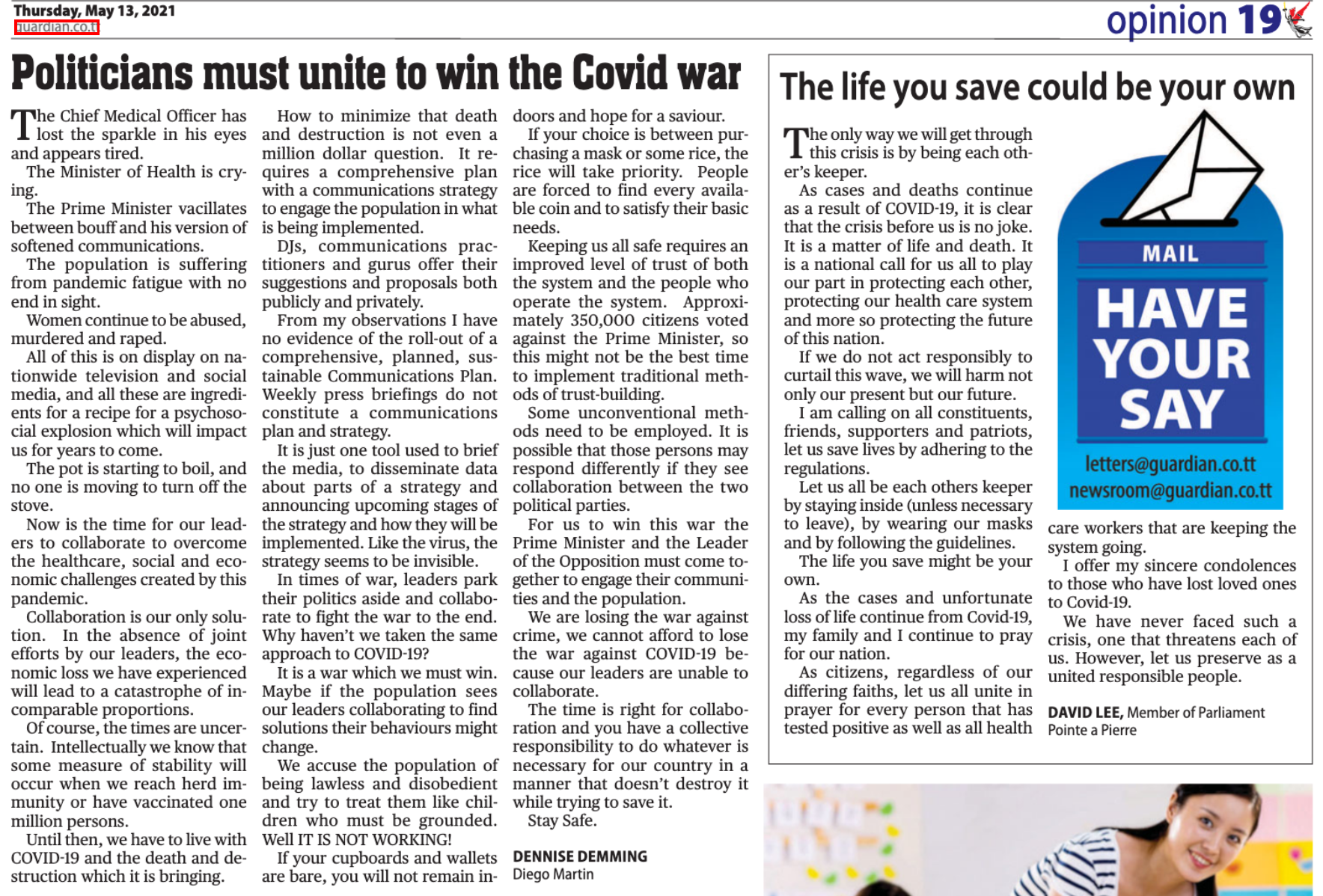
The Chief Medical Officer has lost the sparkle in his eyes and appears tired.

The Minister of Health is crying.

The Prime Minister vacillates between bouff and his version of softened communications.

The population is suffering from pandemic fatigue with no end in sight.

Women continue to be abused, murdered and raped.

All of this is on display on nationwide television and social media, and all these are ingredients for a recipe for a psychosocial explosion which will impact us for years to come. The pot is starting to boil, and no one is moving to turn off the stove.

Now is the time for our leaders to collaborate to overcome the healthcare, social and economic challenges created by this pandemic.  Collaboration is our only solution.  In the absence of joint efforts by our leaders, the economic loss we have experienced will lead to a catastrophe of incomparable proportions.

Of course, the times are uncertain.  Intellectually we know that some measure of stability will occur when we reach herd immunity or have vaccinated one million persons.  Until then, we have to live with COVID-19 and the death and destruction which it is bringing.  

How to minimize that death and destruction is not even a million dollar question.  It requires a comprehensive plan with a communications strategy to engage the population in what is being implemented.

DJs, communications practitioners and gurus offer their suggestions and proposals both publicly and privately.  From my observations I have no evidence of the roll-out of a comprehensive, planned, sustainable Communications Plan.  Weekly press briefings do not constitute a communications plan and strategy.  It is just one tool used to brief the media, to disseminate data about parts of a strategy and announcing upcoming stages of the strategy and how they will be implemented. Like the virus, the strategy seems to be invisible.

In times of war, leaders park their politics aside and collaborate to fight the war to the end.  Why haven’t we taken the same approach to COVID-19?   It is a war which we must win.  Maybe if the population sees our leaders collaborating to find solutions their behaviours might change. 

We accuse the population of being lawless and disobedient and try to treat them like children who must be grounded.  Well IT IS NOT WORKING!  If your cupboards and wallets are bare, you will not remain indoors and hope for a saviour.  If your choice is between purchasing a mask or some rice, the rice will take priority.  People are forced to find every available coin and to satisfy their basic needs.

Keeping us all safe requires an improved level of trust of both the system and the people who operate the system.  Approximately 350,000 citizens voted against the Prime Minister, so this might not be the best time to implement traditional methods of trust-building. Some unconventional methods need to be employed. It is possible that those persons may respond differently if they see collaboration between the two political parties.  

For us to win this war the Prime Minister and the Leader of the Opposition must come together to engage their communities and the population.  We are losing the war against crime, we cannot afford to lose the war against COVID-19 because our leaders are unable to collaborate.  The time is right for collaboration and you have a collective responsibility to do whatever is necessary for our country in a manner that doesn’t destroy it while trying to save it.

Graphic Design Education and Creative Liming

Ju Lee shares her strategies for keeping students engaged in an online environment. Her classroom is designed as her holy space (Sanctum Sanctorum) where students find themselves and their purpose. Life is design and art is her mantra. She comments that Graphic Design is one of the growing areas at Costaatt and expects that her students will continue to be successful, expanding their knowledge and moving to greater heights of excellence.

Her success began with parents who supported her desire to study art at Howard University. Ju Lee worked as a graphic designer at McCann World Group, WHMM TV Channel 32 and the Washington City Paper.

At 15:00 the mood changes to a discussion about value of “liming” with Sonja Dumas who is a performer, choreographer, writer, filmmaker, teacher and arts development consultant.

Sonja acknowledges the wisdom of developing the creative arts offerings at our educational institutions and makes a case for developing local “patrons” who would fund the creation of works of art. She notes that the French Caribbean territories like Martinique and Guadeloupe have designed a creative ecosystem where artists can thrive as professionals as opposed to the English speaking Caribbean where creatives engage their passion as a “side hustle”.

As Sonja projected into the future she suggested that there should be a “government bond” of $100 million to fund the arts. It would require an administrative framework to operationalize and measure and evaluate its success.

Her parting advice was: “be efficient so could you lime more”.

Talking Transportation with UWI Lecturer – Dr. Trevor Townsend and UTT & Culture Lecturer/Saxophonist Tony Paul

Dr. Trevor Townsend, Senior Lecturer in Transportation Engineering at the University of the West Indies weighs in on public transportation in Trinidad and Tobago. He points out that with a population of just over one million persons, the solutions to our transportation problems are within reach but they require that an institution/organization/official takes responsibility for planning and execution. While there are no overnight fixes a focussed approach, with clear allocation of responsibilities will make a difference.

His view is that citizens deserve to be confident that the systems and processes are available to make transportation seamless and convenient. Currently the state is subsidizing each passenger on the Water Taxi services between San Fernando and Port of Spain to the tune of $100.00 per trip and spending $M400 million annually to subsidize a bus company which transports 1% of passengers on the east/west corridor.

At the 19:00 minute mark the mood switches and we welcome Saxophonist/Educator Tony Paul who makes a strong case for pushing the cultural shift from the seasonality of our music to music which can be offered year round and have international appeal.

Tony’s training spans the United Kingdom and the United States where he attained an MMus focused in Music Education from Boston University.

In responding to a question about performance spaces, he spoke about the need for spaces to be more user centred and tailored to both the performers and the supporting public. While the aloneness of Covid has devastated a number of performers, Tony has used the time to refresh some of his skills, improve his craft and work on his new album.

Technology long ceased to be a sector

The official in another country laughed when I presented my driver’s permit because it was a simple laminated card which could be made at any print shop.  That was about 15 years ago and things have improved slightly.  I thought of this when I received my vaccine card which provides evidence that I received my first COVID-19 Jab.  My mind wondered even further when I considered that our celebrated first round of vaccinating 3% of our population will generate at least 80 thousand pieces of paper if the model at the Queens Park Savannah is replicated throughout the country.

A casual scrub through the Facebook page of the Ministry of Public Administration and Digital Transformation (MPADT) throws up the following statement: “Our aim is to bridge the digital divide by providing free and easy to access Wi-Fi to citizens at their convenience.”  I therefore question the missed opportunity to digitize the administering of the COVID-19 vaccines.  

COVID-19 vaccination is an opportunity to interact digitally with the at-risk cohort and the senior citizens cohort.  It is an opportunity to send a message of transformation; to use technology to demonstrate that we can communicate effectively using a modern approach; to map where those 40,000 jabs reside and maybe help communicate the behaviour change which is necessary to transform our country.  So many unintended messages could have been sent had we taken the time to use technology in the vaccine roll-out.

The main document each person needed was their identification card.  The information was copied into a book when you made the appointment, then a form was filled out at the Vaccine Centre and after receiving your vaccine, you were given a vaccination card.  Couldn’t this have been done electronically and your certification emailed?

We have missed these opportunities in the first round, but thankfully it is not too late to develop the systems and processes necessary to digitize the second round.  Taking that bold step requires a forward thinking leadership that understands systemic thinking and behaviour change. The leadership on this giant step should come from the Ministry of Public Administration and Digital Transformation (MPADT) which, as the name suggests, was established to lead our country’s digital transformation.

Finding one specific vaccing card without the use of technology.
Trinidad’s unhackable database. 🙂

Part of the COVID-19 conversation speaks about building back better and bouncing back.  As a developing country we need to go beyond bouncing back and figure out how to bounce forward and take our populations with us.  The world has moved forward to a different landscape where using technology is common, available and all over the place.  Trinidad and Tobago is far behind the curve but we need to find the means necessary to really transform our digital space and be part of the global conversation about sustainability and development. 

The only future wave we need to be on
is the one powered by technology. 

Energy dreamer Philip Julien and Ace Communicator Lisa Ghany are our guests on this edition.

We chat with Philip Julien about the possibility that Trinidad and Tobago could be the first on the planet to produce molecules of hydrogen from clean sources to power industrial plants. Just as our country used previously flared gas to fuel the Pt. Lisas Industry, we have another opportunity to transform another pesky gas into hydrogen for use as a clean energy source.

Phillip believes that we have the mindset to lead the world but citizens must once again believe in ourselves and nourish an independent mind set to believe that we can. Pt. Lisas and the invention of the steel-pan are merely examples of our creativity. We now are on the cusp of leading the world again with the NewGen facility which is likely to be the world’s first large scale producer of low carbon hydrogen from water.

At 16:01 mintues, the discussion shifts to Communciations Specialist and Event Management Entrepreneur Lisa Ghany. She notes the beauty of our environment and the uniqueness of our country while juxtaposing the absence of credible leadership which can change the negative narrative which dominates. Lisa expresses the hope that the leaders in each of us will emerge to communicate the positive values which are latent in our society.

She also focusses on the role of family and comments that our basic needs have not changed. People still long for love, companionships, respect and safety.

Stag can and should do better in its ‘move-men-to-respect’ campaign

How does one step back from the bold misogynistic claim of being ‘The Man’s Beer’? Do you flip the script and position yourself as being anti-violence against women?  

Do you attempt to engage womenfolk and position yourself as our protector by communicating repeated images of male power and strength smashing glasses and bottles in your advertisement? Do you establish a new bold claim in your tagline ‘move-men-to-respect’?  

Photo: A Stag advertisement in its ‘move-men-to-respect’ campaign.

None of the above will change  years of misogynistic posturing.

Our most accurate experience of the essence of your brand was in the low-brow moment of one ad where the protagonist, while purchasing an engagement ring, flirted with his ‘ex’ who worked at the jewellery store and apparently was ‘looking good’.  

When asked by his ‘man friends’: “wha yuh do boy?” His boastful response was: “Yuh know yuh boy!”—which evoked a raucous round of hooting and table-slapping.

You followed this up with a 44-second advertisement which showed eight instances of a man’s hand crushing either a jug or a beer bottle and described at least five instances of violence against women.  

After 31 seconds, the voice-over and imagery spoke to the beer being reserved for men who protect women. In my opinion, the violence and the negative messaging are just overwhelming.

Photo: A Stag advertisement against gender-based violence.

Is it that you are so removed from our reality that you are tone-deaf to the likelihood that this imagery may simply reinforce the culture of violence perpetrated by men against women? Have you and your advisors not considered the context in which such a video will be released?

Assuming that your team created this ad to act as one of the antidotes to gender-based violence—and that increased market share is not your goal—be reminded that years of misogyny cannot be fixed by one advertising campaign.  

You need to do the work and take the time necessary to change your image.

If you want an easy fix, then recognise the clarity of your own misogyny, and use your profits to contribute to the many shelters for battered women. Take one dollar from each green beer you sell and contribute it to the shelters.  

Put up a countdown on your social media channels and challenge the nation to keep the donations rolling in; report the level of contribution to the nation on a quarterly basis and engage the many NGOs in working towards turning around the culture of violence. 

Photo: A demonstration against gender-based violence.
(Copyright Getty)

Challenge your parent organisation, which runs a psychological unit, to give free counselling to victims and perpetrators of domestic abuse—regardless of gender.

Being an alcohol company puts you in a difficult social space. Our love/hate relationship will continue. All we can expect is that you use your brand recognition and money to effectively alleviate some of our difficult problems, which you as a company unintentionally perpetuate.

There is one beer that, since 1988, has stopped production of its product a few times to package water in beer cans so as to help victims of natural disasters. Are you willing to show in a similar, tangible way that you are really committed to preventing domestic/gender-based violence? Or is this just window dressing for you—hoping your clientele is not savvy enough to see through it?

There is an epidemic of violence and gender-based violence plaguing this country and the Covid-19 pandemic has not helped.  As a matter of fact, one major alcohol company boasted that 2020 marked a 10-year record in its gross profits. 

Photo: Women protest against gender-based violence.

It is time for the green campaign to move from speaking out against gender-based violence to putting your big money behind specific, effective programmes.

Originally published on April 22, 2021: https://wired868.com/2021/04/22/demming-stag-can-and-should-do-better-in-its-move-men-to-respect-campaign/

ormer Head of the Public Service Reynold Cooper and Singer/Entrepreneur Vaughnette Bigford.

Former Head of the Public Service makes a case for Trinidad and Tobago to innovate rather than imitate. His dream for the future is that the Ministry of Public Administration and Digital Transformation will achieve its mandate for economic transformation by 2030.
He notes that the ease of doing business and improved access to wifi are two key factors in propelling that transformation.
At 18:00 minutes, the conversation switches to singer/performer Vaugnette Bigford and the joy she gets from the beauty which surrounds us and reviving her old hobby of reading. Vaughnette is currently reading Becoming by Michelle Obama.
Opportunity, Investment and Mind Set are three concepts which she suggests should inform the thinking of our leaders at all levels as we shape the cultural landscape. The conversation ends on the hopeful note that a 25 year vision for the cultural landscape begins with creating the physical and social infrastructure because talent abounds throughout the country.

Demming Chronicles chats with Professor Selwyn Cudjoe and Cultural Entrepreneur George Singh

Demming Chronicles chats with Professor Selwyn Cudjoe and Cultural Entrepreneur George Singh. Two highlights of this conversation are the rubbishing of the notion of tribal voting by Professor Selwyn Cudjoe and the comment by George Singh that Chutney Soca Monarch 2021 attracted 3.9 million pairs of eyeballs during 30 days.

Dr. Terrence Farre & Activist Muhammad Muwakil on Demming Chronicles

Demming Chronicles chats with Dr. Terrence Farrell about the the concerns expressed about foreign exchange shortages in T&T and the fact that the Central Bank has over the past 6 years been injecting foreign exchange into the market. The conversation also took account of the black market, the Heritage and Stabilization Fund, the reserves and the possible concerns of foreign investors. Three takeaways from the conversation are that the country must adjust to suit the reduced income flows; the economy must be diversified away from the energy sector; and that the country needs deep transformation of key institutions including the transformation of our culture and attitudes.

At 17 minutes, the conversation moved from economics to the cultural sector and a chat with Activist Muhammad Muwakil. He commented on the need to insert creatives and artists into every project being considered for development in order to design welcoming, functional spaces. In contemplating what is need for performers to thrive, Muhammad commented on the need for more medium and small performance spaces which cater for the artists who have outgrown the 50 person performance space but are not ready for the 400 person spaces. He ends on the note that if the artists are vibrant then the imagination the country will be vibrant so we need to set the artist’s imagination on fire or all will be lost.